 Coach
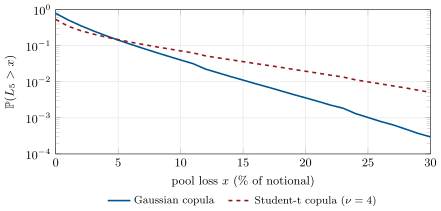
CoachIn the Student-t copula with degrees of freedom the latent variables are with common to all names; a name defaults if . The common scale makes the names default together in bad draws: the copula has tail dependence, which the Gaussian lacks.
Voorbeelden
Example 15.11 (Tails)
At an asset correlation of 25%, the probability that the pool loses more than 12% in five years is 2.24% under the Gaussian copula and 5.23% under the Student-t copula with four degrees of freedom; for a loss above 24%, 0.13% against 1.13%, 8.6 times more (Figure 15.4). Senior tranches priced with the Gaussian copula at one correlation look cheap for the same reason the skew exists: the market prices more tail than the Gaussian gives.