Rates, Credit, XVA and Risk · Rates, credit & risk
15Portfolio Credit
In early 2005 a popular trade sold protection on the equity tranche of the iTraxx Europe index, the first 3% of losses on 125 names, and hedged it against market-wide spread moves by buying protection on the index; the Bank for International Settlements put its carry at 300 to 400 basis points a year. In May, after the downgrades of General Motors and Ford (chapter 14), the correlation implied by equity tranche prices fell sharply, the equity tranche’s spread widened, and unwinds pushed the spreads of the mezzanine tranches down, at times in the opposite direction to the index. Positions hedged by every model their owners had lost on both legs in the same weeks. This chapter builds those models: the dependence of defaults through a copula, the loss distribution of a pool, the prices and risks of tranches, and why a correlation implied from a tranche is a quoting convention whose moves are a risk of their own. One Quant Book 2, chapter 24 introduced tranches, the large pool and base correlation; here the pool is finite, the tranches have a term structure, and the hedges are measured.
15.1 Default correlation and copulas
Definition 15.1 (Default correlation)
The default correlation of two names over a horizon is the correlation of their default indicators and :
A copula (One Quant Book 4, chapter 15) joins the marginal distributions of the default times, each given by a name’s survival curve from chapter 13, into a joint distribution. The market’s choice is the simplest.
Definition 15.2 (Gaussian copula)
In the one-factor Gaussian copula each name has a latent variable with independent standard normals, and defaults by if , where . Each marginal is respected; , the correlation of the latent variables (the asset correlation), sets the dependence.
The asset correlation is not the default correlation. With a five-year default probability of 4.08% (a spread of 50 basis points, recovery 40%), an asset correlation of 25% gives a default correlation of 7.0%: rare events of two names coincide less often than their latent variables co-move.
15.2 The one-factor Gaussian copula and the large pool
Conditional on the common factor the names are independent, each defaulting by with probability
For a finite pool, the distribution of the number of defaults given follows by adding names one at a time: with the probability of defaults among the first names, adding name gives , the recursion of Andersen, Sidenius and Basu (2003). Integrating over by quadrature gives the unconditional loss distribution (Figure 15.1).
def default_count_given_z(pz: np.ndarray) -> np.ndarray:
    """Distribution of the number of defaults for each z row of independent default probabilities."""
    nz, n = pz.shape
    dist = np.zeros((nz, n + 1))
    dist[:, 0] = 1.0
    for i in range(n):
        q = pz[:, i:i + 1]
        dist[:, 1:] = dist[:, 1:] * (1 - q) + dist[:, :-1] * q
        dist[:, 0] *= 1 - q[:, 0]
    return dist


def loss_distribution(p: np.ndarray, rho: float) -> np.ndarray:
    """Unconditional distribution of the number of defaults (Gaussian copula, quadrature over Z)."""
    return _W @ default_count_given_z(conditional_pd(p, rho, _Z))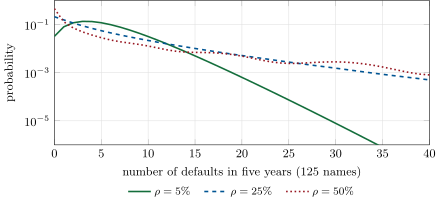
Definition 15.3 (Large homogeneous pool)
The large homogeneous pool approximation takes infinitely many identical names: given the loss fraction is exactly , so the pool’s loss is a monotone function of the factor and its distribution is available in closed form (the limit Vasicek derived for loan portfolios).
The large-pool limit of One Quant Book 2 is fast and close for many names: the equity tranche’s five-year expected loss is 51.6% of its notional in the limit against 49.6% for 125 names at . The finite pool matters for the equity tranche and for pools whose names differ, which is what the recursion is for.
15.3 Pricing tranches: recursion, compound and base correlation
A tranche loses of its notional when the pool has lost . Its expected loss at each premium date, , gives the legs as for a default swap: the premium is paid on the expected outstanding notional, , and the protection pays . The equity tranche trades as an upfront plus 500 basis points running; the others trade at a running spread.
Example 15.4 (Synthetic quotes)
Take 125 names at 50 basis points, recovery 40%, a flat rate of 4%, and a base-correlation skew of 15%, 25%, 31%, 36% and 50% at detachments 3, 6, 9, 12 and 22% (illustrative). The five-year tranches are quoted at an upfront of 37.21% plus 500 running for 0–3%, and at 195, 83.6, 43.6, 17.9 and 3.6 basis points for 3–6, 6–9, 9–12, 12–22 and 22–100%; the index is at 49.6.
Definition 15.5 (Compound correlation)
The compound correlation of a tranche is the single correlation at which the one-factor Gaussian copula reprices it, with both its attachment and detachment losses computed at that correlation.
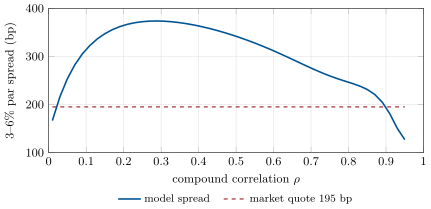
The compound correlations of the synthetic quotes are 15.0% for the equity, 12.9%, 18.4%, 25.2% and 50.0% for the tranches above 6%, and two values for the mezzanine, 2.1% and 89.9%. A mezzanine is long correlation at low correlation (more correlation spreads losses into it) and short at high correlation (they jump past it), so its spread is humped in (Figure 15.2). A quote above the hump’s 374 basis points, near , has no compound correlation at all. This is why the market moved to the base correlation of One Quant Book 2, defined on base tranches whose value is monotone in correlation; a mezzanine is then priced from two base correlations, .
Definition 15.6 (Tranche delta)
The tranche delta is the notional of index protection whose value changes as much as the tranche’s, per unit of tranche notional, when every name’s spread moves together by a small amount, with the base correlations held.
Example 15.7 (Deltas across the structure)
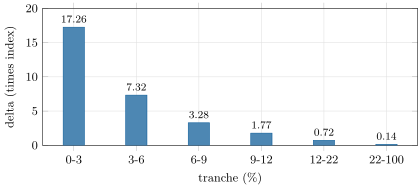
The deltas of the six tranches of Example 15.4 are 17.3, 7.32, 3.28, 1.77, 0.72 and 0.14 (Figure 15.3): EUR 10 million of equity tranche moves like EUR 173 million of index. Hedging the equity with the mezzanine takes times the notional.
Definition 15.8 (Super senior tranche)
The super senior tranche is the top of a capital structure, above the tranche that would earn the highest rating on its own (22–100% in the standard European index structure): a very small expected loss on a very large notional, with most of its risk in the market value of that small loss.
Remark 15.9 (The tail that matters)
At an asset correlation of 50% the chance that the pool’s five-year loss exceeds 22% is 1.88%: small, on the largest notional of the structure. In 2007–08 the super senior tranches of CDOs backed by mortgage securities, retained by underwriters such as Citigroup, Merrill Lynch and UBS or insured by AIG, caused billions of dollars of losses, according to the Financial Crisis Inquiry Commission: holders had treated them as riskless because their expected loss was. UBS alone wrote down about USD 21.7 billion on super senior tranches it had retained, some USD 50 billion before the crisis and its greatest single source of loss; the Swiss regulator found the positions had been viewed as VaR-neutral.
15.4 Beyond the Gaussian: fat tails and tail dependence
Definition 15.10 (Student-t copula)
In the Student-t copula with degrees of freedom the latent variables are with common to all names; a name defaults if . The common scale makes the names default together in bad draws: the copula has tail dependence, which the Gaussian lacks.
Example 15.11 (Tails)
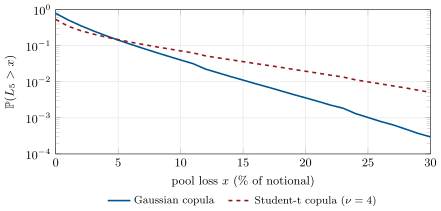
At an asset correlation of 25%, the probability that the pool loses more than 12% in five years is 2.24% under the Gaussian copula and 5.23% under the Student-t copula with four degrees of freedom; for a loss above 24%, 0.13% against 1.13%, 8.6 times more (Figure 15.4). Senior tranches priced with the Gaussian copula at one correlation look cheap for the same reason the skew exists: the market prices more tail than the Gaussian gives.
15.5 May 2005 and 2008
As of September 2026 — May 2005
According to the Bank for International Settlements’ review of June 2005, selling protection on the iTraxx Europe equity tranche hedged with index protection earned 300 to 400 basis points in early 2005; in May the correlation implied by equity tranche prices fell sharply, equity spreads widened (faster after the downgrades of General Motors and Ford), unwinds pushed mezzanine spreads down, and at times the mezzanine moved opposite to the index.
The two episodes stress different parts of the model. In May 2005 the risk was idiosyncratic: one or two names blowing out hit the equity tranche, which absorbs the first losses, far more than an index-sized hedge, and the correlation implied by equity prices fell; the delta, computed for a parallel move with correlation held, hedged neither. In 2008 the risk was systematic: the factor moved, the senior tranches that the Gaussian copula had priced as nearly riskless lost value, and the correlations implied by senior tranches rose towards one.
15.6 Tutorial: tranches by recursion
Goal. Price a tranche structure on a 125-name pool, imply compound correlations, compare copulas and compute deltas. End state: the numbers of Examples 15.4, 15.7 and 15.11 and Figures 15.1, 15.2, 15.3 and 15.4.
- Loss distribution:
loss_distribution(p, rho)for three correlations. - Quotes:
quotes()from the base-correlation skew. - Compound:
compound_table(); plotmezz_curve(). - Tails and deltas:
tail_table(),deltas();fig_rc_portcredit.pywrites the charts.
What to change next. Give ten names a spread of 300 basis points and the rest 40, at the same index level, and compare the equity tranche’s price; raise the mezzanine quote to 400 and watch the compound correlation disappear.
15.7 Build: portfolio credit
Purpose. The firm’s pool models: loss distributions of credit portfolios for tranches, for the counterparty portfolios of Part III, and for credit capital in Part IV.
Interface. Pool(hazards, recovery); conditional_pd, default_count_given_z, loss_distribution; expected_tranche_losses, base_el, legs_from_el, tranche_price; compound_correlations; t_cdf, t_inv, simulate_losses; default_correlation.
Rules. Flat hazards per name, equal notionals, one recovery; quarterly premiums on the expected outstanding notional; 64-point Gauss–Hermite quadrature; Book 2’s firm_tranche is the large-pool limit.
Acceptance tests. code/firm/portcredit/tests/: the recursion without correlation is binomial; a large pool approaches Book 2’s limit; base and compound agree on a flat skew; the index does not depend on correlation; Student-t quantiles; simulated mean losses.
Stretch. Unequal notionals and recoveries (losses on a grid); stochastic recovery; the random-factor-loading and Student-t pricers by quadrature; bespoke pools mapped to index base correlations.
Sources and further reading
- D. X. Li, “On default correlation: a copula function approach”, Journal of Fixed Income 9(4), 2000, 43–54.
- O. A. Vasicek, Finance, Economics and Mathematics, Wiley, 2015, chapter “Loan portfolio value”.
- J. Hull and A. White, “Valuation of a CDO and an -th to default CDS without Monte Carlo simulation”, Journal of Derivatives 12(2), 2004, 8–23.
- Bank for International Settlements, Quarterly Review, June 2005.
- Financial Crisis Inquiry Commission, The Financial Crisis Inquiry Report, 2011.
- L. Andersen, J. Sidenius and S. Basu, “All your hedges in one basket”, Risk, November 2003.
- Swiss Federal Banking Commission, Subprime crisis: SFBC investigation into the causes of the write-downs of UBS AG, 30 September 2008.
15.8 Exercises
Exercise 15.1 ★
A pool of 125 names each has a five-year default probability of 4.08%. How many defaults are expected, and does the expectation depend on correlation?
Solution
Solution of Exercise 15.1.
defaults. No: expectations are linear, so the expected number of defaults depends only on the marginals; correlation changes the dispersion around it.
Exercise 15.2 ★
Which tranches are long correlation and which short, and why is the mezzanine both?
Solution
Solution of Exercise 15.2.
The equity tranche is long correlation: higher correlation raises the chance of few defaults, which is where it survives. Senior tranches are short correlation: only correlated scenarios reach them. The mezzanine sits between: at low correlation more correlation pushes losses into it, at high correlation losses jump past it or none occur, so its value is not monotone.
Exercise 15.3 ★
With a recovery of 40%, how many defaults among 125 names wipe out the 0–3% tranche, and how many reach the super senior at 22%?
Solution
Solution of Exercise 15.3.
Each default costs of the pool: the equity is wiped out by the seventh default (), and losses reach 22% at the forty-sixth ().
Exercise 15.4 ★★
Explain why an asset correlation of 25% gives a default correlation of only 7%.
Solution
Solution of Exercise 15.4.
Default correlation is the correlation of indicators of rare events. Two latent variables with correlation 25% often move together, but both must fall below a threshold 1.74 standard deviations down for a joint default; the joint probability rises well above but stays small relative to , so the indicators’ correlation is small.
Exercise 15.5 ★★
Using the deltas of Example 15.7, how much index protection hedges EUR 50 million of sold 6–9% protection?
Solution
Solution of Exercise 15.5.
million of bought index protection.
Exercise 15.6 ★★
Why does the market quote base correlations rather than compound correlations, and what is wrong with base correlation?
Solution
Solution of Exercise 15.6.
Base tranches’ values are monotone in correlation, so a base correlation always exists and is unique, and it interpolates across detachments; compound correlations can be two or none. But pricing a mezzanine as the difference of two base tranches at different correlations is not a model: interpolated base correlations can give negative expected losses for thin tranches, and bespoke pools and maturities need a mapping rule.
Exercise 15.7 ★★★
Coding. Compute the probability that the pool loses more than 24% in five years under both copulas at an asset correlation of 25%, and the ratio.
Solution
Solution of Exercise 15.7.
tail_table(): 0.13% under the Gaussian copula and 1.13% under the Student-t with four degrees of freedom, a ratio of 8.6.
Exercise 15.8 ★★★
Find the flaw. “Our super senior position has an expected loss of a few basis points and an AAA rating. It needs no hedge and almost no capital.”
Solution
Solution of Exercise 15.8.
Expected loss is not the risk: the value of a super senior tranche moves with the probability of extreme, correlated losses, which rises in a crisis exactly when the holder cannot sell; its large notional turns small price moves into large losses; and a rating based on a model’s tail inherits the model’s error there. It needs a hedge or capital for its market value, as 2007–08 showed.
15.9 Problem: Long Equity, Short Mezzanine
Problem 15.1
Weekend problem — the correlation trade of May 2005
A fund sells EUR 10 million of five-year 0–3% protection at the quotes of Example 15.4 (upfront 37.21% plus 500 running) and buys 3–6% protection at 195 basis points in the delta-neutral amount. Then one name’s spread jumps from 50 to 1 000 basis points, and the equity base correlation falls from 15% to 12%, the other base correlations unchanged.
Part I — The position.
- Give the deltas of the two tranches and the mezzanine notional.
- What does the fund receive at inception, and what does it earn while nothing happens?
- What is its exposure to a parallel widening, to one name defaulting, and to correlation?
- Why was the trade called long correlation?
- Which risks did the delta measure not include?
Part II — One name blows out.
- Give the equity upfront and mezzanine spread after the jump.
- Give the P&L of each leg and the total.
- Why does the hedge not cover the equity’s loss?
- What would one default of that name (recovery 40%) cost the equity tranche directly, in notional?
- Would an index hedge have done better?
Part III — Correlation falls.
- Give the P&L of each leg when only the equity base correlation falls to 12%.
- Why does the mezzanine spread fall?
- Give both legs’ P&L and the total when both happen.
- Which leg did the fund expect to protect it, and what happened to it?
- How does the unwinding of similar positions move the prices further?
Part IV — Judgement.
- What is the correlation that the fund was long, in the model and in the market?
- How would you limit such a book?
- Why did the same models give no warning of 2008’s senior losses?
- State the named result: the two legs’ P&L and the total when one name blows out and equity correlation falls.
- In one sentence: what does a delta-hedged tranche position still bet on?
Solution
Solution of Problem 15.1.
1. 17.3 and 7.32 times the index; EUR 23.56 million of 3–6%. 2. EUR 3.721 million upfront; running, 500 basis points on the equity (EUR 500 000 a year) less 195 on the mezzanine (EUR 459 502), about EUR 40 000 a year while nothing defaults. 3. Flat to a small parallel widening; long default risk of any single name (the equity absorbs the first losses); long correlation. 4. It gains when correlation rises (the equity’s value rises more than the mezzanine’s). 5. Idiosyncratic moves, correlation moves, the convexity of large moves, and the change of the deltas over time. 6. Equity upfront 42.79%; mezzanine 236.5 basis points. 7. Equity , mezzanine , total . 8. The delta is for all names moving together; one name’s widening moves the equity much more than the mezzanine, relative to their parallel deltas. 9. 0.48% of the pool, 16% of the equity tranche: EUR 1.6 million. 10. No: the index moves by one name’s share, , while the equity takes a large part of that name’s risk; single-name protection on the name is the hedge. 11. Equity , mezzanine (its spread falls to 138 basis points), total . 12. The 3–6% expected loss is : with unchanged, a lower raises and lowers the mezzanine’s. 13. Equity , mezzanine , total . 14. The mezzanine protection, bought to gain on widening; its spread fell with correlation, so it lost too. 15. Sellers of equity protection buy it back (widening the equity) and sell back their mezzanine protection (tightening it), moving both legs against every similar position. 16. In the model, the asset correlation of the Gaussian copula; in the market, the price of the equity tranche relative to the rest of the structure, set by supply and demand. 17. Limits on correlation sensitivity and on single-name jump-to-default by name, stress tests of joint idiosyncratic and correlation moves, and the liquidity of the hedges. 18. The Gaussian copula with a correlation fitted to calm markets had thin tails, and the mortgage pools’ correlations were far higher than assumed; the models measured market prices, not the risk of the factor. 19. Named result: the correlation trade in May 2005: the equity leg loses EUR 828 391 and the mezzanine hedge EUR 171 869, a total of EUR 1 000 261 on EUR 10 million of equity. 20. On correlation and on the dispersion of names: the delta removes only parallel spread moves.
15.10 Interview questions
Interview question 15.1 ★ researcher, trader
Write down the one-factor Gaussian copula and the conditional default probability.
Solution
Solution of Interview question 15.1.
, default by if ; conditional on , , and names are independent.
What the interviewer is looking for: the latent variable, the threshold and conditional independence.
Interview question 15.2 ★★ researcher, developer
How do you compute the loss distribution of a finite pool of heterogeneous names without Monte Carlo?
Solution
Solution of Interview question 15.2.
Condition on the factor; names are then independent, and the distribution of losses follows by the recursion adding one name at a time (on a loss grid for unequal notionals); integrate over the factor by Gauss–Hermite quadrature. Cost: names times loss grid times quadrature nodes, per date.
What the interviewer is looking for: conditional independence, recursion and quadrature.
Interview question 15.3 ★★ trader
Compound versus base correlation: what is each, and what goes wrong with each?
Solution
Solution of Interview question 15.3.
Compound: one correlation per tranche; mezzanines can have two or none. Base: the correlation of the base tranche , always unique; tranches priced as differences of base tranches at different correlations, which can give arbitrage (negative expected losses) and needs mapping for bespoke pools.
What the interviewer is looking for: non-uniqueness versus inconsistency.
Interview question 15.4 ★★ risk
How would you risk-manage a book of super senior tranches?
Solution
Solution of Interview question 15.4.
By market value, not expected loss: sensitivities to spreads, correlation and the factor; stress tests of systematic scenarios; tail models beyond the Gaussian; counterparty risk of any protection bought (monolines, AIG); liquidity and concentration limits.
What the interviewer is looking for: market-value risk, stress tests and hedge counterparties.
Interview question 15.5 ★★★ researcher
What is tail dependence, which copulas have it, and why does it matter for senior tranches?
Solution
Solution of Interview question 15.5.
The limit of the probability that one variable is extreme given that the other is. The Gaussian copula has none (for correlation below one); the Student-t and Clayton copulas have it. Senior tranches lose only when many names default together, which is exactly what tail dependence governs.
What the interviewer is looking for: the definition and the link to senior tranches.
Interview question 15.6 ★★★ trader, risk
Explain how a delta-hedged long equity, short mezzanine position lost money in May 2005.
Solution
Solution of Interview question 15.6.
It was flat to parallel moves but long single-name risk and long correlation. Idiosyncratic blow-outs (GM and Ford) widened the equity tranche far more than the mezzanine; the correlation implied by equity prices fell, pushing the equity down further and the mezzanine spread down, so the mezzanine protection lost too; unwinds amplified both.
What the interviewer is looking for: idiosyncratic risk, correlation risk and crowding.