全部书籍

专业

应用 关于 Coach 登录 开始阅读

书籍暂未推出简体中文版——当前显示英文版。

Quantitative Finance · 术语表

什么是 SVI parametrisation?

Definition 8.1 Derivatives and Volatility · 第 8 章 — Parametrising the Surface

The SVI parametrisation (stochastic volatility inspired) of a smile writes the total implied variance of one expiry as

w(k)=a+b(ρ(k−m)+(k−m)2+ς2),w(k)=a+b\Bigl(\rho(k-m)+\sqrt{(k-m)^2+\varsigma^2}\Bigr),

with b≥0b\ge0, ∣ρ∣<1|\rho|<1, ς>0\varsigma>0 and a+bς1−ρ2≥0a+b\varsigma\sqrt{1-\rho^2}\ge0 (so that the minimum of ww is non-negative). The parameters have a shape each: aa the level, bb the angle between the wings, ρ\rho the rotation (the skew), mm the horizontal position of the minimum, ς\varsigma the smoothness of the vertex.

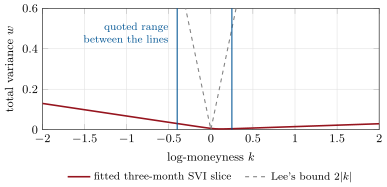
The three-month SVI slice of the tutorial extended far beyond its quoted strikes (between the vertical lines). Its wings are straight, with slopes 0.062 on the left and 0.014 on the right, far inside Lee’s bound 2|k| (dashed): the extrapolation cannot create an arbitrage. Data: the tutorial.
Figure 8.1. The three-month SVI slice of the tutorial extended far beyond its quoted strikes (between the vertical lines). Its wings are straight, with slopes 0.062 on the left and 0.014 on the right, far inside Lee’s bound 2∣k∣2|k| (dashed): the extrapolation cannot create an arbitrage. Data: the tutorial.
在原文中阅读 →