 Coach
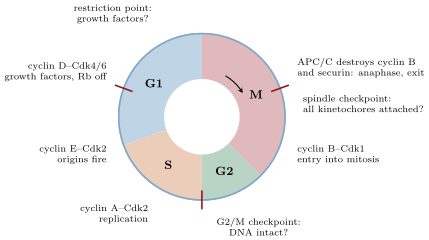
CoachThe cell cycle — G1, S (replication), G2, M (mitosis) — is driven by a family of protein kinases, the cyclin-dependent kinases (CDKs), whose catalytic subunits are present throughout the cycle but active only when bound to a cyclin, a regulatory subunit whose concentration rises and falls in a fixed order: cyclin D with Cdk4/6 in G1 in response to growth factors, cyclin E with Cdk2 at the G1/S transition, cyclin A with Cdk2 through S, cyclin B with Cdk1 at the entry into mitosis. Each cyclin–CDK phosphorylates the proteins of its phase — replication origins, lamins, condensins, the enzymes of spindle assembly — and each is switched off by the destruction of its cyclin: ubiquitin ligases (SCF in G1/S, the anaphase-promoting complex, APC/C, in mitosis) tag the cyclins for the proteasome. The activity of Cdk1 is further gated by an inhibitory phosphorylation put on by the kinase Wee1 and removed by the phosphatase Cdc25, and by small inhibitor proteins (p21, p27, p16) that bind the complexes. The cycle is thus an ordered sequence of kinase waves, each wave ending in the proteolysis of what produced it.
Examples
Example 10.3 (Why the frog egg is a clock)
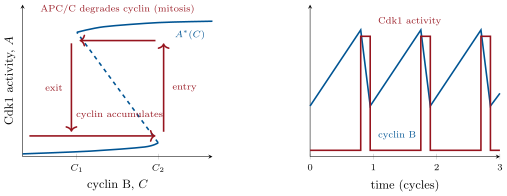
A fertilised frog egg divides twelve times in six hours with no growth, no transcription and no checkpoints, at intervals of : it is the oscillator of the theorem running bare, and an extract of its cytoplasm in a test tube goes on cycling, cyclin rising and falling, with nothing to divide. Adding a non-degradable cyclin B locks the extract in mitosis, since can never fall below ; blocking cyclin synthesis locks it in interphase. In a somatic cell the same engine is wrapped in the controls of the next section, which hold it at the thresholds until conditions are met, so that the period becomes a day rather than half an hour and can be indefinitely long.