
Biology · Glossary

What is Meiosis?

Definition 4.1 University Biology — Year 2 · Chapter 4 — Meiosis, Genetic Mixing and Heredity

A diploid cell (2n2n) carries two homologous chromosomes of each kind, one from each parent, alike in gene content but not necessarily in alleles. Meiosis is the pair of divisions that turns one diploid cell into four haploid cells (nn), each with one chromosome of each kind. It is preceded by one replication, so that each chromosome enters as two sister chromatids; the first division separates homologues (reductional), the second separates sister chromatids (equational), as mitosis does. In animals meiosis makes gametes; in plants and fungi it makes spores (Chapter 5); in every sexual organism it is the step that halves the chromosome number so that fertilisation can double it again.
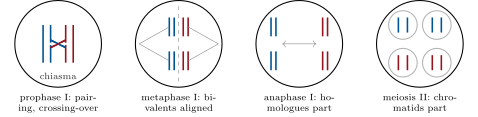
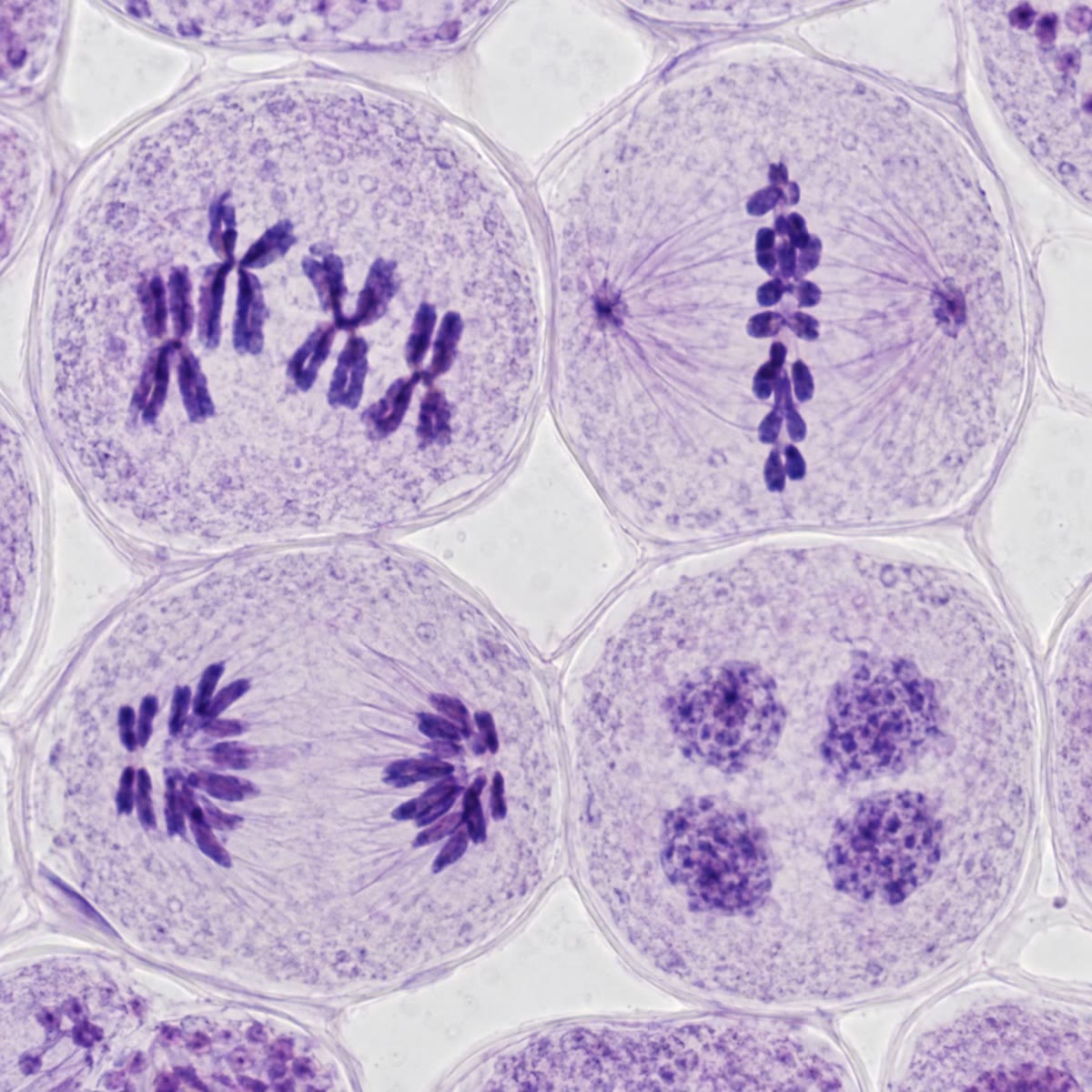
Meiosis for two pairs of homologues (maternal blue, paternal red, each of two chromatids). Homologues pair and exchange segments in prophase I, align as bivalents in metaphase I, separate in anaphase I; meiosis II separates the chromatids into four haploid cells.
Meiosis in the anther of a lily: bivalents in late prophase I, a metaphase I plate, anaphase I, and the four nuclei of a tetrad.
Read in context →