University Biology — Year 2 · Bachelor Year 2
4Meiosis, Genetic Mixing and Heredity
Two brown-eyed parents have a blue-eyed child, and nobody is surprised; two children of the same parents are never alike, and nobody is surprised either. Both facts follow from one process. At the making of every egg and every sperm, a cell with two copies of each chromosome hands on exactly one, chosen at random, after letting the two copies trade segments. Every fertilisation then brings together two such half-sets that have never met. This chapter describes that process — meiosis — and the rules of inheritance that follow from it: Mendel’s ratios, their exceptions, the linkage of genes that share a chromosome and the maps that linkage draws, and the peculiar inheritance of the sex chromosomes and of the organelles.
4.1 Meiosis
Definition 4.1 (Meiosis)
A diploid cell () carries two homologous chromosomes of each kind, one from each parent, alike in gene content but not necessarily in alleles. Meiosis is the pair of divisions that turns one diploid cell into four haploid cells (), each with one chromosome of each kind. It is preceded by one replication, so that each chromosome enters as two sister chromatids; the first division separates homologues (reductional), the second separates sister chromatids (equational), as mitosis does. In animals meiosis makes gametes; in plants and fungi it makes spores (Chapter 5); in every sexual organism it is the step that halves the chromosome number so that fertilisation can double it again.
Proposition 4.2 (The stages)
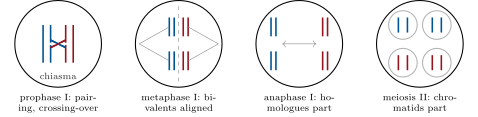
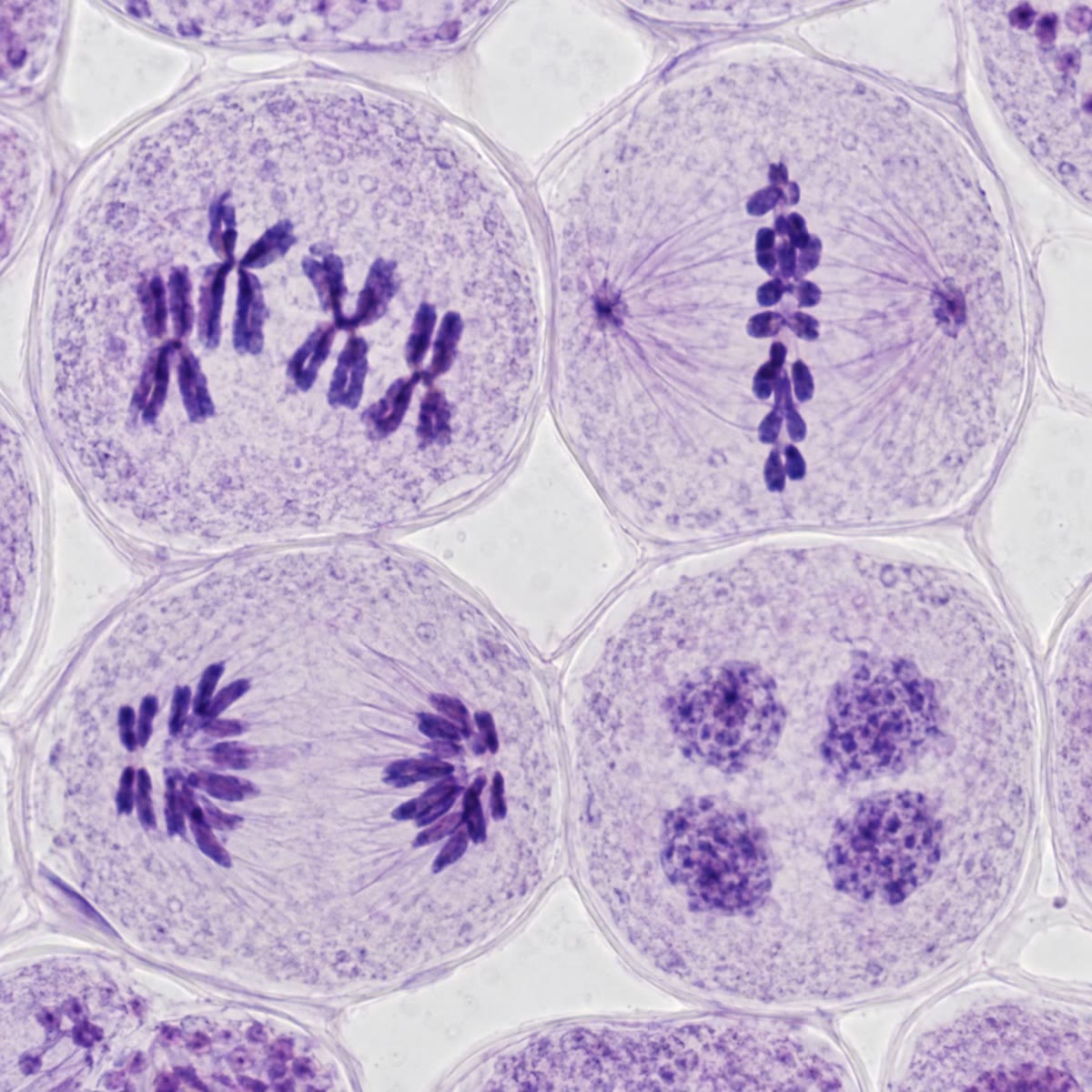
Prophase I is long and is where the mixing happens. The replicated chromosomes condense; each finds its homologue and pairs with it gene for gene (synapsis), held by a protein ladder, the synaptonemal complex, to form a bivalent of four chromatids; non-sister chromatids break and rejoin at matching points (crossing-over), one to several times per bivalent; when the complex dissolves, the homologues stay attached only at these exchange points, visible as chiasmata. Metaphase I: bivalents line up on the spindle, each pair oriented at random — the maternal homologue toward one pole or the other independently of every other pair. Anaphase I: homologues separate, sister chromatids staying together; each pole receives chromosomes of two chromatids each. Telophase I and, usually without replication, meiosis II: the chromosomes line up singly, sister chromatids separate, and four haploid nuclei result. Meiosis I takes hours to decades (a human oocyte pauses in prophase I from before birth until ovulation); meiosis II takes an hour.
Theorem 4.3 (How much mixing meiosis makes)
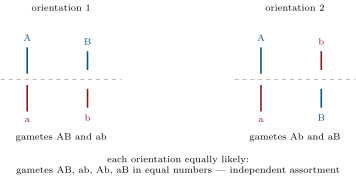
For an organism with pairs of chromosomes, the random orientation of the bivalents at metaphase I produces possible combinations of maternal and paternal chromosomes in a gamete — million in a human — and in a zygote. Crossing-over multiplies this: with about chiasmata per bivalent, each at a variable position, the number of distinct gametes is effectively unbounded, and no two gametes of one person are ever the same. Recombination — new combinations of alleles — arises from both: independent assortment reshuffles whole chromosomes, crossing-over reshuffles genes within a chromosome.
Proof. Each bivalent orients independently with two outcomes, so bivalents give combinations, all equally likely. Each of two parents contributes one such gamete, so the zygote has . A crossover at a distinct position in a chromosome of base pairs can produce of order distinct recombinant chromatids per bivalent, so the count of distinct products grows as per chromosome, which is astronomical for . ∎
Evidence. Creighton and McClintock (1931) used a maize chromosome 9 that carried two visible cytological marks (a knob at one end, a translocated segment at the other) and two genes between them (coloured/colourless kernel, waxy/starchy endosperm). Among the offspring, every plant with a recombined pair of alleles also had a recombined pair of cytological marks — knob without translocation or the reverse — proving that genetic recombination is a physical exchange of chromosome segments. ∎
4.2 Mendelian analysis
Definition 4.4 (The vocabulary of crosses)
A gene is a stretch of chromosome; its alleles are its sequence variants; the locus is its position. A diploid individual carries two alleles at each locus: its genotype is homozygous (, ) or heterozygous (). The phenotype is the observable character. An allele is dominant when the heterozygote shows its phenotype, recessive when it shows only in the homozygote; the distinction is a property of the pair of alleles and of the character observed, not of the allele alone — most recessive alleles are loss-of-function alleles, hidden because one working copy suffices. A pure line breeds true (homozygous); a test cross mates an individual of dominant phenotype with a recessive homozygote, so that its offspring reveal the alleles of its gametes directly.
Theorem 4.5 (Mendel’s ratios)
Because the two alleles of a heterozygote segregate into different gametes in equal numbers (anaphase I), a monohybrid cross gives genotypes , phenotypes if is dominant; the test cross gives . Because alleles of genes on different chromosomes assort independently (metaphase I), a dihybrid makes four kinds of gamete in equal numbers and the cross gives phenotypes , the test cross gives . For independent heterozygous loci, the number of gamete types is and the phenotypic ratio is the product of ratios .
Proof. Segregation: the heterozygote’s gametes are , ; with random fertilisation the zygote genotypes are the products . Independence: the gametes of are , four kinds at ; the dihybrid phenotypes multiply , giving . Each factor is one independent segregation, so loci give a product of factors. ∎
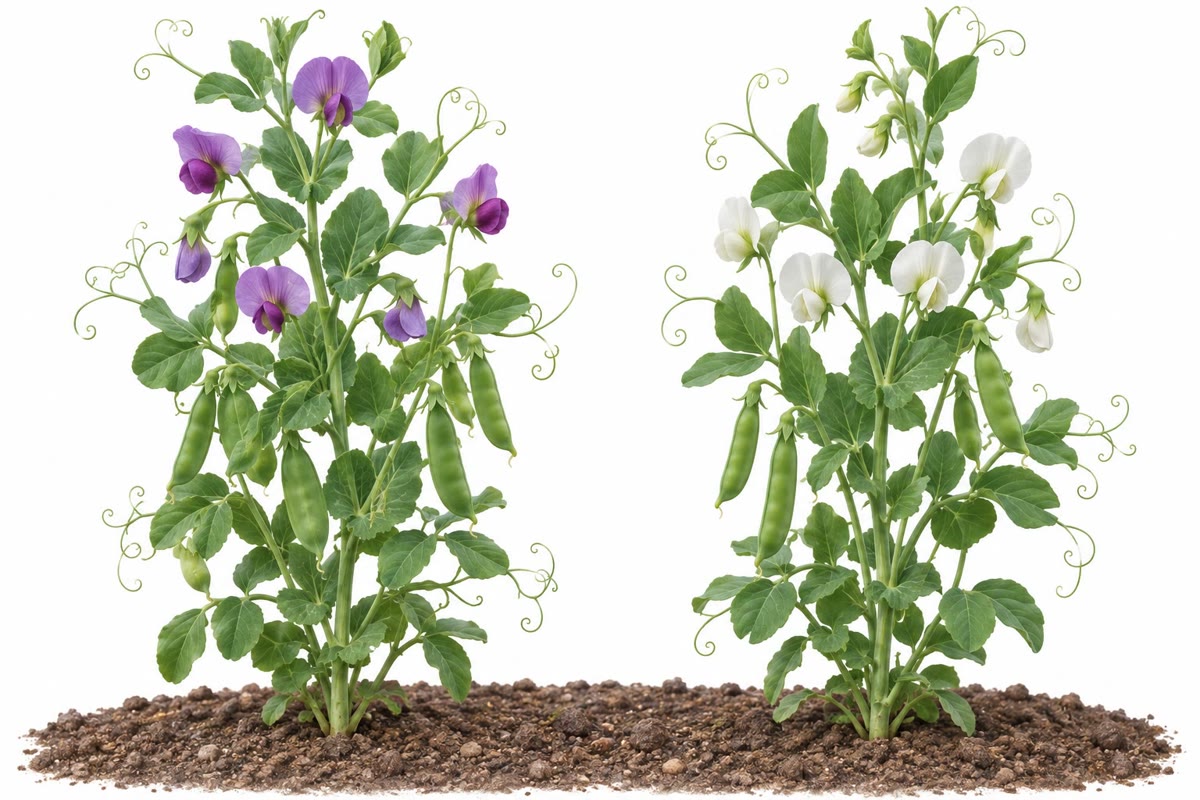
Evidence. Mendel (1866) crossed pure lines of pea differing in one character — round or wrinkled seed, yellow or green cotyledon, purple or white flower, tall or dwarf stem and three others — and found in every case a uniform first generation and a second generation segregating close to : 5474 round to 1850 wrinkled (), 6022 yellow to 2001 green (), 705 purple to 224 white (). In two-character crosses he found (), and by growing on the second generation he showed that the dominant class was of two kinds, one third pure and two thirds segregating. The chromosomes that explain the ratios were found forty years later. ∎
Method 4.6 (Testing a ratio with )
To decide whether observed counts fit a hypothesised ratio:
- Compute the expected counts from the ratio and the total.
- Compute .
- Count the degrees of freedom: the number of classes minus one.
- Compare with the critical value at the level: for 1 degree of freedom, for 2, for 3, for 4. If is below it, the data are consistent with the ratio; if above, the ratio is rejected — the deviation would arise by chance in fewer than one experiment in twenty.
For Mendel’s flowers, against : ; . (The distribution behind the critical values is derived in the statistics of the mathematics series; here the table is a tool.)
Proposition 4.7 (Beyond the simple ratios)
The ratios change, but the mechanism does not, when: alleles show incomplete dominance (a red white snapdragon gives pink, and the second generation ); alleles are codominant, both expressed ( blood: the heterozygote makes both antigens; a locus may have multiple alleles, , , ); an allele is lethal when homozygous (yellow mice: yellow yellow gives yellow to agouti, the dying as embryos); two genes act in one pathway (epistasis: in a cross the double recessive and one single recessive may be indistinguishable, giving , as for albino mice, or the two dominants may both be needed for the phenotype, giving , as for purple sweet peas that need two enzymes to make their pigment); many genes each add a little to a continuous character (height, yield), which is the quantitative genetics of Chapter 22. Reading a ratio back to a mechanism is the everyday craft of genetics.
4.3 Linkage and genetic maps
Definition 4.8 (Linkage and recombination frequency)
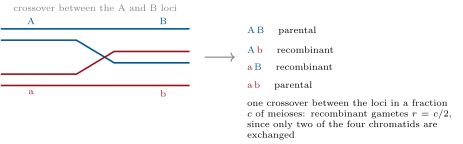
Two genes on the same chromosome are linked: their alleles tend to travel together into the gametes, and a dihybrid makes more parental gametes (, ) than recombinant ones (, ). Recombinants arise only when a crossover falls between the two loci, so their frequency — counted directly in a test cross — measures the distance: ranges from 0 (complete linkage) to (genes so far apart, or on different chromosomes, that they assort independently). The map distance unit is the centimorgan (cM): is recombination for closely linked genes; in humans is about a million base pairs. Linkage was the first proof that genes lie in a line on the chromosome.
Evidence. Morgan (1911) found that the fly’s white-eye and miniature-wing genes, both on the X chromosome, did not assort independently: a test cross gave recombinants instead of , and other pairs gave other, reproducible, percentages. Sturtevant (1913), as an undergraduate, realised that if the frequencies measure distances they should add: from the pairwise frequencies of six X-linked genes he drew the first genetic map, and the distances were, within the error, additive along a line. ∎
Method 4.9 (Mapping two linked genes)
- Cross two pure lines to get the dihybrid; note which alleles it received together (its parental combinations, coupling or repulsion ).
- Test-cross it to the double recessive and classify the offspring: the two most numerous classes are parental, the two least numerous recombinant.
- recombinants total; the distance is cM.
- Check independence first: if the four classes are equal ( against ), the genes are unlinked.
Theorem 4.10 (Haldane’s mapping function)
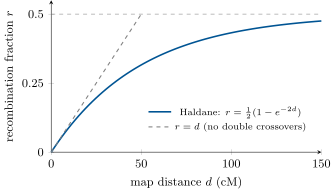
Recombination frequency underestimates distance for genes far apart, because two crossovers between them restore the parental combination. If crossovers fall independently along the chromosome (no interference), with the map distance in Morgans (expected number of crossovers per chromatid), the recombination fraction is
so that for small and as grows; corresponds to , and gives . Real chromosomes show interference — a crossover makes another nearby less likely — which brings closer to than Haldane predicts over short distances.
Proof. Let the map distance be the expected number of crossovers per chromatid in the interval; since every crossover involves two of the four chromatids, the bivalent as a whole carries a Poisson number of crossovers of mean in the interval, and the probability that it carries none is . If it carries at least one, each crossover independently involves a given chromatid with probability , so a given chromatid has been exchanged an odd number of times — is recombinant — with probability exactly , whatever the number of crossovers. Hence ; inverting gives . For small , ; as , . ∎
Method 4.11 (The three-point test cross)
Cross a triple heterozygote to and classify the eight offspring classes.
- The two largest classes are the parentals; the two smallest are the double crossovers.
- The gene that switches between a parental class and the double-crossover class is the middle one: this gives the order.
- For each adjacent pair, the recombination frequency is (single crossovers in that interval + double crossovers) total, since a double crossover recombines both intervals.
- Expected double crossovers total; the coefficient of coincidence is observed/expected and the interference is coincidence.
Example 4.12 (A three-point cross worked)
Offspring of : 580, 592, 45, 40, 89, 94, 3, 5; total 1448. Parentals , ; doubles , ; comparing with , the gene that changed is : order ––. ; ; map: — — — — . Expected doubles , observed 8: coincidence , interference .
4.4 Sex chromosomes and organelles
Proposition 4.13 (Sex-linked inheritance)
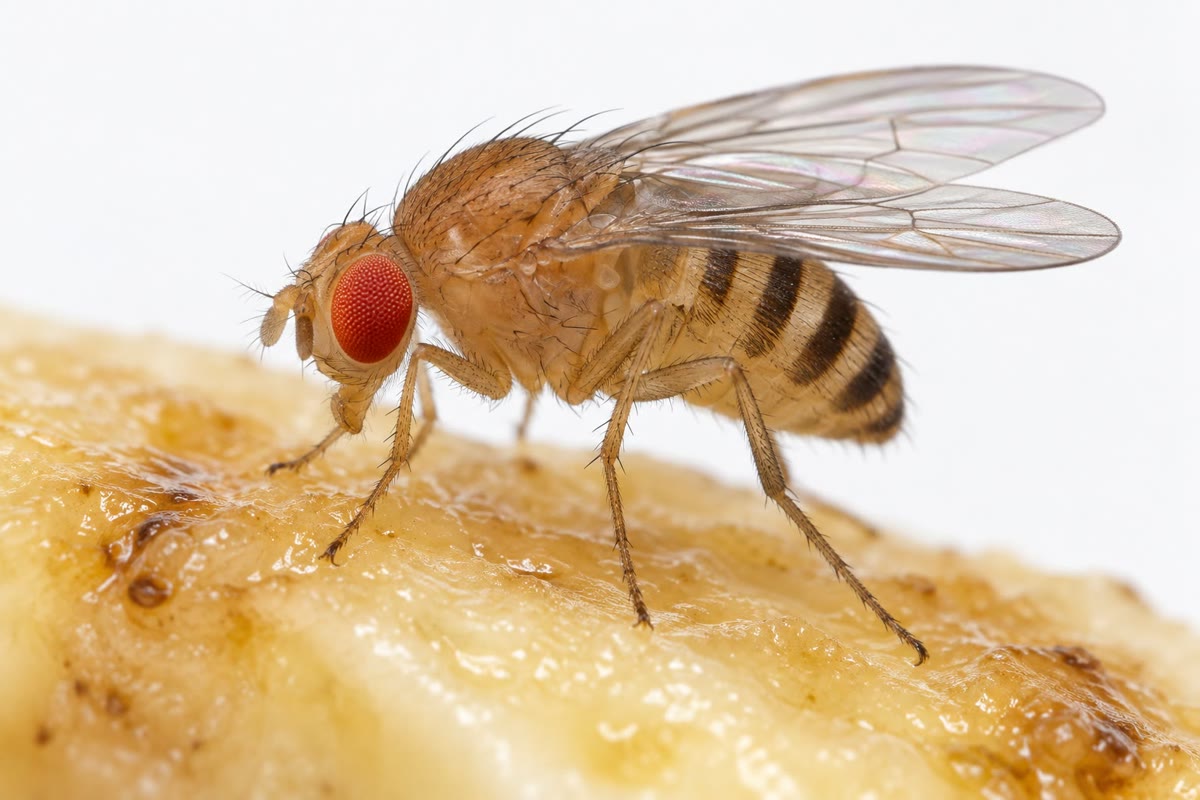
In mammals and flies the female is and the male : the carries few genes, so a male has a single copy of every -linked gene (he is hemizygous) and shows whatever allele he carries, dominant or recessive. Consequences: reciprocal crosses differ (white-eyed female red-eyed male gives white-eyed sons and red-eyed daughters; the reverse cross gives all red); a recessive -linked trait (red–green colour blindness, haemophilia, Duchenne muscular dystrophy) appears mostly in males, is passed by unaffected carrier mothers, and is never passed from father to son (a son gets his father’s ); a father passes his to all his daughters. Birds, butterflies and some reptiles reverse the arrangement ( females, males); many reptiles let temperature decide; and in mammals one of every female cell is silenced at random early in development, so that a heterozygous female is a mosaic (the tortoiseshell cat).
Evidence. Morgan (1910) found one white-eyed male among thousands of red-eyed flies. Crossed to red females, all offspring were red; but in the next generation the white eyes reappeared only in males, half of them. Crossing a white male to his red daughters gave white eyes in both sexes. The pattern was exactly that expected if the gene sat on the X chromosome, which females carry twice and males once — the first gene assigned to a chromosome. ∎
Method 4.14 (Reading a pedigree)
- Two unaffected parents with an affected child: the trait is recessive (both parents heterozygous).
- An affected child always has an affected parent, and the trait appears in every generation: dominant.
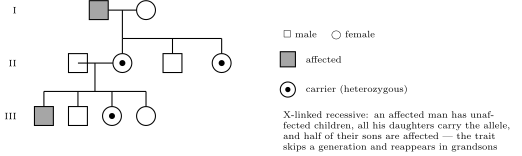
- Affected individuals mostly male, transmitted through unaffected mothers, never father to son: X-linked recessive.
- An affected father has all daughters affected and no son affected: X-linked dominant.
- Transmitted by mothers to all their children, never by fathers: mitochondrial.
- Then compute probabilities from the genotypes implied: a carrier normal couple has a chance of an affected son at each birth ( boy receives the allele).
Definition 4.15 (Extranuclear inheritance)
Mitochondria and chloroplasts carry their own small genomes, in many copies per organelle and many organelles per cell, and they come almost entirely from the egg: the sperm contributes a nucleus and little else. Their genes are therefore maternally inherited, without segregation ratios: a mother passes the trait to all her children, a father to none. Human mitochondrial diseases (defects of the respiratory chain affecting muscle and nerve) follow this pattern, and so does the variegation of some plants, where a mother cell containing both normal and mutant chloroplasts sorts them at random into daughter cells, producing green, white and mixed sectors. Because they never recombine, mitochondrial sequences trace maternal lineages back through time — the tool of Chapter 24.
Proposition 4.16 (Tetrad analysis)
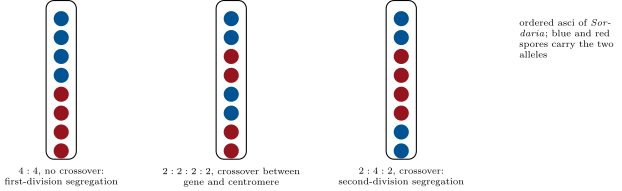
In some fungi (Neurospora, Sordaria) the four products of one meiosis stay together in a sac, the ascus, and in order: a final mitosis gives eight spores whose sequence records the two divisions. For a heterozygote , an ascus with the pattern (first-division segregation) had no crossover between the gene and its centromere — the alleles parted at anaphase I; a pattern or (second-division segregation) had one, so that the alleles parted only at anaphase II. The distance from gene to centromere is half the percentage of second-division asci, since a crossover recombines only two of the four chromatids. Tetrads also show directly that recombination is reciprocal: every recombinant chromatid has its complementary partner in the same ascus.
4.5 Exercises
Exercise 4.1 ★
List four differences between mitosis and meiosis (number of divisions, pairing, products, genetic identity of the products).
Exercise 4.2 ★
How many chromosomally distinct gametes can a person make by independent assortment alone? A fruit fly ()? A pea ()?
Solution
Solution of Exercise 4.2.
; ; — before crossing-over multiplies each of these without limit.
Exercise 4.3 ★
In peas, tall () is dominant over dwarf. Give the phenotypic and genotypic ratios of and of . How do you find out whether a tall plant is or ?
Solution
Solution of Exercise 4.3.
: genotypes , phenotypes tall : dwarf. : , . Test-cross the tall plant to a dwarf: all tall means , half dwarf means (or self it: breeds true, segregates ).
Exercise 4.4 ★
Define linkage, recombination frequency and the centimorgan. Why can two genes on the same chromosome nevertheless assort as if they were independent?
Solution
Solution of Exercise 4.4.
Linked genes lie on the same chromosome and their parental allele combinations are over-represented among gametes; the recombination frequency is the fraction of recombinant gametes (recombinant offspring of a test cross); one centimorgan is one percent recombination. Genes far apart on a long chromosome have at least one crossover between them in nearly every meiosis, and multiple crossovers randomise the combinations, so reaches — indistinguishable from independent assortment.
Exercise 4.5 ★★
Mendel’s dihybrid cross gave round yellow, round green, wrinkled yellow, wrinkled green. Test the hypothesis with (3 degrees of freedom, critical value ).
Solution
Solution of Exercise 4.5.
Total 556; expected ; : consistent with .
Exercise 4.6 ★★
A dihybrid test-crossed gives , , , . Are the genes linked? Compute the recombination frequency and the map distance; what would the dihybrid give?
Solution
Solution of Exercise 4.6.
Against (250 each): : linked. Recombinants of 1000: , . In repulsion, gives 400 , 400 , 100 , 100 : the same distance, the parental and recombinant classes exchanged.
Exercise 4.7 ★★
Using Haldane’s function, convert and to map distances, and and to recombination fractions. Comment on which conversions matter in practice.
Solution
Solution of Exercise 4.7.
: gives , ; gives , . : gives ; gives . Below the correction is negligible; above it is essential, and above saturates so that a single two-point cross can no longer measure the distance — one maps far genes by chaining close ones.
Exercise 4.8 ★★
In Drosophila, white eye () is X-linked recessive. Give the offspring, by sex and phenotype, of (a) a white female red male, (b) a red heterozygous female white male, (c) the cross of the daughters of (a) with their brothers.
Solution
Solution of Exercise 4.8.
(a) : all sons white (), all daughters red (). (b) : sons half red, half white; daughters half red (), half white (). (c) daughters brothers : as in (b) — half of each sex white, half red.
Exercise 4.9 ★★
Two white-flowered pure lines of sweet pea, crossed, give all purple offspring, which selfed give purple : white. Explain with two genes, give the genotypes of the two parental lines, and predict the result of test-crossing the purple hybrid.
Exercise 4.10 ★★★
A three-point test cross gives: 480, 470, 11, 9, 118, 112, 1, 1 (total 1202). Find the gene order, the two distances, the coefficient of coincidence and the interference.
Solution
Solution of Exercise 4.10.
Parentals , ; double crossovers , ; is the gene that switched: order ––. (); (). Expected doubles ; observed 2: coincidence , interference .
Exercise 4.11 ★★★
In Sordaria, a cross of a black-spored strain with a tan-spored one gives asci of pattern and of patterns or . Compute the distance from the spore-colour gene to its centromere, and explain why the factor one half is needed. Draw the chromatids of one meiosis giving .
Solution
Solution of Exercise 4.11.
Second-division asci ; distance . A crossover between gene and centromere involves only two of the four chromatids, so an ascus showing second-division segregation carries two recombinant and two parental chromatids: the recombination frequency is half the frequency of such asci. For : a crossover between the locus and the centromere exchanges the inner two chromatids, so that each half-spindle at meiosis I carries one and one chromatid; meiosis II then separates them in the order (or the reverse), and the final mitosis doubles each spore: .
Exercise 4.12 ★★★
A woman’s maternal grandfather had haemophilia; nobody else in the family is affected. What is the probability that she is a carrier? Given that she has had two healthy sons, what is it now? Show the reasoning.
Solution
Solution of Exercise 4.12.
Her mother is an obligate carrier (she received her father’s only X), so the woman received the allele with probability . Two healthy sons: a carrier has probability of two healthy sons, a non-carrier probability 1. Bayes: .
4.6 Problem: Crosses in the Fly Room
Problem 4.1
Weekend problem — crosses of Drosophila analysed from the monohybrid ratio to a three-point map, and a human pedigree computed, ending on the map of three X-linked genes and its interference
Vestigial wing () and ebony body () are recessive and lie on different autosomes; black body () and are recessive and both lie on chromosome 2; yellow body (), white eye () and miniature wing () are recessive and X-linked. Critical values of at : (1 d.f.), (3 d.f.).
Part I — Two autosomal genes. A pure vestigial fly is crossed to a pure ebony fly; the are all wild type; flies are scored: wild, vestigial, ebony, vestigial ebony.
- Give the genotypes of the parents, the and the gametes of the .
- Compute the expected counts under independent assortment.
- Compute and conclude.
- What fraction of the wild-type flies are homozygous at both loci?
- The is test-crossed to a vestigial ebony fly: predict the four classes and their proportions.
- Ebony flies raised at are paler than at . What does this say about the relation of genotype to phenotype?
Part II — Two linked genes. A pure black fly is crossed to a pure vestigial fly; the females are test-crossed to black vestigial males: black, vestigial, black vestigial, wild type.
- Write the genotype, showing which alleles are on the same chromosome.
- Identify the parental and recombinant classes and explain why the wild type is a recombinant here.
- Compute and the map distance.
- Correct it with Haldane’s function.
- The same cross with males test-crossed gives only two classes, black and vestigial, in equal numbers. What does this show about meiosis in male flies?
- Predict the classes and proportions if the female had come from a black vestigial wild cross.
Part III — A human pedigree. Haemophilia A is X-linked recessive. A man with haemophilia has a daughter, who marries an unaffected man.
- What is the daughter’s genotype, and why is it certain?
- Probability that her first child is an affected son.
- Probability that a daughter of hers is a carrier.
- Probability that, among her three children, none is affected.
- Explain why the disease is never passed from father to son, and how a woman could be affected.
- The affected man’s sister has two healthy sons; their mother (the man’s mother) was a carrier. Compute the probability that the sister is a carrier, before and after taking her sons into account.
Part IV — Three X-linked genes. A female is crossed to a male; her sons are scored: 853, 833, 24, 26, 128, 132, 2, 2.
- Why can the sons be scored directly, without a test cross?
- Identify the parental and double-crossover classes and deduce the gene order.
- Compute the two recombination frequencies and draw the map.
- Compute the expected number of double crossovers, the coefficient of coincidence and the interference.
- Compute the recombination frequency between the two outer genes directly from the data, and explain why it is less than the sum of the two distances.
- What would the daughters of this cross look like, and why are they useless for mapping?
- State the result: the map of the three genes and the interference.
Solution
Solution of Problem 4.1.
1. Parents and ; ; gametes , , , , each . 2. . 3. : independent assortment holds. 4. Homozygous wild at both loci is of all, are wild: . 5. Wild, vestigial, ebony, vestigial ebony, each. 6. The phenotype is the product of genotype and environment (temperature acts on the pigment enzymes): a genotype specifies a norm of reaction, not a fixed character. 7. (repulsion): came with from one parent, with from the other. 8. Parental: black () 965 and vestigial () 944; recombinant: black vestigial () 206 and wild () 185. The wild-type chromosome did not exist in the ; it can only be made by a crossover. 9. : . 10. : . 11. There is no crossing-over in male Drosophila: the male’s gametes carry only the two parental chromosomes. 12. (coupling): parental classes wild and black vestigial, each; recombinant black and vestigial, each. 13. : a daughter receives her father’s only X, which carries , and a normal X from her unaffected mother. 14. (son) (receives ) . 15. : she receives either of the mother’s X chromosomes; the father gives a normal X. 16. Each child unaffected with probability : . 17. A son receives his father’s Y, never his X. A woman is affected only as : an affected father and a carrier (or affected) mother, which is rare. 18. Prior . Two healthy sons have probability if she is a carrier, 1 if not: posterior . 19. A son’s only X comes from his mother, and the Y carries none of these genes, so each son displays one maternal gamete unmasked: the cross is its own test cross. 20. Parentals (853), (833); double crossovers (2), (2); switched: order ––. 21. ; . Map: — — — — . 22. Expected ; observed 4: coincidence , interference . 23. – recombinants: , , , : , against : the four double crossovers restore the parental – combination and are missed, . 24. Daughters receive the father’s X and one maternal X: all are heterozygous and wild in phenotype, whatever recombinant X they carry; the recombination is invisible. 25. — — — — ; coefficient of coincidence , interference .