University Biology — Year 2 · Bachelor Year 2
5Life Cycles and Reproduction of Land Plants
The green cushion of moss on a wall is one plant; the brown stalks that rise from it in spring, each with a capsule of spores, are another — a different individual, with twice the chromosomes, growing out of the first and living on it. A fern frond carries spores on its underside, but the spores do not grow into ferns: they grow into a heart-shaped green scale a few millimetres wide, which is where the sperm and eggs are made, and it is from that scale that a new fern springs. Every land plant alternates in this way between two bodies, one haploid and one diploid. This chapter follows the alternation from the algae to the seed, and shows how a sequence of changes to it — the shrinking of the haploid body, the invention of pollen, the enclosure of the ovule, the seed — freed reproduction from water and let plants cover the continents.
5.1 Three kinds of life cycle
Definition 5.1 (Haplontic, diplontic, haplo-diplontic)
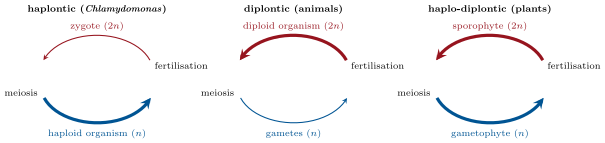
Every sexual life cycle contains one fertilisation, which doubles the chromosome number, and one meiosis, which halves it; the cycles differ in what happens between them. In a haplontic cycle the zygote is the only diploid cell and undergoes meiosis at once; the organism is haploid and its gametes are made by mitosis (Chlamydomonas, many algae and fungi). In a diplontic cycle meiosis makes gametes directly, the gametes are the only haploid cells, and the organism is diploid (animals, the brown alga Fucus). In a haplo-diplontic cycle meiosis makes spores, which grow by mitosis into a haploid organism, the gametophyte, that makes gametes by mitosis; the zygote grows by mitosis into a diploid organism, the sporophyte, that makes spores by meiosis. Two multicellular bodies alternate — the alternation of generations — and this is the cycle of every land plant and of many algae.
Proposition 5.2 (What alternation of generations means)
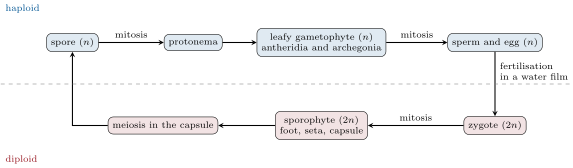
In a land plant the two generations are two organisms, not two stages of one: the gametophyte and the sporophyte have different genomes (haploid and diploid), different bodies, often different sizes by orders of magnitude, and each develops by mitosis from a single cell — a spore or a zygote. The gametophyte makes gametes in multicellular organs, antheridia (sperm) and archegonia (one egg each, in a flask whose neck the sperm swims down); the sporophyte makes spores in sporangia. Across the land plants the balance shifts: in mosses the gametophyte is the plant and the sporophyte a dependent stalk; in ferns the sporophyte is the plant and the gametophyte a free-living scale; in seed plants the gametophyte is reduced to a few cells hidden inside the sporophyte’s tissues — the pollen grain and the contents of the ovule.
Evidence. Hofmeister (1851) germinated the spores of mosses, ferns, horsetails and clubmosses, followed the development of the small green bodies they produced, found on them the antheridia and archegonia, and watched the embryo grow from the fertilised egg inside the archegonium into the spore-bearing plant. He then showed that the ovule of a conifer contains the same structures, reduced — archegonia within a tissue that is a retained gametophyte — and so that mosses, ferns and seed plants are one series with one cycle. The chromosome counts that explained the two generations (Strasburger, 1894) came forty years later. ∎
5.2 Mosses: the gametophyte is the plant
Definition 5.3 (The moss life cycle)
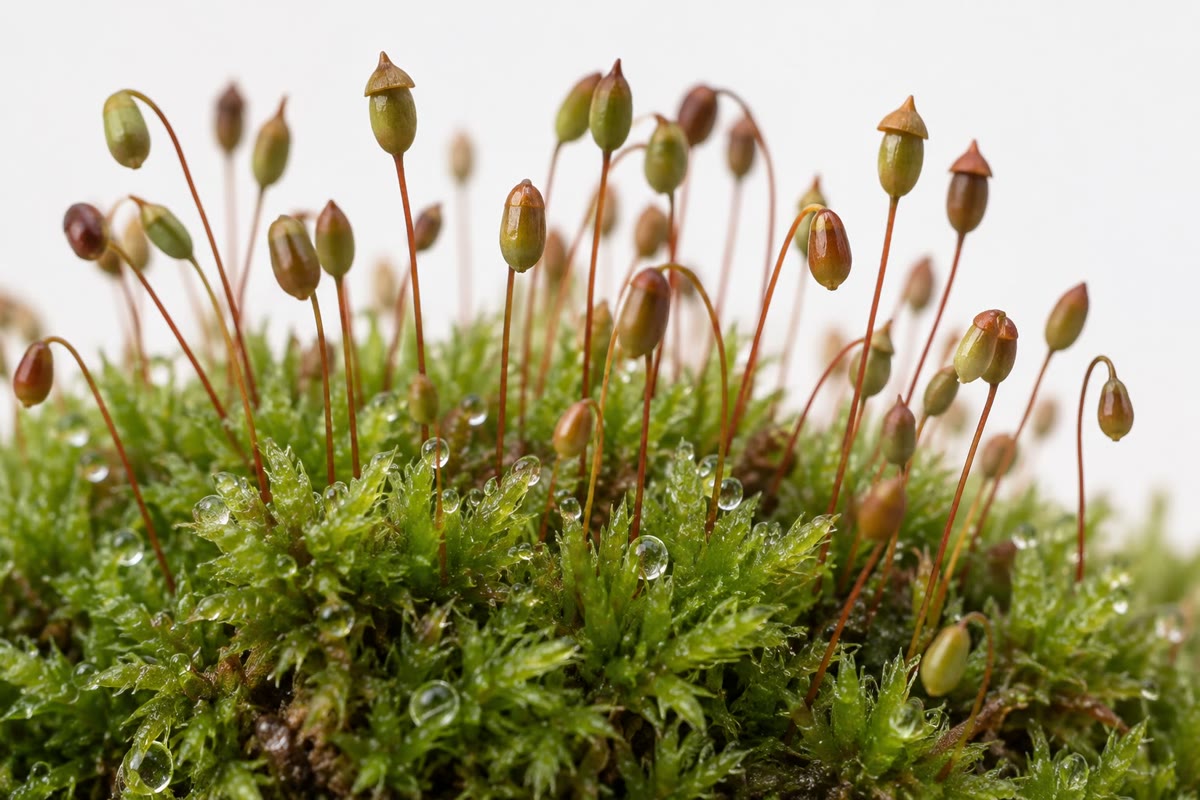
A moss spore germinates into a branching green filament, the protonema, from which buds grow into the leafy shoots — the gametophyte, a few centimetres tall, without true roots, xylem or phloem, anchored by rhizoids and drawing water over its whole surface. At the shoot tips it bears antheridia, which release biflagellate sperm into a film of rain or dew, and archegonia, each with one egg at the base of a neck; the sperm swim a few centimetres at most, guided by chemical attractants, and fertilise the egg in place. The zygote grows into the sporophyte: a foot embedded in the gametophyte, a stalk (seta), and a capsule in which meiosis makes tens of thousands of spores, shed through a ring of hygroscopic teeth that open in dry air. The sporophyte photosynthesises a little but is fed by the gametophyte through its foot and never lives alone.
Example 5.4 (The cost of swimming sperm)
A moss sperm swims at about ; to reach an archegonium away it needs of continuous water film — a splash of rain, a heavy dew. Fertilisation is therefore confined to wet weather and to short distances, and most mosses, ferns and their relatives live in damp places or reproduce in the wet season; the antheridia of some mosses sit in a splash cup whose shape throws raindrops, and the sperm they carry, half a metre. It is this dependence that the seed plants escaped.
5.3 Ferns: the sporophyte is the plant
Definition 5.5 (The fern life cycle)
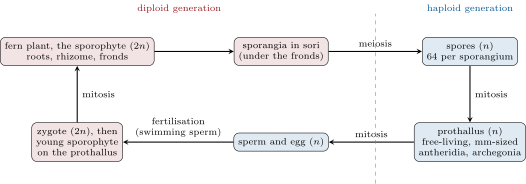
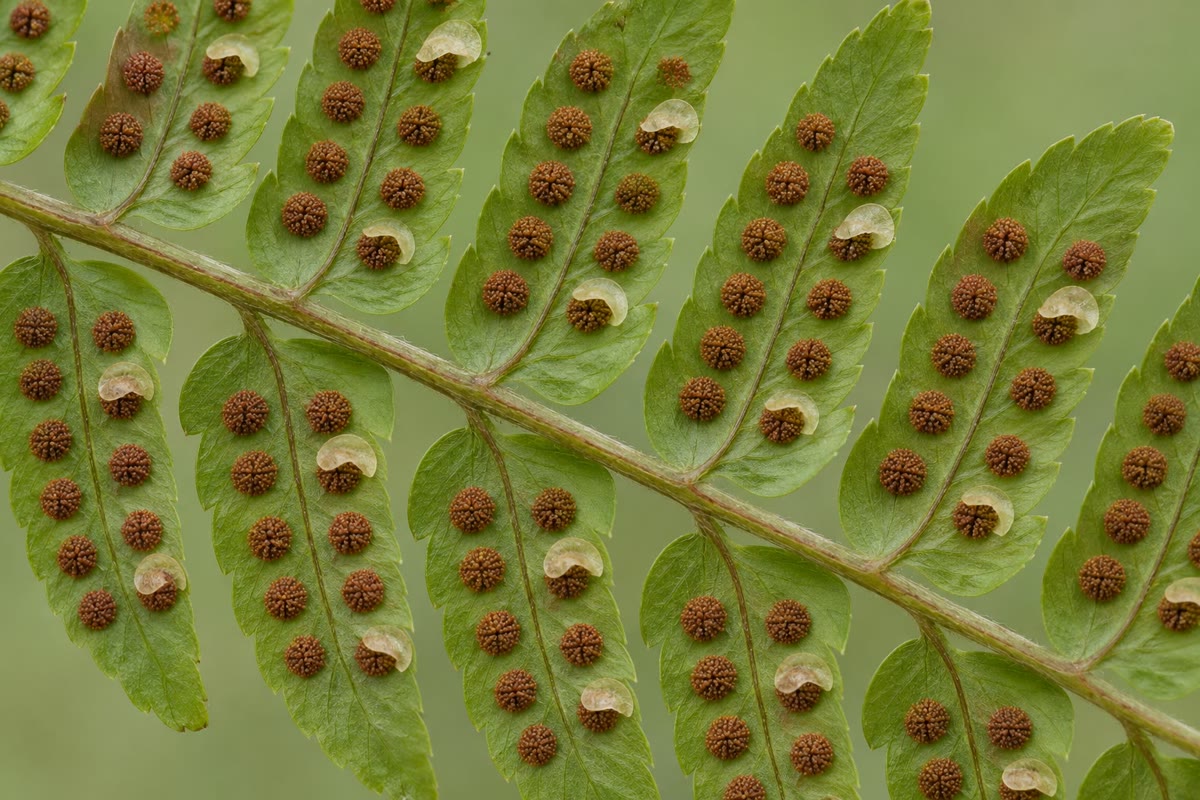
The fern is the sporophyte: a rhizome with roots, xylem and phloem, and fronds. On the underside of fertile fronds, clusters of sporangia (sori, often under a protective flap) each make 64 spores by meiosis and fling them by the snap of a drying ring of thick-walled cells. A spore that lands on damp soil grows into a prothallus: a heart-shaped green gametophyte a few millimetres across, one cell thick, with rhizoids, living free for a few weeks. It bears antheridia and archegonia on its underside; sperm swim in the soil film to the egg; the zygote grows into a young sporophyte that draws its first food from the prothallus and then roots, and the prothallus dies. The two generations are both independent, but unequal: the sporophyte lives for decades and can be metres tall, the gametophyte for weeks and millimetres.
Theorem 5.6 (Dispersal of a spore)
A spore of radius and density released at height into a horizontal wind of speed falls at the Stokes terminal speed and lands, in still-layered air, at a distance
from the plant. A fern spore of radius and density () falls at ; from a frond at in a wind of it travels about , and in the turbulent air of a windy day, which lifts a fraction of the spores far above the release height, a few travel hundreds of kilometres — which is why the fern floras of oceanic islands are rich and their seed-plant floras poor.
Proof. The fall time is (the spore reaches its terminal speed in microseconds), during which the wind carries it . The terminal speed follows from balancing the Stokes drag against the weight minus buoyancy , as in Chapter 1. ∎
5.4 Seed plants: the gametophyte is hidden
Definition 5.7 (Heterospory, pollen, ovule)
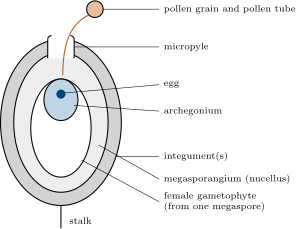
Mosses and most ferns are homosporous: one kind of spore, one kind of gametophyte bearing both sexes. Seed plants (and a few ferns and clubmosses) are heterosporous: microspores, small and many, grow into male gametophytes; megaspores, large and few, into female ones. In seed plants both are reduced to almost nothing and neither leaves the sporophyte’s tissues on its own. The male gametophyte is the pollen grain: a microspore that has divided two or three times inside its wall, carried by wind or animals to the female organ, where it grows a pollen tube and delivers its sperm — no water needed. The female gametophyte develops inside the megasporangium, which stays on the parent enclosed in one or two integuments with a pore, the micropyle: the whole structure is the ovule. After fertilisation the ovule becomes the seed: an embryo sporophyte, a store of food, and a coat made from the integuments, dormant until conditions are right.
Proposition 5.8 (The conifer cycle)
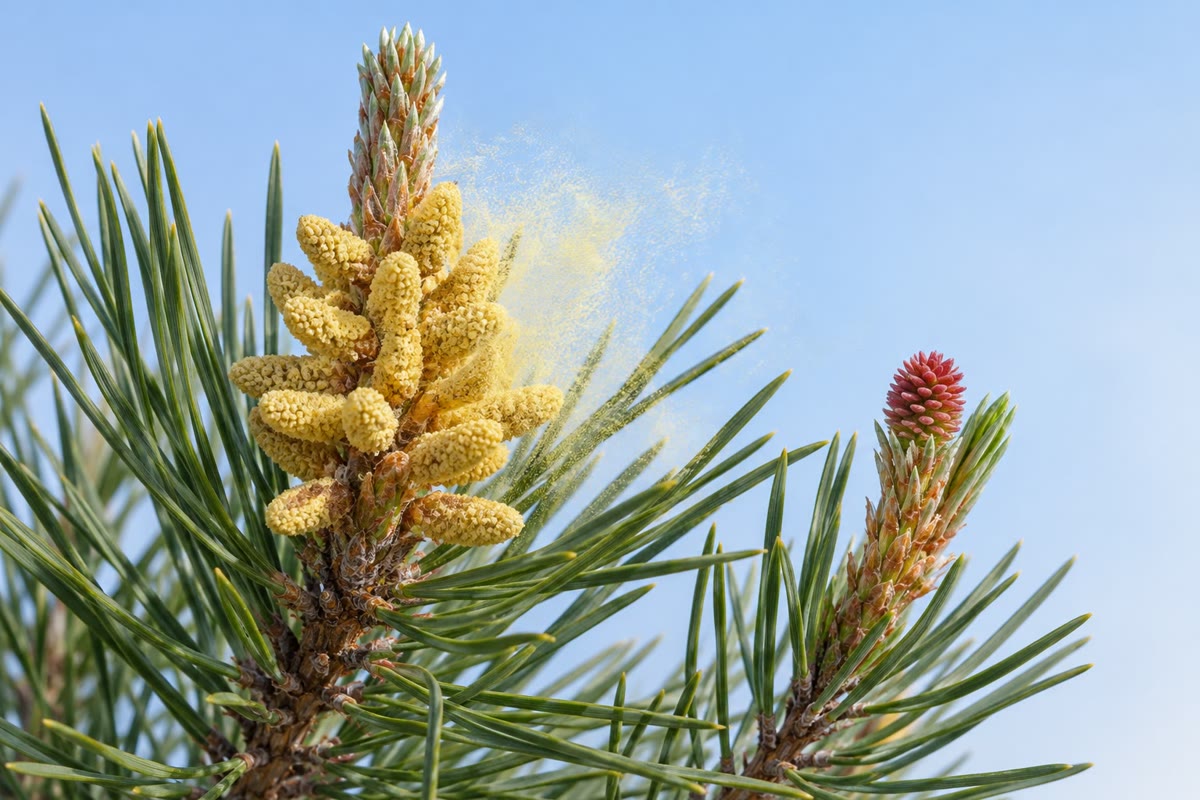
A pine bears two kinds of cone. Small male cones, in clusters in spring, hold microsporangia in which meiosis makes microspores; each divides into a four-celled pollen grain with two air bladders and is shed by the million into the wind. Female cones carry two ovules on the upper face of each scale. Pollen blown between the scales is drawn to the micropyle by a drop of fluid; the female gametophyte, which has not yet developed, then grows over the following year from the single surviving megaspore into a tissue of a few thousand cells with two or three archegonia; a pollen tube grows slowly through the nucellus and, fifteen months after pollination, delivers a sperm to an egg. The embryo develops in the gametophyte, which becomes the food store of the seed; the seed, winged, is shed in the second autumn when the cone opens. Seeds take years, and cost a great deal; in return they are dispersed dry, survive winter and drought, and carry the seedling’s first weeks of food.

Example 5.9 (Pollen in the wind)
A pine pollen grain, across with two bladders, falls at about ; a large tree releases some grains in a season, enough to coat ponds yellow. The chance that one grain lands on a given ovule is tiny, and the strategy works only in numbers: wind pollination is cheap per grain, costly in grains, and confined to plants that grow in stands of their own species — conifers, grasses, oaks. The flowering plants (Chapter 6) found a way to deliver pollen by animals, one grain at a time to the right address.
5.5 Trends across the land plants
Proposition 5.10 (Four trends)
From mosses to ferns to seed plants: (1) the sporophyte grows from a dependent stalk to the whole plant, and the gametophyte shrinks from the plant to a scale to a few cells; (2) homospory gives way to heterospory, and the female gametophyte stays on the parent; (3) fertilisation passes from swimming sperm in surface water to a pollen tube, so that reproduction no longer needs rain; (4) the dispersal unit passes from the spore — a single cell with a day’s reserves — to the seed, an embryo with food and a coat, which can wait. The diploid generation is favoured on land because a diploid body masks recessive mutations, can grow larger and longer-lived with a vascular system, and because a spore made by meiosis on a tall sporophyte travels further than a gamete swimming from a low gametophyte. The trend continues into the flowering plants, where the female gametophyte is seven cells and the seed is wrapped in a fruit.
Example 5.11 (The groups compared)
| mosses | ferns | conifers | |
|---|---|---|---|
| dominant generation | gametophyte | sporophyte | sporophyte |
| gametophyte | leafy shoot, cm | prothallus, mm, free | pollen grain (4 cells); ovule contents (thousands of cells) |
| spores | one kind | one kind | microspores, megaspores |
| fertilisation | sperm swim in water | sperm swim in water | pollen tube |
| dispersal unit | spore | spore | seed |
| vascular tissue | none | xylem, phloem | xylem, phloem, wood |
5.6 Exercises
Exercise 5.1 ★
Define gametophyte, sporophyte, spore and gamete, and say by which kind of division (mitosis or meiosis) each of the four is produced.
Solution
Solution of Exercise 5.1.
Gametophyte: the haploid multicellular generation, grown by mitosis from a spore, that makes gametes by mitosis. Sporophyte: the diploid generation, grown by mitosis from a zygote, that makes spores by meiosis. Spore: a haploid cell made by meiosis that grows without fusing. Gamete: a haploid cell made by mitosis (in plants) that must fuse with another.
Exercise 5.2 ★
The fern Ophioglossum reticulatum has chromosomes in its leaf cells. How many in a spore, a prothallus cell, a sperm, an egg, a zygote?
Solution
Solution of Exercise 5.2.
Leaf cells are : spore 630, prothallus cell 630, sperm 630, egg 630, zygote 1260.
Exercise 5.3 ★
Which generation is the green cushion of a moss? The brown stalk with a capsule? A fern frond? A prothallus? A pollen grain? A pine seed’s food store? A pine seed’s embryo?
Solution
Solution of Exercise 5.3.
Green cushion: gametophyte. Stalk and capsule: sporophyte. Fern frond: sporophyte. Prothallus: gametophyte. Pollen grain: male gametophyte. Seed’s food store (in a pine): female gametophyte. Seed’s embryo: the next sporophyte.
Exercise 5.4 ★
Name the three kinds of life cycle and give an organism for each. Where does meiosis take place in each?
Solution
Solution of Exercise 5.4.
Haplontic (Chlamydomonas): meiosis in the zygote, at once. Diplontic (animals, Fucus): meiosis makes the gametes. Haplo-diplontic (mosses, ferns, seed plants, many algae): meiosis makes spores in the sporophyte’s sporangia.
Exercise 5.5 ★★
A moss sperm swims at . How long does it take to reach an archegonium away? A dew film evaporates in after sunrise: what is the maximal range of fertilisation? Comment on the sizes of moss colonies.
Solution
Solution of Exercise 5.5.
, five minutes. In , . Fertilisation works only between plants a few centimetres apart, so mosses grow in dense cushions with both sexes (or both organs) within reach.
Exercise 5.6 ★★
Compute the settling speed in air of a fern spore of radius and density (, ), and the distance it travels from in a wind. Redo it for a pine seed of mass whose wing gives it a descent speed of , shed from .
Solution
Solution of Exercise 5.6.
, ; distance . Seed: — a heavier unit shed from higher with a wing goes about as far.
Exercise 5.7 ★★
A fern frond carries sori of sporangia, each sporangium making spores. How many spores per frond? If one spore in becomes a prothallus and one prothallus in produces a sporophyte, how many young ferns does a frond yield?
Exercise 5.8 ★★
Explain why heterospory is a precondition for the seed, and why a homosporous plant could not enclose its female gametophyte in an ovule.
Solution
Solution of Exercise 5.8.
A seed is a retained ovule: the female gametophyte must be kept on the parent, enclosed, and fed, while the male gametophyte must travel to it. That needs two kinds of spore with two fates. A homosporous plant’s one spore must be shed to grow into a free bisexual gametophyte; retaining it would retain the male function as well and force self-fertilisation on every plant, and there would be nothing to travel.
Exercise 5.9 ★★
Compare a fern spore (a sphere of radius , density ) and a pine seed () as dispersal units: mass, energy content (take of dry matter, dry), and what each can and cannot do on landing.
Solution
Solution of Exercise 5.9.
Spore: , ; energy . Seed: , — times more. The spore can grow one small photosynthetic scale and nothing before light; the seed can grow a root and a shoot in the dark, wait through a season, and survive being eaten or dried.
Exercise 5.10 ★★★
A pine releases pollen grains over a forest; at ovule height the grains are spread in a layer deep over . Estimate the pollen concentration (grains per cubic metre), the number of grains per second passing through an ovule’s micropylar opening () in a wind, and the time for an ovule to receive one grain. What does this say about the timing of cone opening?
Solution
Solution of Exercise 5.10.
grains per cubic metre; flux grains per second; about , a quarter of an hour, per grain. The cone must be open and receptive for hours to days, and precisely when the male cones shed — pollination is timed to the week.
Exercise 5.11 ★★★
Give three reasons why the diploid generation came to dominate the life cycle of land plants, and one reason why the haploid generation did not disappear altogether.
Solution
Solution of Exercise 5.11.
Diploidy masks recessive deleterious mutations; a diploid body with vascular tissue can be large and long-lived, and height helps both light capture and spore dispersal; spores made high on a sporophyte disperse in air, whereas gametes must swim. The haploid generation persists because meiosis and fertilisation require a haploid phase, and the pollen grain and embryo sac are the minimal bodies that carry gametes to each other and feed the embryo.
Exercise 5.12 ★★★
Hofmeister worked before chromosomes were known. Explain what he could and could not establish about the alternation of generations by microscopy and culture alone, and what the chromosome counts added.
Solution
Solution of Exercise 5.12.
By culturing spores and following them under the microscope he could establish that a spore grows into a small body bearing sex organs, that the embryo arises from the fertilised egg inside the archegonium, that the spore-bearing plant grows from it, and that the same organs exist in reduced form in the conifer ovule: the alternation as a sequence of bodies and organs. He could not know what distinguished the two generations at the level of the cell. Chromosome counts showed that the two bodies differ by a factor two in chromosome number, that meiosis sits at spore formation and fertilisation at the egg, and so explained why the alternation is obligatory.
5.7 Problem: From Spore to Seed
Problem 5.1
Weekend problem — the reproductive arithmetic of a fern and a pine compared, from the number of spores and pollen grains to their dispersal, the fate of gametophytes, and the cost of a seed, ending on the number of propagules each plant must make for one replacement
A fern plant bears fertile fronds, each with sori of sporangia making spores each. Spores: radius , density . A pine produces female cones’ worth of ovules over its life — take ovules per cone — and pollen grains per year. Seeds: , dry matter at . Air: , ; .
Part I — The fern’s spores.
- Compute the number of spores the plant sheds in a season.
- Compute the mass of one spore and of the whole crop.
- Compute the spore’s settling speed in air.
- From fronds at in a wind, how far do the spores travel? Over how large an area (a disc of that radius) are they spread, and how many land per square metre?
- Explain why turbulence carries a few spores much further, and what this implies for the colonisation of a new island.
- Compute the energy content of one spore ( dry matter at ) and of the whole crop, and compare with the energy of one pine seed.
Part II — The gametophytes. One spore in lands on soil damp enough to grow into a prothallus; a prothallus lives weeks and needs a wet night — probability per week — for fertilisation; a fertilised prothallus gives a young sporophyte with probability ; a young sporophyte survives to adulthood with probability .
- How many prothalli does the plant’s crop produce?
- Compute the probability that a prothallus experiences at least one wet night in its six weeks.
- Compute the expected number of adult ferns produced by the crop of one season.
- If the parent lives years, how many adult offspring does it leave, and what does this say about the fern population?
- A fern sperm swims at and a prothallus’s archegonia lie from its own antheridia. How long does self-fertilisation take? Why do many ferns nevertheless avoid it (give one mechanism)?
- In what sense is the prothallus the weak link of the fern cycle?
Part III — The pine’s pollen.
- A pollen grain is a sphere of radius of effective density (air bladders included). Compute its settling speed.
- From a cone at in a wind, how far does it travel?
- The grains are spread through of forest to a depth of . Compute the concentration.
- A micropyle presents an opening of to a wind of . Compute the number of grains entering it per hour, and the time to receive the first grain.
- Explain why a lone pine from the forest sets almost no seed, and why wind-pollinated species grow in stands.
- Compare the numbers: how many pollen grains does the forest make per ovule, if it holds pines with ovules each?
Part IV — The pine’s seeds. Of the tree’s ovules, are pollinated and of those fill a seed; a seed becomes a seedling with probability and a seedling an adult with probability .
- Compute the number of seeds the tree makes in its life, and their total mass and energy.
- A winged seed descends at . From in a wind, how far does it travel? Compare with the pollen.
- Compute the expected number of adult offspring, and compare with the fern’s.
- Compute the energy the tree invests per adult offspring, and the fern per adult offspring (spores only), and compare.
- The fern spore can wait a few weeks; the pine seed several years. Explain, with the energy figures, why the seed can afford dormancy and the spore cannot.
- Give two advantages that make the seed worth its cost and two conditions under which the fern’s strategy is the better one.
- State the result: propagules per adult offspring for the fern and for the pine, and the energy each spends per adult offspring.
Solution
Solution of Problem 5.1.
1. spores. 2. per spore; crop kg, . 3. . 4. ; disc of ; about spores per square metre. 5. Updrafts of a few centimetres per second exceed , so a spore caught in turbulence stays aloft for hours and travels hundreds of kilometres; a single spore founds a population if its prothallus can self-fertilise (it bears both organs), which is why remote islands have rich fern floras. 6. Spore: ; crop: ; one pine seed: — the whole spore crop equals sixteen seeds. 7. prothalli. 8. . 9. adult ferns per season. 10. : far more than the one replacement of a stable population, so the survival figures are optimistic — in a full habitat most young sporophytes die of crowding and shade. 11. . Many ferns mature antheridia and archegonia at different times, or release a hormone (antheridiogen) that makes neighbouring young prothalli male, so that sperm come from another individual. 12. It is one cell thick, rootless, unprotected, needs liquid water for fertilisation and lives a few weeks: nearly all the mortality of the cycle falls on it (one spore in becomes one; a quarter of those never see a wet night). 13. . 14. . 15. per cubic metre. 16. : 3.6 per hour; the first arrives after about , a quarter of an hour. 17. Five kilometres downwind the cloud has spread sideways and upward and most grains have settled (a range per of height), so the concentration is orders of magnitude lower and an ovule may wait days for a grain; the tree’s own pollen mostly gives selfed seeds, which abort. Wind pollination needs a dense cloud, hence stands. 18. grains for ovules: grains per ovule. 19. ovules seeds; ; . 20. : the pollen goes a kilometre, the seed a few tree-heights; the genes travel by pollen, the plant by seed. 21. adult offspring, against the fern’s 57. 22. Pine: per adult offspring; fern: per adult offspring, two hundred times less. 23. Both are half dry matter at , so at a basal rate of, say, per gram dry both last s, about eight months: the duration of dormancy is not what the seed’s energy buys. It buys what happens after germination — a root and a shoot built in the dark from reserves, weeks before the seedling feeds itself — and, with the coat, protection meanwhile; the spore’s builds a few cells that must photosynthesise at once. 24. Seed: fertilisation without water; a provisioned, protected, dormant embryo that establishes in dry or seasonal places; dispersal by wings, fruits and animals. Fern strategy wins in wet, shaded, stable habitats, and in colonising distant or newly opened ground, where cheap, light, numerous propagules matter more than provisioning. 25. Fern: spores per season for 1.9 adults, spores per adult offspring, each; pine: seeds for 480 adults, seeds per adult offspring, each.