 Coach
CoachA motif is a short pattern — a transcription-factor site, a splice signal, a phosphorylation site — represented by a position weight matrix of the frequency of each base or residue at each position . The information content of position is bits for DNA, where is its entropy: bits for an invariant base, for a position where all four are equally likely. The total is drawn as a sequence logo, each position a stack of letters whose total height is and whose letters are sized by frequency.
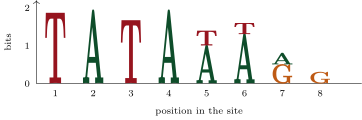
Examples
Example 5.14 (Expected chance matches)
A restriction site of six fixed bases has bits and matches a random position with probability : about times in an E. coli genome of read on both strands (the site is palindromic, so once per position), and times in the human genome. A eukaryotic factor whose motif carries bits matches million positions in the human genome, several thousand times more than the genes it regulates. A motif alone is a weak predictor in a large genome; the chromatin state, the neighbouring motifs and the conservation of the site across species are what make a prediction.