 Coach
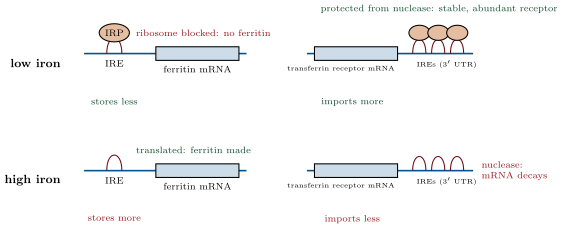
CoachA messenger’s half-life ranges from minutes to days and is set by elements in its 3 untranslated region. AU-rich elements (AUUUA repeats) in the messengers of cytokines, growth factors and proto-oncogenes are bound by proteins that recruit deadenylases and give half-lives of , so that a burst of transcription produces a burst of protein and no more; mutations that remove them cause overexpression and, for some proto-oncogenes, cancer. Localisation elements, often structured, are bound by adaptors that link the messenger to a motor: bicoid and oskar messengers are carried to the two poles of the fly egg by dynein and kinesin on microtubules, -actin messenger to the leading edge of a fibroblast, and the messengers of synaptic proteins into dendrites, where they are translated on demand. The iron-responsive element (IRE), a stem–loop bound by the iron-regulatory proteins IRP1 and IRP2 when iron is scarce, does two opposite jobs from two positions: in the 5 untranslated region of the ferritin messenger, bound IRP blocks the ribosome; in the 3 untranslated region of the transferrin receptor messenger, bound IRP protects the transcript from a nuclease.
Examples
Example 2.12 (Iron, read by one hairpin)
When iron is low, IRP binds both messengers: ferritin, the storage protein, is not translated, and the transferrin receptor, which imports iron, is stabilised and abundant — the cell stores less and imports more. When iron is high it converts IRP1 into an aconitase (it acquires an iron–sulfur cluster and loses its RNA affinity) and triggers the degradation of IRP2: ferritin is translated, the receptor messenger decays within minutes, and the cell stores more and imports less. No change of transcription is needed. A point mutation in the ferritin IRE that prevents IRP binding causes constitutive ferritin synthesis and the hereditary hyperferritinaemia–cataract syndrome.