University Biology — Year 3 · Bachelor Year 3
2Non-coding RNAs and Post-transcriptional Regulation
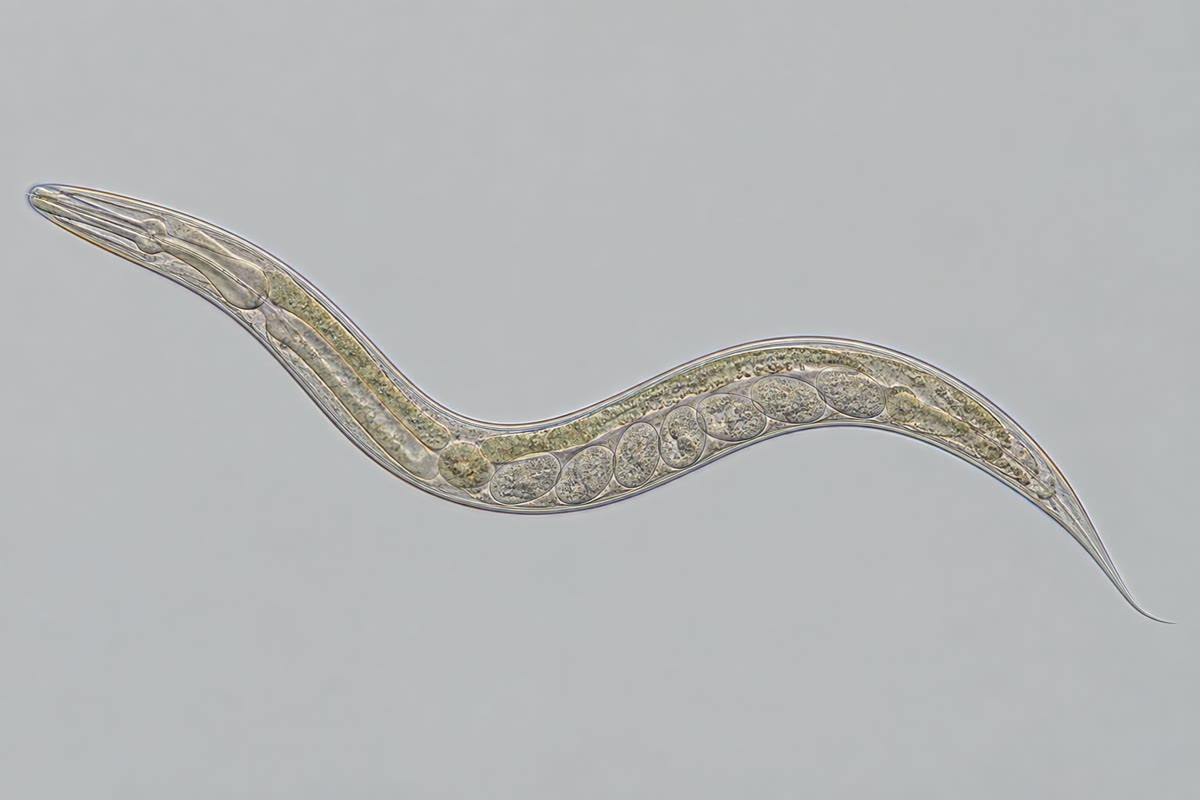
In 1990 two plant biologists tried to make petunias a deeper purple by giving them extra copies of the gene for the pigment enzyme. Nearly half of the transgenic plants came out white, or purple with white sectors: the added gene had switched off the plant’s own copy as well as itself. Eight years later, two worm geneticists injecting RNA into Caenorhabditis elegans found that a double-stranded RNA matching a muscle gene silenced that gene, in the injected worm and in its progeny, far more potently than either strand alone. The two puzzles had one answer: cells possess a machinery that uses short RNAs to find and silence RNAs of matching sequence. That machinery, and the wider world of regulation that happens to a messenger RNA after it has been transcribed — how it is spliced, where it is sent, how long it lives, whether it is translated — is the subject of this chapter. The Year 1 volume treated the gene as a unit that is on or off at its promoter; here the transcript itself becomes the object of control.
2.1 The RNA census of a cell
Definition 2.1 (Non-coding RNA)
A non-coding RNA (ncRNA) is a transcript that functions as RNA rather than as a template for protein. Beyond the ribosomal and transfer RNAs of translation and the small nuclear RNAs (snRNAs) of the spliceosome, a eukaryotic cell contains: microRNAs (miRNAs), nucleotides, cut from hairpins in the cell’s own transcripts and guiding the repression of partly complementary messengers; small interfering RNAs (siRNAs), the same length, cut from long double-stranded RNA and guiding the cleavage of perfectly matching targets; Piwi-interacting RNAs (piRNAs), nucleotides, active in the germ line against transposons; small nucleolar RNAs that guide the modification of rRNA; and long non-coding RNAs (lncRNAs), transcripts longer than with no open reading frame of consequence, of which Xist of Chapter 1 is the best understood. Protein-coding exons are about of the human genome; a large fraction of the rest is transcribed at some time in some cell, but how much of that transcription is functional is an open question.
Remark 2.2 (Abundance is not function)
A transcript can be detected because polymerase is leaky, not because the RNA does something; most lncRNAs are present at fewer than one copy per cell, poorly conserved, and dispensable when deleted. The test of function is genetic: a phenotype when the RNA, and not merely its DNA, is removed. Xist, the miRNAs and the piRNAs pass it decisively; of the tens of thousands of annotated lncRNAs, a few hundred have so far.
2.2 RNA interference and the microRNAs
Definition 2.3 (RNA interference)
RNA interference (RNAi) is the sequence-specific silencing of a gene by a small RNA derived from double-stranded RNA. The enzyme Dicer, an RNase III, cuts long double-stranded RNA into -nucleotide duplexes with two-nucleotide 3 overhangs; one strand of each duplex, the guide, is loaded into an Argonaute protein to form the RNA-induced silencing complex (RISC). The guide pairs with a complementary target RNA, and Argonaute’s endonuclease domain cuts the target opposite nucleotides 10 and 11 of the guide; the cut RNA is then degraded and the RISC is released to find another. In plants, worms and fungi an RNA-dependent RNA polymerase copies the target into new double-stranded RNA, so the signal is amplified and spreads; mammals lack this step.
Evidence. Napoli, Lemieux and Jorgensen (1990) introduced an extra chalcone synthase gene into petunia to intensify the flower colour; of the transformants were white or variegated, with both the transgene and the endogenous gene silenced — “cosuppression”. Guo and Kemphues (1995) found that antisense RNA against a C. elegans gene silenced it, but so did the sense control. Fire, Mello and colleagues (1998) resolved the paradox: their preparations of single strands were contaminated with double strands, and purified double-stranded RNA of unc-22 injected into a worm gave the twitching unc-22 phenotype at concentrations of a few molecules per cell, whereas pure sense or antisense RNA gave almost nothing; the silencing crossed into tissues far from the injection site and into the progeny. Hamilton and Baulcombe (1999) detected the RNAs in silenced plants, and Zamore and colleagues (2000) showed in a fly extract that the double-stranded RNA is cut into them and that the target is cleaved at intervals. ∎

Definition 2.4 (MicroRNAs)
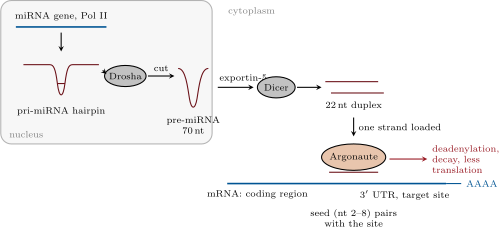
A microRNA is encoded in the genome — in its own gene or in an intron of a protein-coding gene — and transcribed by RNA polymerase II as a long primary transcript (pri-miRNA) containing a hairpin of about . In the nucleus the RNase III Drosha, with its partner DGCR8, cuts the hairpin out (the pre-miRNA); exportin-5 carries it to the cytoplasm, where Dicer removes the loop, leaving a duplex. One strand is loaded into Argonaute. The mature miRNA recognises its targets chiefly through its seed, nucleotides 2 to 8, pairing with sites usually in the 3 untranslated region of a messenger; the rest of the miRNA pairs imperfectly, so the target is not cleaved but repressed: the RISC recruits proteins that shorten the poly(A) tail, remove the cap and inhibit translation, and the messenger is degraded faster. Because a seed is only seven nucleotides, one miRNA has hundreds of targets, and more than half of human protein-coding genes carry conserved sites for at least one of the several hundred confidently identified human miRNAs.
Evidence. lin-4, a gene needed for the worm to progress from its first larval stage to the second, was found by Lee, Feinbaum and Ambros (1993) to encode not a protein but a RNA, complementary to seven sites in the 3 untranslated region of the messenger of lin-14, the gene it was known to repress. As the larva enters the second stage the LIN-14 protein disappears while its mRNA remains: repression is post-transcriptional. Reinhart and colleagues (2000) found a second such RNA, let-7, controlling the later larval transitions; Pasquinelli (2000) found let-7 in flies and humans, with the same sequence, which made a worm curiosity a general mechanism. ∎
Theorem 2.5 (What a microRNA does to a messenger’s level and speed)
A messenger is synthesised at a constant rate and degraded with first-order rate ; a microRNA present at level adds a decay term . Then the mRNA level obeys
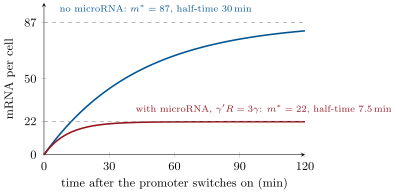
The microRNA lowers the steady state by the factor and shortens the time constant of every change in from to by the same factor. A microRNA-regulated gene is therefore both quieter and faster: it reaches a new steady state sooner after its promoter changes, and fluctuations in its transcription are damped.
Proof. The equation is linear with constant coefficients; its fixed point is where the right-hand side vanishes, and writing gives , whence the exponential. The half-time of the approach is , and where is the messenger’s natural half-life. ∎
Example 2.6 (A four-fold repression)
A messenger with a natural half-life of (), transcribed at molecules per minute, sits at copies per cell and takes to move half-way to a new level after its promoter changes. A microRNA that triples its decay rate () brings it to copies and cuts the half-time to . The same numbers, read backwards, show why miRNA knockouts often have mild phenotypes: a four-fold change in a messenger that is itself buffered downstream can leave the organism nearly normal, and the effect shows under stress or in timing.
Method 2.7 (Knocking a gene down with RNAi)
To silence a gene without touching its DNA: (1) choose a sequence unique to its messenger, avoiding seed matches to other genes; (2) deliver it as a synthetic siRNA duplex (transient, a few days) or as a short hairpin RNA (shRNA) expressed from a vector, which Dicer processes continuously; in worms, feed the animals bacteria expressing the double-stranded RNA; (3) measure the messenger by quantitative PCR and the protein by immunoblot, expecting loss rather than the complete absence of a knockout; (4) control for off-target effects with a second, non-overlapping siRNA and a rescue by an RNAi-resistant version of the gene. A knockdown is a partial, reversible loss of function; the gene therapies now approved on this principle deliver siRNAs against liver messengers (transthyretin, PCSK9) coupled to a sugar that the hepatocyte takes up.
2.3 Small RNAs that guard the genome
Definition 2.8 (piRNAs and transposon silencing)
piRNAs are -nucleotide RNAs, made without Dicer from long single-stranded transcripts of genomic piRNA clusters — graveyards of defective transposon copies — and loaded into the PIWI subfamily of Argonaute proteins in the germ line. A piRNA antisense to a transposon guides cleavage of the transposon’s transcripts; the cleaved fragment becomes a new sense piRNA, which in turn cuts cluster transcripts to make more antisense piRNAs — the ping-pong cycle, an amplification that targets whatever transposon is currently active. Nuclear PIWI proteins also direct H3K9 methylation and DNA methylation onto the transposon’s genomic copies, connecting the RNA to the chromatin marks of Chapter 1. A mother deposits her piRNAs in the egg; a female whose lineage has never met a transposon has no piRNAs against it, and her offspring by a male carrying it are sterile — hybrid dysgenesis, first seen in Drosophila crosses between laboratory and wild strains.
Proposition 2.9 (RNA-directed chromatin silencing)
In plants, a dedicated pathway — RNA polymerase IV transcribes a locus, an RNA-dependent RNA polymerase makes it double-stranded, a Dicer cuts siRNAs, Argonaute 4 carries them back to the nascent transcripts of polymerase V at the same locus and recruits the methyltransferase DRM2 — methylates the DNA of transposons and repeated sequences; it is the mechanism of paramutation. In fission yeast, siRNAs from the centromeric repeats recruit the H3K9 methyltransferase and build the heterochromatin the centromere needs. In both cases an RNA finds a place in the genome by complementarity and a chromatin mark is written there: sequence-specific, self-reinforcing, and heritable through divisions.
2.4 The life of a messenger
Definition 2.10 (Regulated splicing)
Alternative splicing produces different messengers from one gene by exon skipping, the choice between mutually exclusive exons, the retention of an intron, or the use of alternative 5 or 3 splice sites. It is regulated by RNA-binding proteins that bind sequence elements in the exons and introns near a splice site: SR proteins bound to exonic enhancers recruit the spliceosome and promote inclusion of the exon, hnRNP proteins bound to silencers block it, and the outcome in a given cell is set by the relative amounts of the two kinds. More than of human multi-exon genes are alternatively spliced; the Dscam gene of Drosophila, with four blocks of mutually exclusive exons (12, 48, 33 and 2 alternatives), can produce distinct proteins, each neuron expressing a different set that lets its branches recognise and avoid one another.
Evidence. The sex of a fruit fly is decided by a splicing cascade. In females the Sex-lethal (Sxl) gene makes a functional protein; SXL is an RNA-binding protein that blocks a splice site in its own transcript (so that a stop-codon exon is skipped and the protein keeps being made) and in the transcript of transformer, forcing the female splice; TRA, with TRA-2, then binds an exonic enhancer in the doublesex transcript and directs the female form of the DSX transcription factor. In males, with no SXL, every one of these transcripts takes the default splice, transformer contains a stop codon, and DSX comes out in the male form. Every sexually dimorphic feature of the fly follows from which DSX is made; a female in which tra is mutated develops as a male. ∎
Definition 2.11 (mRNA stability and localisation)
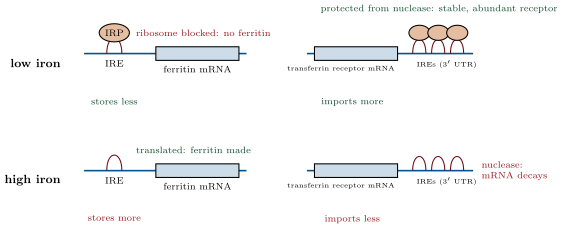
A messenger’s half-life ranges from minutes to days and is set by elements in its 3 untranslated region. AU-rich elements (AUUUA repeats) in the messengers of cytokines, growth factors and proto-oncogenes are bound by proteins that recruit deadenylases and give half-lives of , so that a burst of transcription produces a burst of protein and no more; mutations that remove them cause overexpression and, for some proto-oncogenes, cancer. Localisation elements, often structured, are bound by adaptors that link the messenger to a motor: bicoid and oskar messengers are carried to the two poles of the fly egg by dynein and kinesin on microtubules, -actin messenger to the leading edge of a fibroblast, and the messengers of synaptic proteins into dendrites, where they are translated on demand. The iron-responsive element (IRE), a stem–loop bound by the iron-regulatory proteins IRP1 and IRP2 when iron is scarce, does two opposite jobs from two positions: in the 5 untranslated region of the ferritin messenger, bound IRP blocks the ribosome; in the 3 untranslated region of the transferrin receptor messenger, bound IRP protects the transcript from a nuclease.
Example 2.12 (Iron, read by one hairpin)
When iron is low, IRP binds both messengers: ferritin, the storage protein, is not translated, and the transferrin receptor, which imports iron, is stabilised and abundant — the cell stores less and imports more. When iron is high it converts IRP1 into an aconitase (it acquires an iron–sulfur cluster and loses its RNA affinity) and triggers the degradation of IRP2: ferritin is translated, the receptor messenger decays within minutes, and the cell stores more and imports less. No change of transcription is needed. A point mutation in the ferritin IRE that prevents IRP binding causes constitutive ferritin synthesis and the hereditary hyperferritinaemia–cataract syndrome.
Proposition 2.13 (Translational control)
The initiation step is the usual point of control of translation. Phosphorylation of the initiation factor eIF2 by kinases sensing amino-acid starvation, unfolded proteins, viral double-stranded RNA or haem deficiency shuts down general initiation within minutes, sparing a few messengers with special features — notably those with upstream open reading frames, short reading frames in the 5 untranslated region which normally trap ribosomes and which, under stress, are bypassed so that the stress-response factors (GCN4 in yeast, ATF4 in mammals) are made precisely when everything else is not. The cap-binding factor eIF4E is held inactive by 4E-binding proteins until the growth-signalling kinase mTOR phosphorylates them: a cell translates at full rate only when nutrients and growth factors say so. In bacteria, riboswitches do it without any protein: a structured 5 region binds a metabolite (thiamine pyrophosphate, S-adenosyl methionine, a purine) and, on binding, refolds to bury the ribosome-binding site or to form a transcription terminator, so that a biosynthetic operon shuts off when its product is abundant.
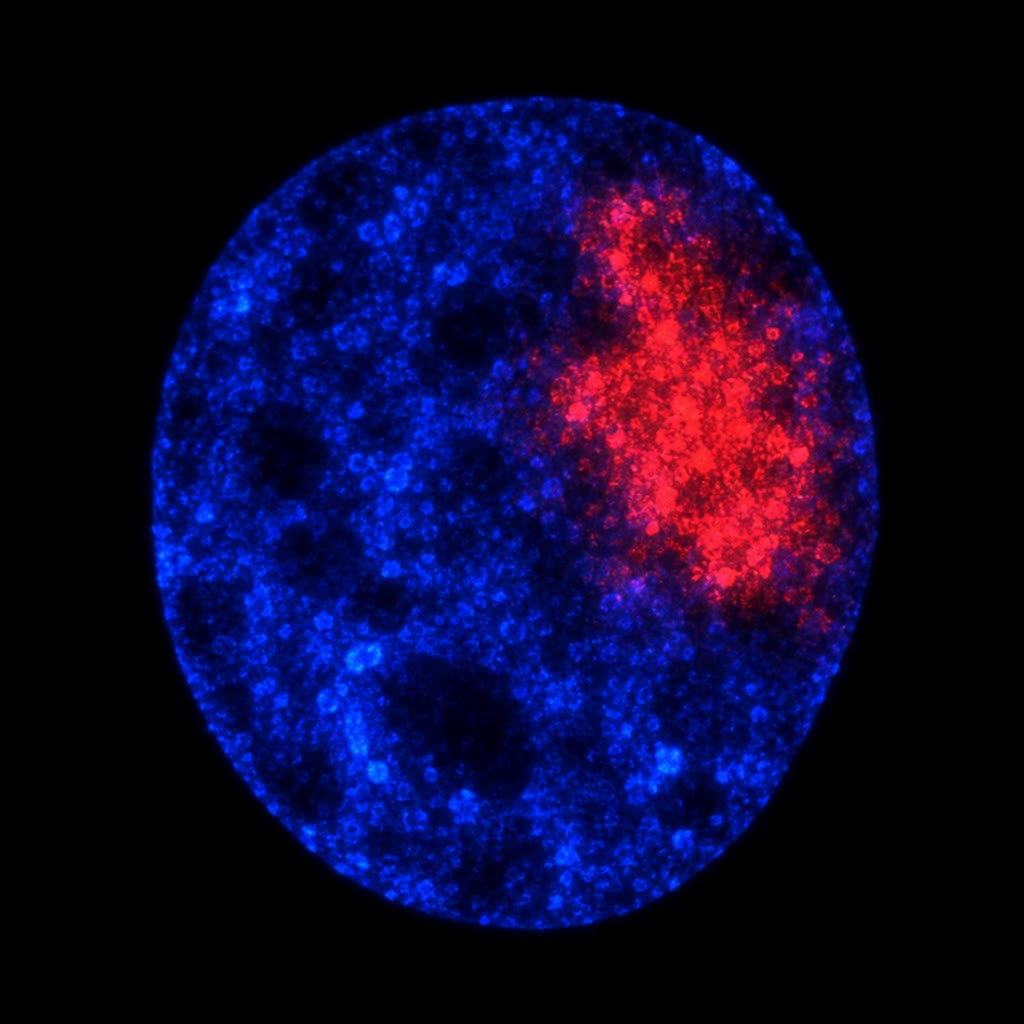
Remark 2.14 (What post-transcriptional control buys)
Transcriptional control acts through the nucleus, with a delay of minutes to hours before a new messenger is made, exported and translated. Control of the messenger itself acts where the protein is needed, in seconds to minutes, and can be local: a single dendrite translating one messenger at one synapse, a fibroblast’s leading edge making actin where it crawls. It also makes one gene into many proteins, and lets one signal — iron, an amino acid, a microRNA — coordinate hundreds of messengers at once without touching a single promoter.
2.5 Exercises
Exercise 2.1 ★
Distinguish miRNA, siRNA and piRNA by origin, length, Dicer dependence, and what they do to their targets.
Solution
Solution of Exercise 2.1.
miRNA: encoded in the genome as a hairpin, , cut by Drosha then Dicer, pairs imperfectly through its seed and represses translation and stability of many messengers. siRNA: from long double-stranded RNA (viral, transgene, experimental), , Dicer-dependent, pairs perfectly and directs Argonaute to cleave the target. piRNA: from single-stranded transcripts of piRNA clusters, , Dicer-independent, loaded on PIWI proteins in the germ line, cleaves transposon transcripts (ping-pong) and directs chromatin silencing of transposon DNA.
Exercise 2.2 ★
Trace the biogenesis of a microRNA from its gene to a repressed messenger, naming the enzyme at each cut.
Solution
Solution of Exercise 2.2.
Pol II transcribes the pri-miRNA; Drosha (with DGCR8) cuts the hairpin out in the nucleus; exportin-5 exports the pre-miRNA; Dicer cuts off the loop, leaving a duplex; one strand is loaded into Argonaute; the seed (nucleotides 2–8) pairs with a 3 UTR site; Argonaute recruits the deadenylase and decapping machinery and blocks initiation — the messenger is translated less and decays faster.
Exercise 2.3 ★
Why did injecting sense RNA of unc-22 into worms silence the gene in the early experiments, and what did Fire and Mello change?
Solution
Solution of Exercise 2.3.
RNA made in vitro by a phage polymerase contained double-stranded contaminants (the polymerase also copies the template’s other strand and runs off ends), so “sense” preparations carried the real trigger. Fire and Mello purified each strand, showed that either alone did little, then annealed them deliberately: the double-stranded RNA was at least a hundred times more potent, a few molecules per cell sufficing.
Exercise 2.4 ★
What happens to ferritin and to the transferrin receptor when a cell is starved of iron? Which step of expression is controlled in each case?
Solution
Solution of Exercise 2.4.
Iron-starved: IRP binds the IREs. Ferritin: translation initiation is blocked, no storage protein is made (control of translation). Transferrin receptor: the messenger is protected from its nuclease and accumulates, so more receptor is made and more iron imported (control of messenger stability).
Exercise 2.5 ★★
A messenger has a half-life of and is made at molecules per minute. Compute its steady-state level, then the level and half-time when a microRNA doubles its decay rate.
Solution
Solution of Exercise 2.5.
; molecules. Decay doubled: , half-time .
Exercise 2.6 ★★
A seed of seven nucleotides matches a random sequence with probability . In a set of messengers with 3 untranslated regions averaging , how many sites does one microRNA seed match by chance? What, then, distinguishes a real target?
Solution
Solution of Exercise 2.6.
Total 3 UTR sequence nt; chance matches sites. A real target is distinguished by conservation of the site across species, favourable context (an AU-rich neighbourhood, a site away from the stop codon, extra pairing at the 3 end of the miRNA), the co-expression of miRNA and target in the same cell, and experiment: the messenger falls when the miRNA is present and no longer does when the site is mutated.
Exercise 2.7 ★★
Predict the sex of a fly (a) with a tra loss-of-function mutation and two X chromosomes; (b) expressing TRA from a constitutive transgene, with one X; (c) lacking dsx altogether.
Solution
Solution of Exercise 2.7.
(a) XX, tra null: SXL is made but TRA is not, dsx takes the default male splice — a somatic male (sterile). (b) XY with constitutive TRA: TRA-2 is present in both sexes, so DSX is made in the female form — female somatic development (a sterile “pseudo-female”, the germ line following other cues). (c) No dsx: neither DSX form, so neither programme of terminal differentiation is imposed — an intersex with mixed or incomplete characters.
Exercise 2.8 ★★
A proto-oncogene messenger normally has a half-life of owing to an AU-rich element. A chromosomal translocation removes the element and the half-life becomes . By what factor does the protein level rise, if translation and protein degradation are unchanged? Why is this oncogenic although the protein is normal?
Solution
Solution of Exercise 2.8.
At steady state the messenger, and hence the protein, is proportional to the messenger half-life: -fold more protein. The protein is a normal growth signal that is meant to be transient, a pulse after each stimulus; made twelve-fold and continuously, it drives proliferation without a stimulus. Dose and timing, not sequence, make it oncogenic.
Exercise 2.9 ★★
A laboratory strain of Drosophila lacks P elements; a wild strain carries them. Predict the fertility of the offspring of (a) laboratory females wild males, (b) wild females laboratory males, and explain the asymmetry with piRNAs.
Solution
Solution of Exercise 2.9.
(a) Laboratory mother, wild father: the eggs carry no piRNAs against P elements (the mother’s lineage never met them), the paternal P elements transpose freely in the germ line of the offspring — sterile (dysgenic). (b) Wild mother: her eggs contain P-element piRNAs, which silence the elements in the offspring — fertile. The asymmetry is maternal deposition of piRNAs, an inheritance of RNA, not of genes.
Exercise 2.10 ★★★
Using Theorem 2.5, argue that the protein made from a messenger fluctuates less, in relative terms, when the messenger is under microRNA control, at equal mean messenger level. (The protein averages the messenger over its own lifetime, and the messenger renews itself faster.) Why might a cell pay for a microRNA and a higher transcription rate to get the same mean?
Solution
Solution of Exercise 2.10.
The protein integrates its messenger over its own lifetime . Messengers live ; during the protein therefore sees about independent messenger lifetimes, each a random birth–death event. The relative fluctuation of an average over independent events falls as , so the shorter under microRNA control — at the same mean messenger, which requires a proportionally higher — gives a smoother protein. The cell pays for the microRNA and the extra transcription to buy precision and speed: a level set by a balance of fast synthesis and fast decay is both less noisy and quicker to readjust than the same level set by slow synthesis and slow decay.
Exercise 2.11 ★★★
In worms, an RNA-dependent RNA polymerase makes secondary siRNAs from the target messenger; in mammals there is none. Predict, for each, whether silencing by a single injection of double-stranded RNA lasts through many cell divisions and whether it spreads to other tissues, and explain the medical consequence for siRNA drugs.
Solution
Solution of Exercise 2.11.
Worm: the RNA-dependent RNA polymerase makes new siRNAs from the target messenger itself, so the signal is renewed as long as the target is transcribed, survives dilution through divisions and, with a double-stranded-RNA channel between cells, spreads to other tissues and into the germ line for a few generations. Mammal: no amplification, so the siRNAs are consumed and diluted at each division, act only in the cells that received them, and fade within days in dividing cells. Consequence: an siRNA drug must be delivered into every target cell, works best in cells that do not divide (hepatocytes, hence the liver drugs), and needs repeated dosing.
Exercise 2.12 ★★★
A newly annotated lncRNA is expressed in the heart. Design the experiments that would distinguish (a) a functional RNA, (b) a functional act of transcription whose RNA is irrelevant, and (c) noise, and say what result each predicts.
Solution
Solution of Exercise 2.12.
(a) Functional RNA: destroying the transcript after it is made (siRNA, antisense oligonucleotide) gives a phenotype, and expressing the RNA from a transgene elsewhere in the genome rescues it. (b) Functional transcription: inserting an early polyadenylation signal that stops transcription (or deleting the promoter) gives the phenotype, while destroying the RNA post-transcriptionally does not, and an ectopic transgene does not rescue — the act of transcription (or the DNA element) matters, as for many enhancer-associated RNAs. (c) Noise: neither manipulation changes anything, the RNA is at less than a copy per cell, its sequence and expression are not conserved.
2.6 Problem: A Worm’s Timer
Problem 2.1
Weekend problem — the lin-4/lin-14 switch of the worm timed with the messenger kinetics, an injected RNA diluted through the divisions of an embryo and rescued by amplification, the iron regulon quantified, and a splicing count, ending on the repression fold, the half-time of the switch and the number of divisions an unamplified signal survives
Data: the lin-14 messenger is made at molecules per minute per cell and has a half-life of . LIN-14 protein is made at per messenger per minute and has a half-life of . From the start of the second larval stage, lin-4 RNA accumulates and adds a decay term to the messenger and, by blocking initiation, halves . A worm embryo develops from one cell to about cells at hatching; an adult has somatic cells.
Part I — The messenger.
- Compute and the steady-state lin-14 messenger level before lin-4 appears.
- Compute the protein degradation rate and the steady-state LIN-14 protein level.
- Once lin-4 is present, compute the new messenger level and the new time constant of the messenger.
- Compute the new protein steady state, and the overall repression fold on the protein.
- How long after lin-4 appears does the messenger reach half-way to its new level? And the protein — which step limits the speed of the switch?
- The original experiments found the protein gone while the mRNA was still detectable. Is this consistent with your numbers? What fraction of the messenger remains?
Part II — Dilution and amplification.
- A worm’s gonad is injected with molecules of double-stranded RNA, which are shared equally among eggs. How many molecules per egg?
- If the molecules were simply shared out at each division, how many would each cell of the -cell hatchling hold? After how many further divisions would the average fall below one per cell?
- Fire and Mello saw silencing in the whole animal and in its progeny, at a few molecules per cell. Explain what an RNA-dependent RNA polymerase adds to the account, and why the effect nevertheless fades after a few generations.
- In a mammalian cell with no such polymerase, an siRNA transfection puts duplexes into a cell that divides daily; the RISC is stable but is diluted by division. After how many days does the count fall below , roughly the number needed for effective silencing?
- A therapeutic siRNA against a liver messenger is given once and works for six months. Hepatocytes rarely divide. Explain why the mechanism of question 10 does not limit it, and what does.
- A seed of seven nucleotides matches at random once every nucleotides. The worm transcriptome has about of 3 untranslated sequence. How many chance seed matches does lin-4 have, and how did the geneticists know which target mattered?
Part III — The iron regulon.
- In iron-rich cells the transferrin receptor messenger has a half-life of ; with IRP bound, . With transcription unchanged, by what factor does the messenger rise when iron becomes scarce?
- Ferritin messenger is unchanged in level but its translation falls from to proteins per messenger per minute when IRP binds. By what factor does ferritin synthesis fall?
- Combine the two: by what factor does the ratio of import capacity to storage capacity change between iron-rich and iron-poor states?
- The IRP1 protein is either an RNA-binding protein or an aconitase, depending on whether it holds an iron–sulfur cluster. Explain why this makes it a sensor of iron itself and not of a hormone.
- A patient carries a ferritin IRE mutation that abolishes IRP binding. Predict the ferritin level, the serum iron, and why the eye lens is affected.
- Explain in one sentence why the same hairpin can activate in one position and repress in another.
- IRP2 has no iron–sulfur cluster; when iron is high it is destroyed by a ubiquitin ligase whose own stability requires iron and oxygen. Why might a cell keep two sensors of such different chemistry?
Part IV — Counting isoforms.
- Dscam has exon blocks with 12, 48, 33 and 2 mutually exclusive alternatives. How many isoforms? If each neuron expresses about at random, what is the probability that two given neurons share at least one? (Use .)
- Why does a neuron benefit from having isoforms that its neighbours almost certainly lack?
- A gene with cassette exons, each independently included or skipped, gives how many messengers? How many for ? Why is the real number in a given cell type usually far smaller?
- In the fly, why does a female with two X chromosomes but a null Sxl allele die rather than simply develop as a male? (Consider what else the X-counting system controls: dosage compensation of X-linked genes.)
- SXL promotes the productive splicing of its own transcript. Explain why this makes the sex decision a memory that persists after the X-counting signal, present only in the early embryo, has gone, and relate it to the self-sustaining switches of Chapter 1.
- Summarise the timer: the repression fold on LIN-14 protein (question 4), the half-time of the messenger switch (question 5) and the number of divisions an unamplified signal survives before falling below one molecule per cell (question 8).
Solution
Solution of Problem 2.1.
1. ; messengers. 2. ; proteins. 3. Decay ; ; time constant . 4. : ; repression -fold ( from decay, from translation). 5. Messenger half-time . The protein then decays with its own half-life, : the protein’s degradation limits the switch. 6. Yes: the messenger falls only to (still easily detected) while the protein falls to and keeps falling as the old protein turns over; the early observation that the protein vanished “while the mRNA remained” reflected mostly the translational half of the repression. 7. molecules per egg. 8. per cell at hatching. for divisions from the zygote — about three divisions after hatching. 9. The polymerase copies the target messenger into new double-stranded RNA, cut into secondary siRNAs: the trigger is regenerated from the target itself, so it survives dilution and spreads (a channel passes double-stranded RNA between cells and into the germ line). It fades because amplification needs both the target and a primary trigger; once the injected RNA is gone the secondary pool is diluted generation by generation and the germline resets. 10. : , days ( copies left). 11. Non-dividing cells do not dilute the RISC; the limit is the chemical lifetime of the siRNA (nuclease degradation, slowed by chemical modification of the strands) and the slow leakage of the endosomal depot that feeds the cytoplasm. 12. chance matches. Genetics decided: lin-14 loss gives the opposite phenotype to lin-4 loss, lin-14 gain-of-function alleles were deletions of exactly the 3 UTR sites, and the seven sites were conserved. 13. Level half-life: -fold rise. 14. -fold fall in ferritin synthesis. 15. Import/storage rises -fold from iron-rich to iron-poor. 16. The cluster assembles only when cytosolic iron is available, so the protein’s conformation is a direct readout of the iron concentration, without receptor, hormone or transcription — like a riboswitch, a metabolite sensed by the molecule it controls. 17. Ferritin is translated regardless of iron: serum ferritin very high, serum iron and stores normal (no overload). In the lens, which has no turnover, ferritin accumulates for years and crystallises — an early cataract. 18. The hairpin is only a landing site; the effect is whatever the bound protein physically obstructs — scanning ribosomes at the 5 end, a nuclease at the 3 end. 19. Two chemistries cover two conditions: the iron–sulfur cluster of IRP1 is also destroyed by oxidants and low oxygen, so IRP1 responds to the redox state, while the iron-dependent degradation of IRP2 responds to iron itself across the physiological oxygen range; redundancy makes the regulon robust, and the two report different things. 20. . : about . 21. Identical isoforms bind homophilically and repel: the branches of one neuron avoid each other and spread out, while branches of different neurons, sharing almost no isoform, may cross — a private identity per cell. 22. ; for . Fewer in reality: inclusion is decided by cell-type-specific factors and coordinated across exons, many combinations shift the reading frame and are destroyed by nonsense-mediated decay, and the exons are not independent. 23. Sxl also controls dosage compensation: in females SXL blocks the translation of msl-2, so the two X chromosomes are not hypertranscribed; without SXL an XX embryo assembles the MSL complex on both X chromosomes and doubles their output — a lethal overdose of every X-linked gene, before sex is even at issue. 24. The early promoter fires only while the X:A signal is present; the SXL it makes forces productive splicing of the transcript from the maintenance promoter, which is active in both sexes, so once SXL exists it keeps making itself and the signal is no longer needed — the same reader-recruits-writer, self-sustaining logic as the chromatin marks, here with a protein and a splice. 25. LIN-14 protein repressed -fold; messenger switch half-time ; an unamplified RNA falls below one molecule per cell after divisions.