
Biology · Glossary

What is Productivity?

Definition 26.6 University Biology — Year 1 · Chapter 26 — Ecosystems and Trophic Structure

The gross primary productivity (GPP) of an ecosystem is the rate at which its producers fix energy by photosynthesis, per unit area and time (kJm2yr1\mathrm{kJ}\,\mathrm{m}^{-2}\,\mathrm{yr}^{-1}, or grams of carbon or dry matter); the net primary productivity (NPP) is what remains after the producers’ own respiration — the organic matter actually made available to the rest of the system. Secondary productivity is the rate at which consumers build their own biomass from what they eat. Biomass is the standing stock, the mass present at a moment; productivity is a flow, biomass a store, and the ratio of the two is the turnover time.
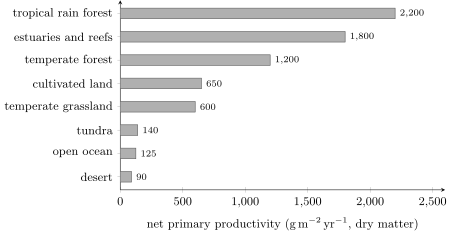

Mean net primary productivity of the main biomes. A twenty-fold range, set by water, warmth, light and nutrients.
Grazers on a savanna: a primary-consumer level of a million animals, following the rains that set the grass’s productivity, and carrying a tenth of its energy to the predators behind them.
Read in context →