Coach
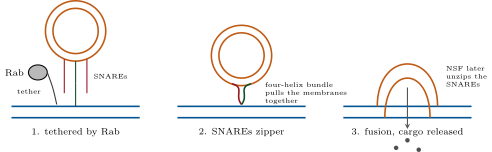
CoachA vesicle finds its target by two layers of recognition. Rab GTPases — some sixty in a human cell, each on the membranes of one compartment — recruit long tethering proteins that catch an incoming vesicle carrying the matching Rab. Then the SNAREs act: a v-SNARE on the vesicle and t-SNAREs on the target, helical proteins anchored in their membranes, wind around each other from their distal ends toward the membranes, and the energy of the four-helix bundle they form pulls the two bilayers together until they fuse. Each SNARE pairing is specific, a second check on the address. After fusion the bundle is pried apart by the ATPase NSF for reuse. Fusion can be made to wait for a signal: in the nerve terminal the SNAREs are held half-zipped by complexin until synaptotagmin, binding calcium that enters when an action potential arrives, completes the zippering in under a millisecond — the release of neurotransmitter treated in the Year 2 volume. The neurotoxins of tetanus and botulism are proteases that cleave SNAREs.