Coach
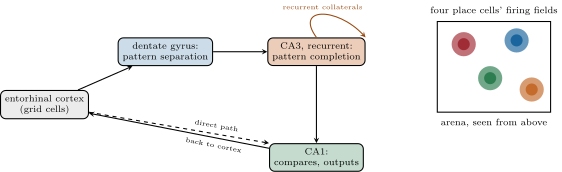
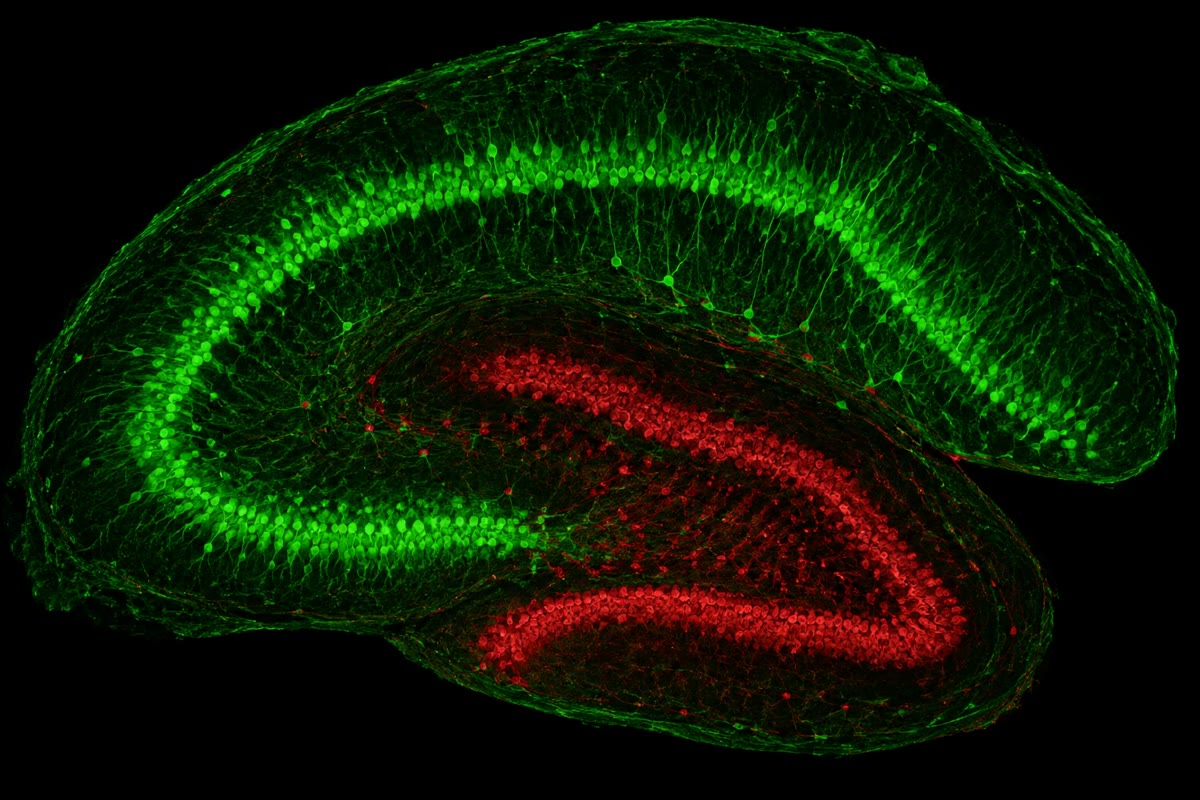
CoachCortical input reaches the hippocampus through the entorhinal cortex and passes through three stages: the dentate gyrus, whose granule cells outnumber their inputs and fire sparsely (separating similar patterns); CA3, whose pyramidal cells connect recurrently to one another, each receiving thousands of synapses from others — an autoassociative network that can complete a stored pattern from a fragment; and CA1, which compares the CA3 output with the direct input and returns the result to the cortex. In a rat exploring an arena, a hippocampal pyramidal cell fires only when the animal is in one place — a place cell (O’Keefe, 1971) — and a few hundred of them map the arena; in the entorhinal cortex upstream, grid cells (Moser, 2005) fire at the vertices of a hexagonal lattice covering the space, a coordinate system from which place fields are built. During sleep and rest the sequences of place cells that fired during a run are replayed at high speed, and blocking the replay impairs the memory of the run: the hippocampus rehearses the day’s paths to the cortex.