Coach
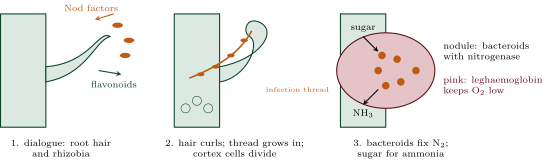
CoachLegumes house nitrogen-fixing bacteria (rhizobia) in root nodules, organs built for the purpose after a molecular dialogue. The root secretes flavonoids; a rhizobium of the matching species answers with Nod factors — lipochitooligosaccharides whose decorations specify the partner; a receptor kinase on the root hair binds them and triggers oscillations of calcium in the nucleus, the curling of the root hair around the bacteria, and an infection thread that grows inward through the cells while the cortex below begins to divide into a nodule. The bacteria are released into the nodule cells inside membranes and differentiate into bacteroids that express nitrogenase, the enzyme that reduces N to ammonia at the cost of sixteen ATP per molecule. Nitrogenase is destroyed by oxygen, yet the bacteroids respire hard; the nodule solves the contradiction with a diffusion barrier and with leghaemoglobin, a plant haemoglobin that binds oxygen tightly and ferries it to the bacteroids at a low free concentration — it is what makes a cut nodule pink. The plant pays six to ten per cent of its photosynthate and receives most of its nitrogen; the fixed nitrogen of the world’s legume crops approaches that of the fertiliser industry.