Biology · Glossary

What is X-chromosome inactivation?

Definition 1.13 University Biology — Year 3 · Chapter 1 — Chromatin and Epigenetics

In female mammals one of the two X chromosomes of every somatic cell is transcriptionally silenced early in development, a form of dosage compensation that equalises X-linked gene expression between XX females and XY males. The silenced chromosome is compacted into a dense body against the nuclear envelope, the Barr body. The choice of which X to silence is random in the embryo proper and, once made, is inherited clonally by all descendants of the cell. Inactivation is initiated by Xist, a 17kb17\,\mathrm{kb} non-coding RNA transcribed from the X-inactivation centre of the chromosome that will be silenced: it coats that chromosome in cis, recruits Polycomb (H3K27me3), the histone variant macroH2A and finally DNA methylation of the promoters, and the silence is thereafter maintained without Xist being needed for each division. About 15%15\,\% of human X-linked genes escape inactivation, in part or wholly.
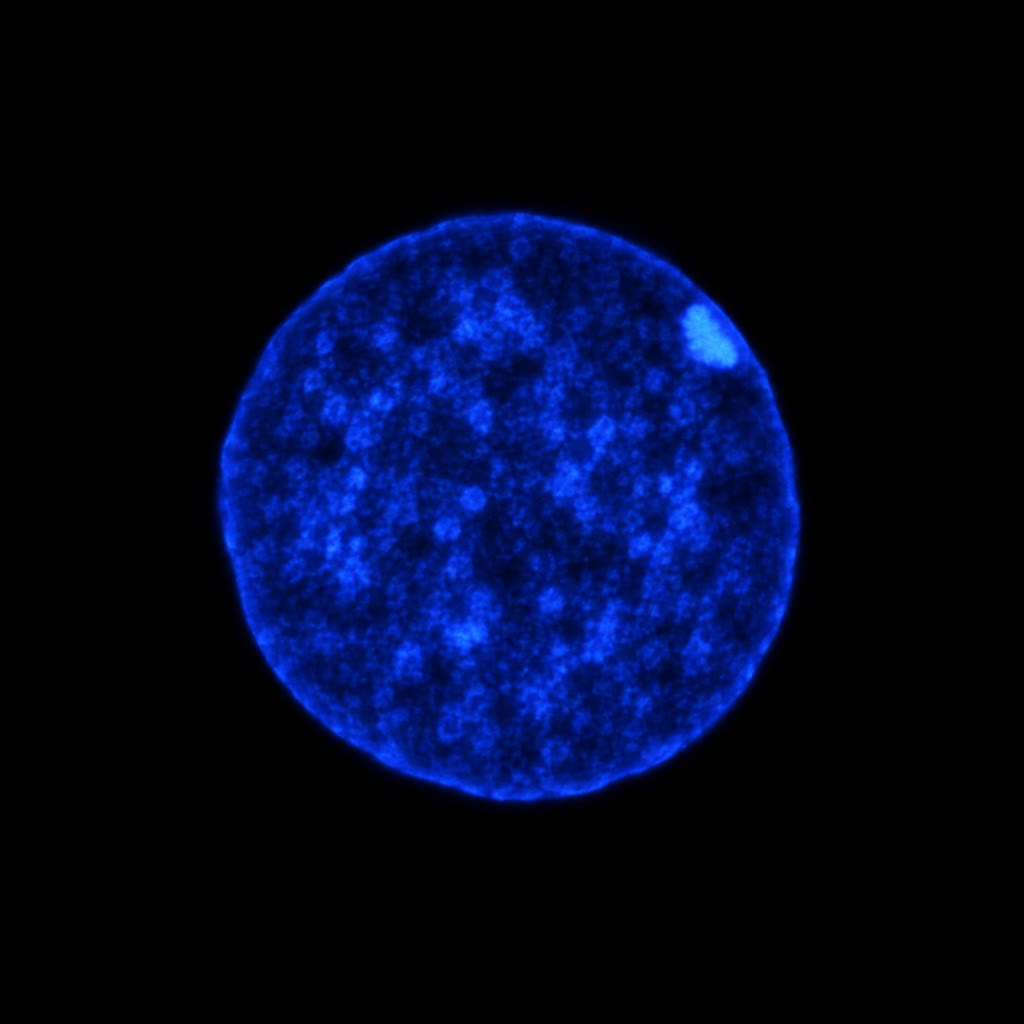
Left: a female nucleus stained for DNA, with the compact inactive X — the Barr body — pressed against the nuclear edge. Right: a calico cat. Each orange or black patch is a clone of skin cells that silenced the same X chromosome; the white is a separate, autosomal, spotting gene. Left: a female nucleus stained for DNA, with the compact inactive X — the Barr body — pressed against the nuclear edge. Right: a calico cat. Each orange or black patch is a clone of skin cells that silenced the same X chromosome; the white is a separate, autosomal, spotting gene.
Left: a female nucleus stained for DNA, with the compact inactive X — the Barr body — pressed against the nuclear edge. Right: a calico cat. Each orange or black patch is a clone of skin cells that silenced the same X chromosome; the white is a separate, autosomal, spotting gene.
Read in context →