All books

Professional

Apps About Coach Log in Start reading

Chemistry · Glossary

What is Close packing, FCC, HCP?

Also known as: close packing · face-centred cubic · hexagonal close-packed · body-centred cubic

Definition 5.9 University Chemistry — Year 1 · Chapter 5 — Crystals I: The Perfect Crystal and Metals

A close packing of identical spheres is built from close-packed layers, in which each sphere touches six others, stacked so that each sphere of a layer sits in a hollow of the layer below. The stacking ABCABC…ABCABC\dots gives the face-centred cubic structure (FCC, or cubic close-packed); the stacking ABAB…ABAB\dots gives the hexagonal close-packed structure (HCP). A third, non-close-packed, structure of metals is the body-centred cubic structure (BCC), a cube with one atom at each corner and one at its centre.
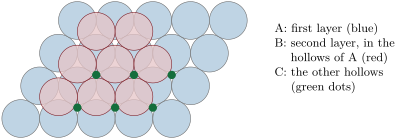
Two close-packed layers seen from above. A third layer can sit above the hollows marked C (stacking ABC, face-centred cubic) or above the atoms of A (stacking AB, hexagonal close-packed).
Two close-packed layers seen from above. A third layer can sit above the hollows marked C (stacking ABCABC, face-centred cubic) or above the atoms of A (stacking ABAB, hexagonal close-packed).
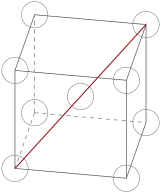
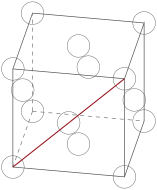
Left: the face-centred cubic cell (corner atoms grey, face-centre atoms blue). The atoms touch along a face diagonal (red line, a√2 = 4R). Right: the body-centred cubic cell; the atoms touch along the main diagonal (red line, a√3 = 4R). Atoms drawn smaller than their contact size, for clarity. Left: the face-centred cubic cell (corner atoms grey, face-centre atoms blue). The atoms touch along a face diagonal (red line, a√2 = 4R). Right: the body-centred cubic cell; the atoms touch along the main diagonal (red line, a√3 = 4R). Atoms drawn smaller than their contact size, for clarity.
Left: the face-centred cubic cell (corner atoms grey, face-centre atoms blue). The atoms touch along a face diagonal (red line, a2=4Ra\sqrt2 = 4R). Right: the body-centred cubic cell; the atoms touch along the main diagonal (red line, a3=4Ra\sqrt3 = 4R). Atoms drawn smaller than their contact size, for clarity.
Read in context →