University Chemistry — Year 1 · Bachelor Year 1
5Crystals I: The Perfect Crystal and Metals
A copper wire can be drawn thinner than a hair without breaking; a lump of salt shatters under a hammer. A blacksmith heats a bar of iron until it glows, hammers it, plunges it into water, and the bar comes out much harder than it went in. The difference between these behaviours lies in the way the atoms are stacked in the solid. Most solids are crystals: their atoms sit on a pattern that repeats itself, identical, billions of times in every direction. This chapter describes such patterns, counts their atoms, measures how tightly they are packed and where the gaps between them lie, and uses the result to understand metals and alloys. The next chapter applies the same tools to ionic, covalent and molecular solids.
You already know
Metals lose their valence electrons easily: they have low ionisation energies and electronegativities (Chapter 2). Atomic radii were defined in Definition 2.6. Density, a property studied in physics, is used as known: .

5.1 The perfect-crystal model
Definition 5.1 (Crystal, amorphous solid, perfect crystal)
A crystal is a solid whose particles (atoms, ions or molecules) are arranged in a pattern that repeats periodically in three dimensions. A solid without such long-range order is an amorphous solid (glass, most plastics). The perfect crystal model describes a crystal as infinite and without defects: no missing or extra atoms, no impurities, no boundaries.
Definition 5.2 (Lattice, motif, unit cell)
A lattice is an infinite set of points, the nodes, obtained from one of them by all the translations with integer , , . The crystal is obtained by placing on every node the same motif (one atom, a group of atoms or ions). A unit cell is a parallelepiped built on , , whose translations fill space; its edge lengths and angles are the lattice parameters , , , , , . In a cubic cell and the angles are .
Remark 5.3 (Real crystals)
Real crystals are finite and imperfect: they contain vacancies, impurities, dislocations and grain boundaries, which govern many properties (the ductility of copper, the hardness of steel). These defects are studied in the Year 3 volume; the perfect crystal gives the geometry, density and compactness, which defects barely change.
Definition 5.4 (Multiplicity of a cell)
The multiplicity of a cell is the number of motifs (or atoms) that belong to it, each atom shared with the neighbouring cells counting for the fraction that lies inside it.
Method 5.5 (Counting the atoms of a cell)
In a cubic cell an atom at a corner is shared by 8 cells and counts ; on an edge it is shared by 4 and counts ; on a face it is shared by 2 and counts ; inside it counts 1. Sum the contributions.
Definition 5.6 (Coordination number)
The coordination number of a particle in a solid is the number of its nearest neighbours, those at the shortest distance.
Definition 5.7 (Compactness)
The compactness (or packing fraction) of a crystal of hard spheres is the fraction of the volume occupied by the spheres: for a cell of volume containing spheres of radius ,
Proposition 5.8 (Density from the cell)
The density of a crystal whose cell, of volume , contains particles of molar mass is
Proof. The cell contains particles, of mass ; the crystal is the cell repeated, so its density is that of one cell. ∎
5.2 Close packings: face-centred cubic and hexagonal
Definition 5.9 (Close packing, FCC, HCP)
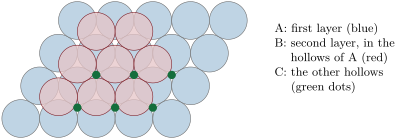
A close packing of identical spheres is built from close-packed layers, in which each sphere touches six others, stacked so that each sphere of a layer sits in a hollow of the layer below. The stacking gives the face-centred cubic structure (FCC, or cubic close-packed); the stacking gives the hexagonal close-packed structure (HCP). A third, non-close-packed, structure of metals is the body-centred cubic structure (BCC), a cube with one atom at each corner and one at its centre.
Proposition 5.10 (Face-centred cubic)
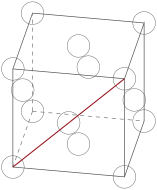
In the FCC structure the atoms occupy the eight corners and the six face centres of a cube of edge . Then , the coordination number is 12, the atoms touch along a face diagonal, , and the compactness is
Proof. . A face-centre atom touches the four corners of its face and the four face centres of each of the two cells sharing the face: neighbours at . On a face diagonal, of length , lie a corner atom, a face-centre atom and a corner atom in contact: . Then . ∎
Proposition 5.11 (Hexagonal close-packed)
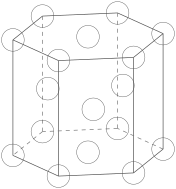
In the HCP structure the conventional hexagonal prism, of base edge and height , contains 6 atoms; the coordination number is 12; for touching spheres , , and the compactness is the same as for FCC, .
Proof. The prism has 12 corner atoms shared by 6 prisms, 2 face-centre atoms shared by 2, and 3 atoms inside: . Each atom touches six neighbours in its layer and three in each adjacent layer: 12. An atom of layer B sits on three touching atoms of layer A, forming a regular tetrahedron of edge , whose height is ; two layers apart, , so . The prism volume is , and . ∎
5.3 Body-centred cubic and the metallic elements
Proposition 5.12 (Body-centred cubic)
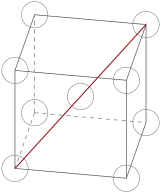
In the BCC structure , the coordination number is 8, the atoms touch along the main diagonal of the cube, , and the compactness is
Proof. . The central atom touches the eight corners: the main diagonal holds a corner, the centre and a corner, . Then . ∎
Proposition 5.13 (Close packing is the densest)
No packing of identical spheres has a compactness larger than , the value of FCC and HCP.
Proof. Admitted at this level. ∎
History — Kepler’s conjecture, 1611–2017
In a short essay on snowflakes, written in 1611, Johannes Kepler stated that no way of stacking cannonballs could be denser than the grocer’s pyramid, the face-centred cubic packing. The statement resisted proof for almost four centuries. Thomas Hales gave a computer-assisted proof in 1998, and a formal proof checked line by line by computer was completed in 2014 and published in 2017.
Example 5.14 (Three metals)
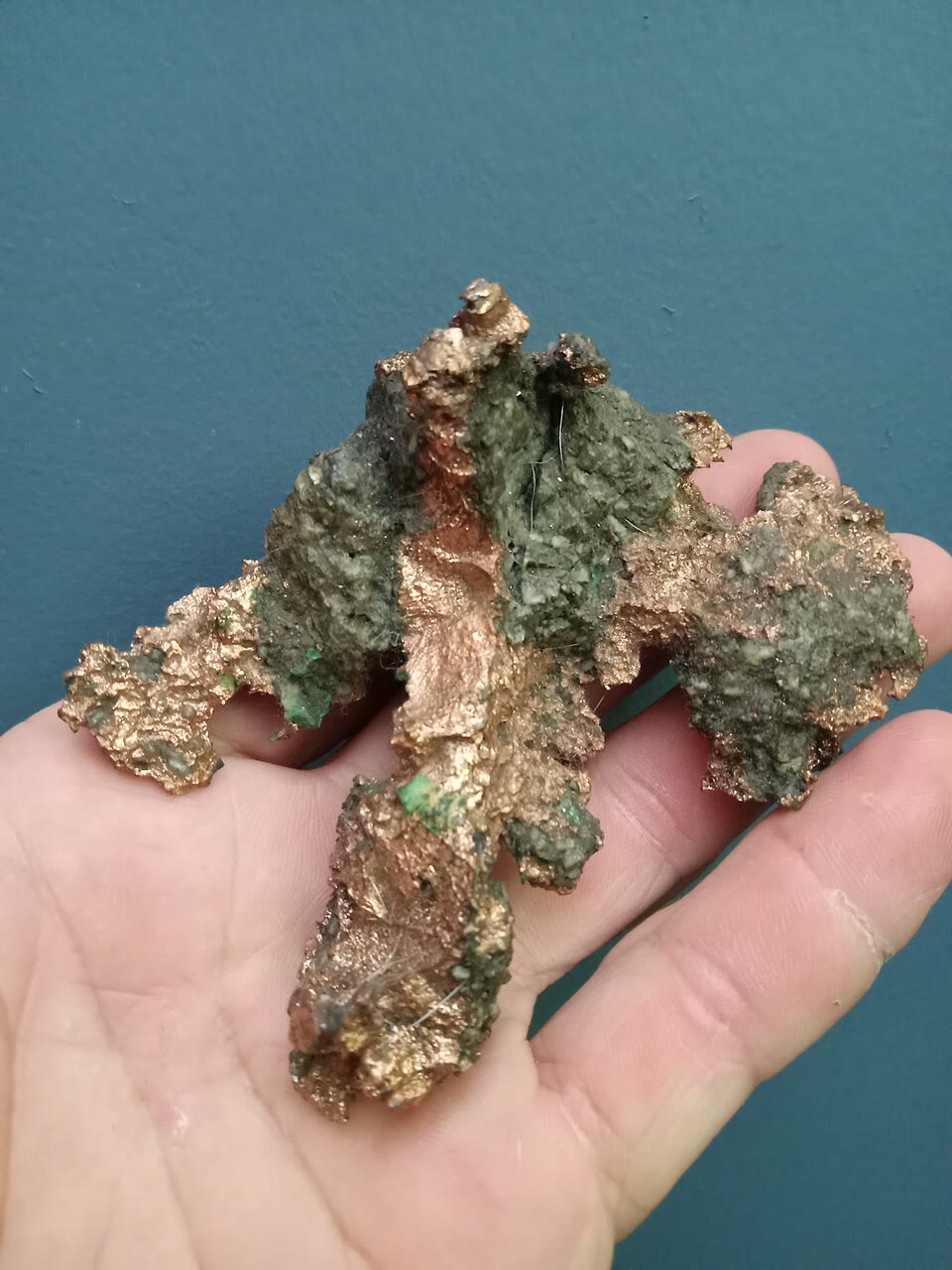
Copper is FCC with : and , the measured density. Iron at room temperature (-iron) is BCC with : , . Magnesium is HCP with and : , close to the ideal ; zinc, with , is an elongated hexagonal packing.
| metal | structure | (pm) | (pm) | computed | measured |
|---|---|---|---|---|---|
| aluminium | FCC | 405.0 | 143.2 | 2.70 | 2.70 |
| copper | FCC | 361.5 | 127.8 | 8.93 | 8.93 |
| silver | FCC | 408.6 | 144.5 | 10.50 | 10.50 |
| sodium | BCC | 429.1 | 185.8 | 0.967 | 0.97 |
| -iron | BCC | 286.7 | 124.1 | 7.87 | 7.87 |
| tungsten | BCC | 316.5 | 137.0 | 19.26 | 19.3 |
5.4 Interstitial sites
Definition 5.15 (Interstitial sites)
An interstitial site is a gap between the atoms of a crystal where a smaller atom can sit. A tetrahedral site lies at the centre of a tetrahedron of four atoms, an octahedral site at the centre of an octahedron of six. The habitability of a site is the radius of the largest sphere that fits in it without pushing the surrounding atoms apart.
Proposition 5.16 (Sites of the FCC structure)
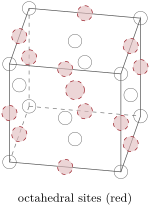
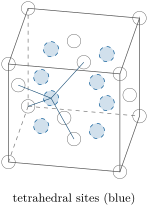
An FCC cell contains 4 octahedral sites, at the centre of the cube and at the middles of its 12 edges, and 8 tetrahedral sites, at the centres of the 8 small cubes of edge . For touching atoms of radius , the habitabilities are
Proof. Octahedral sites: , as many as atoms. The centre of the cube is from the six face centres: with , so . Tetrahedral sites: the centre of a small cube of edge is half its main diagonal, , from the four atoms at alternate corners: . ∎
5.5 Metallic bonding and alloys
Definition 5.17 (Metallic bond)
In the metallic bond, each atom of a metal gives its valence electrons to the whole crystal: the solid is a lattice of cations bathed in electrons that belong to no atom in particular and move freely through it. The bond is the attraction between the cations and this shared electron cloud; it is not directed.
Proposition 5.18 (Properties of metals)
The metallic bond explains the properties of metals: the mobile electrons conduct electricity and heat and reflect light (lustre); because the bond is not directed, layers of atoms can slide over one another without breaking the crystal (ductility, malleability), and close packings, which maximise the number of neighbours, are the most common structures.
Proof. Admitted at this level. ∎
Definition 5.19 (Alloys)
An alloy is a metallic solid made of several elements. In a substitutional alloy the atoms of the added element replace atoms of the host on its lattice; this requires radii within about 15 % of each other (copper and nickel, copper and zinc in brass). In an interstitial alloy small atoms (, , , ) occupy interstitial sites of the host (carbon in steel).
Definition 5.20 (Allotropy)
Different crystal structures of the same element are its allotropes. Iron is BCC (-iron) at room temperature; it has been measured FCC (-iron) from to , and BCC again (-iron) at , up to its melting point. Carbon exists as diamond and as graphite (Chapter 6).
Example 5.21 (Steel)
Carbon, of covalent radius (half the distance in diamond), is too large for the sites of iron without distortion, but much less so in -iron, whose octahedral sites are the largest. Steel is made by dissolving carbon in hot -iron; quenched, the carbon is trapped as the iron returns to a body-centred structure, which it distorts, and the distorted crystal is hard.
Remark 5.22 (The iron transitions)
The temperatures of Definition 5.20 are those of pure iron at atmospheric pressure; dissolved carbon lowers the temperature at which -iron forms, which makes steel workable. Phase diagrams of alloys are studied in the Year 2 volume.
5.6 Exercises
Exercise 5.1 ★
Count the atoms of a simple cubic cell (atoms at the corners only), of a BCC cell and of an FCC cell, and give the coordination number in each.
Solution
Solution of Exercise 5.1.
Simple cubic: atom, coordination 6. BCC: , coordination 8. FCC: , coordination 12.
Exercise 5.2 ★
Show that the compactness of the simple cubic structure (atoms touching along an edge) is , and compare with FCC and BCC.
Solution
Solution of Exercise 5.2.
The atoms touch along an edge: , , , less than BCC (0.68) and FCC (0.74).
Exercise 5.3 ★
Aluminium is FCC with . Compute its atomic radius and its density ().
Solution
Solution of Exercise 5.3.
; .
Exercise 5.4 ★
Sodium is BCC with . Compute its atomic radius and its density (), and compare with the measured .
Solution
Solution of Exercise 5.4.
; , in agreement with the measured .
Exercise 5.5 ★★
Silver is FCC and its density is (). Compute the lattice parameter and the atomic radius.
Solution
Solution of Exercise 5.5.
, so and .
Exercise 5.6 ★★
Show that in an HCP structure of touching spheres . Magnesium has , . Compute and the density of magnesium ().
Solution
Solution of Exercise 5.6.
The proof is that of Proposition 5.11. Magnesium: . The prism of volume holds 6 atoms, so .
Exercise 5.7 ★★
In an FCC cell of edge , give the coordinates of the 4 atoms that belong to the cell, of the 4 octahedral sites and of the 8 tetrahedral sites. How many of each per atom?
Solution
Solution of Exercise 5.7.
Atoms: , , , . Octahedral sites: , , , . Tetrahedral sites: the 8 points whose coordinates are each or . One octahedral and two tetrahedral sites per atom.
Exercise 5.8 ★★
Copper and nickel are both FCC, with and . Compute their atomic radii. They form a substitutional alloy in all proportions: explain. What kind of alloy can hydrogen, a very small atom, form with a metal?
Solution
Solution of Exercise 5.8.
, : radii within 3 % and the same structure, so either atom can take the other’s place on the lattice. Hydrogen, much smaller, can only sit in interstitial sites: it forms an interstitial alloy.
Exercise 5.9 ★★
Tungsten is BCC with . Compute its radius, its density () and the number of atoms in .
Solution
Solution of Exercise 5.9.
; ; atoms per : .
Exercise 5.10 ★★★
In the BCC structure, an octahedral site lies at the centre of each face (and at the middle of each edge), and a tetrahedral site at on each face. Show that their habitabilities are and , and express them as fractions of . Which site is larger?
Solution
Solution of Exercise 5.10.
The face centre is from the body centres of the cells above and below: . The point is at from the corners and and from the body centres : . With : and . The tetrahedral site is the larger one in BCC.
Exercise 5.11 ★★★
A metal crystallises with atoms per cubic cell of edge . Show that the compactness can be written , then that . Apply to copper (, ) to check the value .
Solution
Solution of Exercise 5.11.
and , so . Copper: .
Exercise 5.12 ★★★
Gold is FCC with and silver FCC with . Gold and silver mix in all proportions. Estimate the lattice parameter of an alloy with 50 % atoms of each (assume the average) and its density (, ).
Solution
Solution of Exercise 5.12.
; mean molar mass ; .
5.7 Problem: Why Steel Holds Carbon
Problem 5.1
Weekend problem — iron below and above its transition near 1190 K, the holes between its atoms, and the room they leave for carbon
Data: , , . At room temperature -iron is BCC with . At , just above the transition, -iron (still present below the transition) is measured with and -iron, FCC, with . Diamond is cubic with , each carbon touching four others at a quarter of the main diagonal.
Part I — -iron at room temperature.
- How many atoms belong to a BCC cell? What is the coordination number?
- Along which line do the atoms touch? Compute the radius of an iron atom.
- Compute the density of -iron.
- How many iron atoms are there in of -iron?
- Compute the compactness of the BCC structure.
- Compare with the measured density, .
Part II — Crossing the transition.
- Compute the radius of an iron atom in -iron and in -iron at .
- Compute the volume per atom in each phase.
- Which phase is denser? Compute both densities.
- By what percentage does the volume of a bar change when it passes from to on heating?
- Is the result consistent with the compactnesses of the two structures?
Part III — Holes in -iron.
- From the diamond structure, compute the covalent radius of carbon.
- In BCC -iron at , compute the habitability of an octahedral site, .
- Compute that of a tetrahedral site, .
- Compare with the radius of carbon. What must happen to the lattice around a carbon atom?
- Explain why carbon dissolves only in tiny amounts in -iron.
Part IV — Holes in -iron.
- How many octahedral sites does an FCC cell of -iron contain, per iron atom?
- Compute the habitability of a tetrahedral site of -iron.
- If all octahedral sites were filled by carbon, what would be the formula of the solid and the mass fraction of carbon?
- If one octahedral site in ten were filled, what would the mass fraction of carbon be?
- Explain why steel is made by dissolving carbon in hot iron.
- Compute the radius of the largest sphere that fits in an octahedral site of -iron.
Solution
Solution of Problem 5.1.
1. ; coordination 8. 2. Along the main diagonal: , . 3. . 4. atoms. 5. . 6. The computed and measured densities agree to three figures. 7. : ; : . 8. : per atom; : per atom. 9. is denser: , . 10. : the bar contracts by about 1 % on heating through the transition. 11. Yes: FCC is more compact (0.74 against 0.68), which outweighs the larger atomic radius: . 12. . 13. . 14. . 15. Carbon () is twice as large as the largest site: the neighbouring iron atoms must be pushed apart. 16. The distortion costs much energy, so very few carbon atoms enter -iron. 17. 4 octahedral sites per cell of 4 atoms: one per iron atom. 18. . 19. One carbon per iron: , . 20. One carbon per ten irons: . 21. The octahedral sites of -iron are much larger than any site of -iron: hot iron dissolves carbon, which quenching then traps. 22. , the largest hole of iron and still smaller than a carbon atom (): carbon dissolves in hot iron, but stretches it.