All books

Professional

Apps About Coach Log in Start reading

Chemistry · Glossary

What is Conjugate-base mechanism?

Definition 19.9 University Chemistry — Year 3 · Chapter 19 — Reaction Mechanisms of Complexes

The conjugate-base mechanism of base hydrolysis of an ammine complex, [Co(NH3)5X]2++OH−→[Co(NH3)5(OH)]2++X−\mathrm{[Co(NH_3)_5X]^{2+} + OH^- \to [Co(NH_3)_5(OH)]^{2+} + X^-}, is the deprotonation of an ammine ligand in a fast pre-equilibrium, followed by the dissociative loss of X−\mathrm X^- from the amido conjugate base, whose NH2−\mathrm{NH_2^-} ligand labilises the complex.

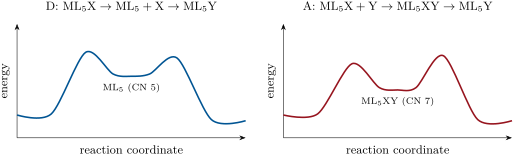
Energy profiles of a dissociative and an associative substitution (schematic): both pass through an intermediate, of lower coordination number (CN) in D and of higher coordination number in A. In the interchange mechanisms the well disappears and a single transition state remains.
Read in context →