
All books

Professional

Apps About Coach Log in Start reading

Chemistry · Glossary

What is Cross-coupling reactions?

Also known as: cross-coupling reaction · Heck reaction · Suzuki--Miyaura coupling

Definition 21.9 University Chemistry — Year 3 · Chapter 21 — Homogeneous Catalysis in Industry

A cross-coupling reaction joins two different carbon fragments, an organic halide and an organometallic reagent or an alkene, on a metal catalyst, usually palladium. In the Heck reaction an aryl or vinyl halide couples with an alkene, giving a substituted alkene; in the Suzuki–Miyaura coupling it couples with an organoboron compound in the presence of a base.
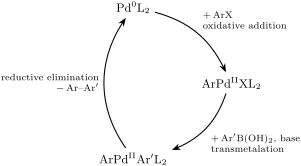
The Suzuki–Miyaura cycle: palladium(0) inserts into the C–X bond of the aryl halide, receives the second aryl group from the boronic acid activated by the base, and releases the biaryl by reductive elimination.
Read in context →