
All books

Professional

Apps About Coach Log in Start reading

Chemistry · Glossary

What is Doping?

Also known as: dopant · n-type semiconductor · donor level · p-type semiconductor · acceptor level

Definition 22.10 University Chemistry — Year 3 · Chapter 22 — Solid-State Chemistry: Bands, Defects and Semiconductors

A dopant is a foreign atom put in a semiconductor on purpose, in small amounts, to provide carriers. In an n-type semiconductor the dopant has one more valence electron than the atom it replaces (phosphorus in silicon) and gives it to the conduction band from a donor level just below that band; in a p-type semiconductor it has one fewer (boron in silicon) and accepts an electron from the valence band into an acceptor level just above it, leaving a hole.
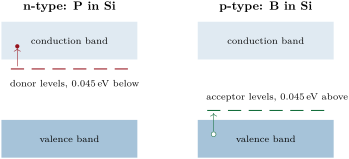
Donor and acceptor levels in the gap of silicon (gap not to scale: the dopant levels lie about 0.045 eV from the band edges, the gap is 1.12 eV). A donor gives its electron (dot) to the conduction band; an acceptor takes one from the valence band, leaving a hole (circle).
Read in context →