
সব বই

পেশাদার

1 Markets I: The Ecosystem and Exchange-Traded Marketsবাজার অনলাইন 2 Markets II: Rates, FX and Creditবাজার অনলাইন 3 Markets III: Commodities, Energy and Cryptoবাজার অনলাইন 4 Quantitative Methodsপদ্ধতি অনলাইন 5 Derivatives and Volatilityডেরিভেটিভস অনলাইন 6 Rates, Credit, XVA and Riskসুদহার, ঋণ ও ঝুঁকি অনলাইন 7 Research Craft: Predictors, Backtests, Measurement, Portfoliosগবেষণা অনলাইন 8 Strategies I: Equities and Futuresকৌশল অনলাইন 9 Strategies II: Volatility, Relative Value, Macro and the Bank Desksকৌশল অনলাইন 10 Microstructure and Executionএক্সিকিউশন অনলাইন 11 Market Making and High-Frequency Tradingমার্কেট মেকিং অনলাইন 12 Machine Learning for Marketsমেশিন লার্নিং অনলাইন 13 Low-Latency Softwareপ্রযুক্তি অনলাইন 14 Networks, Hardware and Trading Infrastructureপ্রযুক্তি অনলাইন 15 Research, Data and Risk Platformsপ্রযুক্তি অনলাইন 16 The Desk and the Firmপ্রতিষ্ঠান অনলাইন 17 The Industry: Firms, Roles and Careersক্যারিয়ার অনলাইন 18 Interviews I: Maths, Probability and Speedক্যারিয়ার অনলাইন 19 Interviews II: Markets, Trading Games and the Final Roundক্যারিয়ার অনলাইন 20 Interviews III: Codeক্যারিয়ার অনলাইন
অ্যাপ পরিচিতি Coach সাইন ইন পড়া শুরু করো

বইগুলো এখনো বাংলা ভাষায় পাওয়া যায় না — ইংরেজি সংস্করণ দেখানো হচ্ছে।

Chemistry · পরিভাষা

Liquidus and solidus কী?

অন্য নাম: liquidus · solidus

Definition 8.5 University Chemistry — Year 2 · অধ্যায় 8 — Binary Solid–Liquid Diagrams

On a solid–liquid diagram the liquidus is the curve above which everything is liquid; it gives the composition of the liquid in equilibrium with a solid. The solidus is the curve below which everything is solid; where the solid is a solution, it gives the composition of the solid in equilibrium with the liquid.
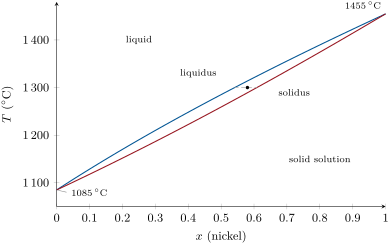
Copper–nickel, computed for ideal solid and liquid solutions from the melting points and enthalpies of fusion of the two metals. At 1300 C an alloy of composition 0.58 is split into a liquid of 0.541 and a solid of 0.609 (dashed tie line).
Copper–nickel, computed for ideal solid and liquid solutions from the melting points and enthalpies of fusion of the two metals. At 1300∘C1300{}^{\circ}\mathrm{C} an alloy of composition 0.58 is split into a liquid of 0.541 and a solid of 0.609 (dashed tie line).

উদাহরণ

Example 8.8 (An alloy at 1300∘C1300{}^{\circ}\mathrm{C})

For the alloy of nickel mole fraction 0.58 at 1300∘C1300{}^{\circ}\mathrm{C}, the fraction of the atoms in the solid is (0.58−0.541)/(0.609−0.541)=0.57(0.58 - 0.541)/(0.609 - 0.541) = 0.57. The first solid to appear, near 1315∘C1315{}^{\circ}\mathrm{C}, is richer in nickel than the alloy, the last liquid poorer.

Example 8.12 (Cooling a benzene–naphthalene mixture)

A liquid of naphthalene mole fraction 0.5 cools until the naphthalene branch of the liquidus, near 46∘C46{}^{\circ}\mathrm{C}, where pure solid naphthalene starts to crystallise. The liquid, losing naphthalene, slides down the branch; at −3.5∘C-3.5{}^{\circ}\mathrm{C} it reaches the eutectic, and the rest freezes at constant temperature into the eutectic mixture. By the lever rule, just above the eutectic, the solid naphthalene is (0.5−0.133)/(1−0.133)=42 %(0.5 - 0.133)/(1 - 0.133) = 42~\% of the moles, the eutectic liquid 58 %.

প্রসঙ্গসহ পড়ো →