University Chemistry — Year 2 · Bachelor Year 2
8Binary Solid–Liquid Diagrams
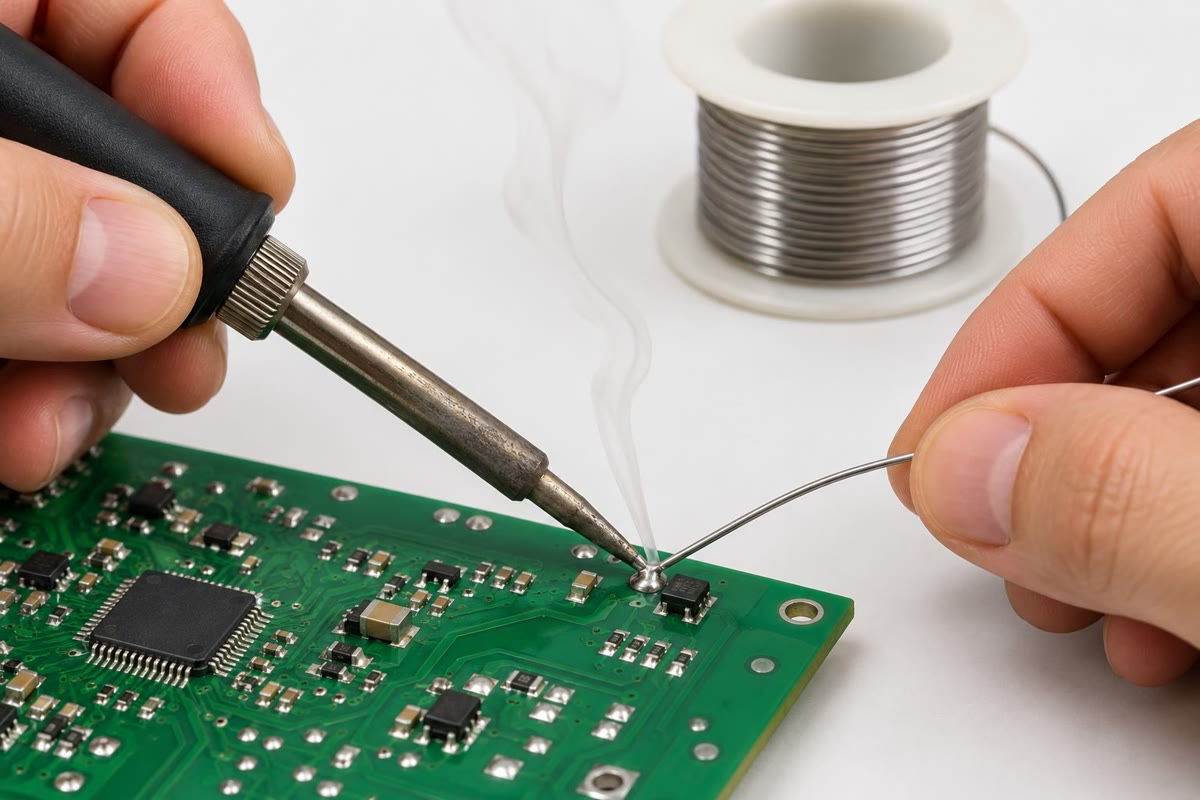
Tin melts at and lead at , yet the old solder of electricians, a mixture of the two, melts at , below both. Salt spread on a road melts ice, but only down to about ; on a colder night it does nothing. Copper and nickel, on the other hand, mix in any proportion even in the solid, and their alloys melt over a range of temperatures between those of the two metals. The diagrams of this chapter tell, for each pair, which solids crystallise from a cooling liquid, at which temperatures and in which amounts — the knowledge behind every casting, every solder joint and every low-melting alloy.
You already know
Chapter 3: chemical potential of a component in an ideal mixture, cryoscopy. Chapter 4: the variance. Chapter 7: binary diagrams, tie lines and the lever rule. The Year 1 volume: metallic bonding, substitutional and interstitial alloys, crystal types.
8.1 Thermal analysis
Definition 8.1 (Thermal analysis)
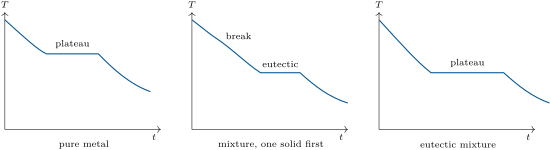
Thermal analysis determines the temperatures of the changes of state of a sample from its temperature recorded while it is heated or cooled at a steady rate. The record of temperature against time during a slow cooling is a cooling curve.
Far from any change of state, the sample cools smoothly. When a solid starts to crystallise, the heat of crystallisation slows the cooling: the curve shows a break in slope, or stops at a constant temperature for a while — a plateau — if the freezing occurs at fixed temperature.
Proposition 8.2 (Plateaus)
At fixed pressure, a pure substance freezes at constant temperature, and so does a binary liquid from which two solids crystallise together. A binary liquid from which one solid crystallises freezes over a range of temperatures.
Proof. With the pressure fixed, the variance is . Pure substance, liquid + solid: . Binary, liquid + two solids: . Binary, liquid + one solid: : the temperature changes as the liquid composition does. A variance 0 means the temperature cannot change while all the phases are present: the heat removed is supplied by the freezing, until a phase disappears. ∎
Method 8.3 (Building a diagram from cooling curves)
- Record cooling curves for a series of compositions, pure components included.
- On a (composition, temperature) graph, plot for each composition the temperature of the first break (the start of crystallisation) and of each plateau.
- Join the points of first crystallisation: this is the liquidus. Join the ends of freezing: the solidus. A plateau found at the same temperature for many compositions is an invariant line (a eutectic).
- The length of the eutectic plateau, largest at the eutectic composition, locates that composition.
8.2 Total miscibility in the solid
Definition 8.4 (Solid solution)
A solid solution is a single crystalline phase of variable composition, in which atoms of one component replace atoms of the other on the sites of the same lattice (substitutional) or occupy the holes of that lattice (interstitial).
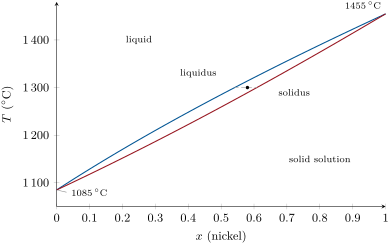
Copper and nickel have the same face-centred cubic structure and atoms of close radii: they form a substitutional solid solution at every composition.
Definition 8.5 (Liquidus and solidus)
On a solid–liquid diagram the liquidus is the curve above which everything is liquid; it gives the composition of the liquid in equilibrium with a solid. The solidus is the curve below which everything is solid; where the solid is a solution, it gives the composition of the solid in equilibrium with the liquid.
Proposition 8.6 (The lens)
If the two components form ideal solutions in the liquid and in the solid, the liquidus and the solidus join the two melting points and enclose a lens-shaped two-phase domain; at each temperature the mole fraction of each component in the liquid and in the solid are related by
Proof. The chemical potential of is the same in both phases, , so , and with constant , . Together with in each phase, the two relations fix the two compositions at each (solved numerically for the figure); that the resulting curves form a lens is admitted. ∎
Method 8.7 (Reading a solid–liquid diagram)
- Follow the vertical line of the overall composition downwards from the liquid.
- On the liquidus, the first solid appears; its composition is read on the other end of the tie line (the solidus, or a pure component).
- In the two-phase domain, read the two compositions at the ends of the tie line and the proportions by the lever rule, in moles with mole fractions, in mass with mass fractions.
- On a horizontal invariant line, the temperature stops until one phase has gone; below it, read the new pair of phases.
Example 8.8 (An alloy at )
For the alloy of nickel mole fraction 0.58 at , the fraction of the atoms in the solid is . The first solid to appear, near , is richer in nickel than the alloy, the last liquid poorer.
The diagram describes equilibrium, which in a solid is slow: the first crystals, rich in nickel, are covered by layers poorer and poorer in it as the liquid changes, and diffusion in the solid has no time to even them out. A casting cooled quickly is made of cored crystals, graded from the centre to the edge; a long heating below the solidus homogenises them.
8.3 No miscibility in the solid: the eutectic
When the two solids do not mix at all, each component crystallises pure, and the liquidus has two branches, one per solid.
Theorem 8.9 (Schröder–van Laar)
If a component A crystallises pure from an ideal liquid mixture, the liquidus on which the solid A appears is given by
with the mole fraction of A in the liquid, and the melting point and enthalpy of fusion of pure A (taken as constant).
Proof. At equilibrium, the chemical potential of pure solid A equals that of A in the liquid: . Hence . By Gibbs–Helmholtz, ; integrating from , where , to gives . ∎
For a dilute solution, and : , the cryoscopic law of Chapter 3. For benzene (, , ), the cryoscopic constant comes out as .
Definition 8.10 (Eutectic)
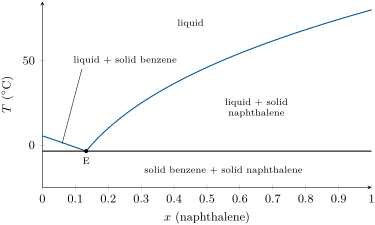
The eutectic point of a binary system is the point where the liquid is in equilibrium with two solids at once; it is the lowest temperature at which a liquid exists in that part of the diagram. A liquid of the eutectic composition, and the fine intimate mixture of the two solids into which it freezes, are called a eutectic mixture.
Corollary 8.11 (The eutectic is where the liquidus branches meet)
For two components immiscible in the solid and ideal in the liquid, the eutectic temperature and composition are the solution of , each given by the Schröder–van Laar equation of its own solid.
Proof. At the eutectic the liquid is saturated with both solids: it lies on both branches at once, with the same composition read in A and in B. ∎
Example 8.12 (Cooling a benzene–naphthalene mixture)
A liquid of naphthalene mole fraction 0.5 cools until the naphthalene branch of the liquidus, near , where pure solid naphthalene starts to crystallise. The liquid, losing naphthalene, slides down the branch; at it reaches the eutectic, and the rest freezes at constant temperature into the eutectic mixture. By the lever rule, just above the eutectic, the solid naphthalene is of the moles, the eutectic liquid 58 %.
Proposition 8.13 (Length of the eutectic plateau)
For samples of the same mass cooled with the same rate of heat removal, the duration of the eutectic plateau is proportional to the amount of liquid that reaches the eutectic, maximal for the eutectic composition and zero for the pure components.
Proof. On the plateau the temperature is constant: the heat removed, at a constant rate , is the heat released by the freezing of the eutectic liquid, . So , proportional to the mass of eutectic liquid, which the lever rule gives. ∎
8.4 Partial miscibility and defined compounds
Most pairs of metals are neither fully miscible nor fully immiscible in the solid: each dissolves a little of the other. Lead dissolves up to 19 % of tin by mass, tin up to 3.4 % of lead. The diagram then holds two solid solutions, (Pb) and (Sn), and a eutectic between them; the eutectic line no longer reaches the sides of the diagram, but stops at the limits of the solid solutions.
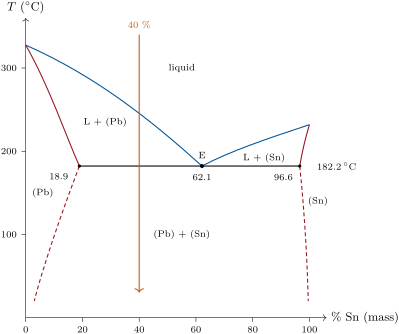
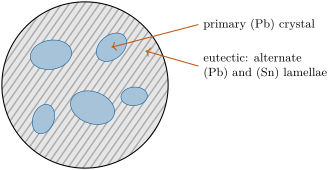
A 40 % tin solder starts to freeze on the liquidus by depositing crystals of the lead-rich solution (Pb); the liquid grows richer in tin until, at , it reaches the eutectic composition and freezes into a fine mixture of (Pb) and (Sn) lamellae, around the primary crystals.
Definition 8.14 (Defined compound)
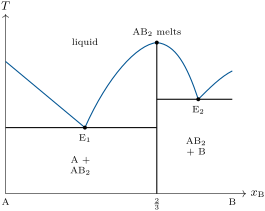
A defined compound is a solid of fixed composition formed by the two components. It shows congruent melting when it melts into a liquid of its own composition: the liquidus then has a maximum at that composition.
A compound with congruent melting splits the diagram in two: each half, A with and with B, is a diagram of its own, with its own eutectic. The composition of the maximum, read in mole fraction, gives the formula of the compound.
8.5 Uses
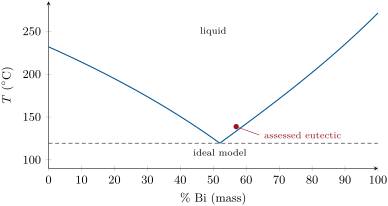
Solders and low-melting alloys. A solder must melt below the parts it joins and freeze quickly, without a pasty range: the eutectic composition is the natural choice. The tin–lead eutectic melts at ; because lead is toxic, electronics now use lead-free solders, among them the bismuth–tin eutectic, which melts at and contains 57 % bismuth by mass.
De-icing. Ice and salt form a eutectic: the ice–salt dihydrate eutectic lies at () and 23.3 % sodium chloride by mass. Above that temperature, salt in contact with ice forms a brine whose freezing point is below the temperature of the road, and the ice melts; below it, no liquid can exist, and salt is useless.
Crystallisation. The diagram of a salt and water is read like any other: cooling a hot saturated solution crosses the solubility curve (the liquidus of the salt), and pure crystals of the salt are deposited while the impurities, too dilute to reach their own liquidus, stay in the mother liquor. This is the purification by recrystallisation of the Year 1 volume, seen on a diagram.
8.6 Exercises
Exercise 8.1 ★
On the copper–nickel diagram, give the phases present at for nickel mole fractions 0.40, 0.58 and 0.70.
Solution
Solution of Exercise 8.1.
At the liquidus is at 0.541 and the solidus at 0.609. 0.40: liquid only. 0.58: liquid (0.541) and solid solution (0.609). 0.70: solid solution only.
Exercise 8.2 ★
of a copper–nickel alloy of nickel mole fraction 0.58 are held at . Compute the amounts of solid and liquid and the amount of nickel in each.
Solution
Solution of Exercise 8.2.
Solid fraction : of solid, of liquid. Nickel: in the solid, in the liquid; total .
Exercise 8.3 ★
Compute the variance at fixed pressure (a) of a pure metal while it freezes; (b) of a copper–nickel alloy while it freezes; (c) of a lead–tin liquid on the eutectic line.
Solution
Solution of Exercise 8.3.
At fixed pressure (no reaction). (a) . (b) . (c) Liquid and two solid solutions: .
Exercise 8.4 ★
Sketch the cooling curve of pure tin from to and explain why the temperature stops at .
Solution
Solution of Exercise 8.4.
A smooth fall to , a horizontal plateau while the tin freezes, then a smooth fall again, slower near room temperature. On the plateau liquid and solid coexist at fixed pressure, variance 0: the heat removed is supplied by the crystallisation, and the temperature cannot change until the last liquid has frozen.
Exercise 8.5 ★★
With the data of the chapter (benzene , ; naphthalene , ), check that at the two Schröder–van Laar mole fractions add up to 1, and give the eutectic composition.
Solution
Solution of Exercise 8.5.
Benzene: , . Naphthalene: , . The sum is 1.000: () is the eutectic temperature, and the eutectic liquid has 0.133 naphthalene.
Exercise 8.6 ★★
Describe the cooling of a lead–tin alloy of 30 % tin by mass, from the liquid to room temperature, and compute the mass fraction of eutectic it contains.
Solution
Solution of Exercise 8.6.
The liquid cools to the lead-side liquidus, where crystals of (Pb) appear; the liquid grows richer in tin, down to the eutectic at and 62.1 %. There the remaining liquid freezes into the eutectic mixture. Mass fraction of eutectic: . On further cooling the solubility of tin in (Pb) decreases (dashed line): a little (Sn) precipitates inside the (Pb) crystals.
Exercise 8.7 ★★
What mass of sodium chloride per kilogram of water does the eutectic brine contain? Why is salting a road useless at ?
Solution
Solution of Exercise 8.7.
23.3 % NaCl by mass: of salt per kilogram of water. At , below the eutectic, no liquid can exist whatever the proportions: salt and ice stay side by side as solids.
Exercise 8.8 ★★
On the schematic diagram with the compound , describe the cooling of liquids of and : first solid, eutectic reached, solids at the end.
Solution
Solution of Exercise 8.8.
lies between E and the compound: crystallises first, the liquid moves towards E, freezes there into the eutectic of A and ; at the end, A + . lies between E and B: B crystallises first, the liquid reaches E; at the end, + B.
Exercise 8.9 ★★
In zone refining, a molten zone is passed slowly along a bar. Near pure nickel, the ratio of the copper mole fractions in the solid and in the liquid at equilibrium is about 0.78. Explain why the copper is carried along with the molten zone, and why several passes are needed.
Solution
Solution of Exercise 8.9.
At the rear edge of the zone the liquid freezes into a solid holding only 0.78 times its copper mole fraction: the copper rejected stays in the liquid, which moves on and grows richer, so the copper is swept towards the end of the bar. With a ratio close to 1 each pass removes only a fraction of the impurity: many passes are needed, each starting from the bar left by the previous one.
Exercise 8.10 ★★★
Derive the Schröder–van Laar equation, then show that for a dilute liquid it reduces to , with and the molality of the solute; compute for benzene.
Solution
Solution of Exercise 8.10.
Derivation as in the chapter. For a dilute liquid, , , so ; with , . Benzene: .
Exercise 8.11 ★★★
The magnesium–lead diagram has a liquidus maximum at 19.0 % magnesium by mass. Find the formula of the compound.
Solution
Solution of Exercise 8.11.
Per : of Mg, of Pb; ratio : .
Exercise 8.12 ★★★
Equal masses of lead–tin alloys are cooled under the same conditions. The eutectic alloy shows a plateau of ; an unknown alloy shows one of . Find the two possible compositions of the unknown, and say how to tell them apart.
Solution
Solution of Exercise 8.12.
The plateau is proportional to the mass of eutectic liquid: the unknown holds of it. On the lead side, tin; on the tin side, . The first break of the cooling curve (higher for the 36 % alloy, whose liquidus is on the steep lead side) or a micrograph (primary (Pb) or primary (Sn) crystals) tells them apart.
8.7 Problem: Solder
Problem 8.1
Weekend problem — the lead–tin diagram from its invariant points, the freezing of a 40 % solder by the lever rule, a lead-free bismuth–tin solder predicted by the ideal-liquid model, and the choice of a solder
Data (NIST, calculated invariant equilibria): lead–tin eutectic at , liquid of 62.13 % tin by mass, in equilibrium with (Pb) of 18.91 % and (Sn) of 96.59 % tin; bismuth–tin eutectic at , liquid of 56.97 % bismuth. Melting points and enthalpies of fusion: lead , ; tin , ; bismuth , . Molar masses (): Pb 207.2, Sn 118.71, Bi 208.98.
Part I — The lead–tin diagram.
- Convert the melting points of lead and tin to degrees Celsius.
- Convert the eutectic composition to a mole fraction of tin.
- Place on a (mass % Sn, ) graph the melting points, the eutectic and the two ends of the eutectic line.
- Draw the diagram and name its six domains.
- Write the eutectic transformation on cooling.
- Compute the variance on the eutectic line at fixed pressure.
Part II — Cooling a 40 % solder.
- Which solid appears first, and why is it not pure lead?
- How does the composition of the liquid change during the cooling down to the eutectic?
- Just above : which phases, of which compositions?
- Compute their mass fractions.
- Just below: which phases, of which compositions, and in which mass fractions?
- What fraction of the alloy is made of eutectic constituent, and what fraction of primary (Pb) crystals?
- Sketch the cooling curve and compare its plateau with that of the eutectic alloy.
Part III — A lead-free solder by the ideal-liquid model.
- Write the Schröder–van Laar equation for the liquidus of tin.
- Write it for the liquidus of bismuth.
- Write the condition defining the eutectic.
- Compute the sum of the two mole fractions at , and , and find the eutectic temperature of the model to the nearest degree.
- Give the eutectic composition of the model, in mole and in mass fraction of bismuth.
- Compare with the assessed eutectic.
- Tin dissolves up to 21 % of bismuth in the solid. Explain how this makes the real eutectic hotter than the model’s.
Part IV — Choosing a solder.
- Why is a eutectic composition preferred for a solder?
- Give one reason to replace lead in solders.
- What does the low melting point of the bismuth–tin eutectic offer, and what could it cost?
- Compute the masses of bismuth and tin in of bismuth–tin eutectic solder.
- State the eutectic temperature of bismuth–tin predicted by the ideal-liquid model.
Solution
Solution of Problem 8.1.
1. Lead , tin . 2. Per : of tin and of lead; . 3. Points (0, 327.5), (100, 231.9), (62.13, 182.2), (18.91, 182.2), (96.59, 182.2). 4. As in the figure: liquid; L + (Pb); L + (Sn); (Pb); (Sn); (Pb) + (Sn). 5. L (62.1 % Sn) (Pb) (18.9 %) + (Sn) (96.6 %). 6. : the temperature and the three compositions are fixed. 7. The lead-rich solid solution (Pb): lead dissolves tin, so the solid in equilibrium with the liquid already holds tin, in the proportion read on the solidus. 8. It follows the liquidus towards the eutectic, growing richer in tin, up to 62.13 %. 9. Liquid of 62.13 % and (Pb) of 18.91 % tin. 10. (Pb): ; liquid 0.488. 11. (Pb) of 18.91 % and (Sn) of 96.59 %; (Sn): ; (Pb): 0.729. 12. Eutectic constituent 48.8 % (the liquid present just above); primary (Pb) 51.2 %. The (Pb) of question 11 is the sum of the primary crystals and of the (Pb) lamellae of the eutectic. 13. A break at the liquidus, a slower fall, then a plateau at lasting 0.488 times that of the eutectic alloy. 14. . 15. . 16. . 17. At : ; at : ; at : . The sum reaches 1 near : to the nearest degree. 18. ; in mass . 19. The model gives and 52 % bismuth, the assessed diagram and 57 %: about too low. 20. The tin that crystallises is not pure but a solution holding bismuth: its chemical potential is lower than that of pure tin, the solid is more stable, and it crystallises from the liquid at a higher temperature for a given liquid composition. The tin branch of the liquidus is raised, and it meets the bismuth branch higher (a non-ideal liquid adds its own correction). 21. It melts and freezes at one temperature, the lowest of the system: no pasty range during which a joint moved would crack. 22. Lead is toxic, and electronic waste ends up in the environment. 23. Heat-sensitive components can be soldered at a lower temperature; but the joint softens at a lower temperature in service, and bismuth makes it brittle. 24. of bismuth and of tin. 25. The ideal-liquid model predicts a eutectic at , against assessed.