All books

Professional

Apps About Coach Log in Start reading

Chemistry · Glossary

What is Mesomeric effect, donor and acceptor groups?

Also known as: mesomeric effect · donor group · acceptor group

Definition 18.3 University Chemistry — Year 1 · Chapter 18 — Electronic Effects and Reactive Intermediates

The mesomeric effect is the shift of electron density through a conjugated π\pi system, shown by resonance structures. A donor group gives a lone pair to the system, a +M+M effect (−OH\ce{-OH}, −OX−\ce{-O^-}, −NHX2\ce{-NH2}, −OR\ce{-OR}); an acceptor group draws electrons from it through a π\pi bond to an electronegative atom, a −M-M effect (−NOX2\ce{-NO2}, −C=O\ce{-C=O}, −C≡N\ce{-C#N}).

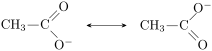
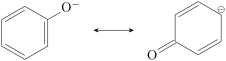
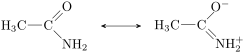
Resonance structures of the ethanoate ion (the charge shared by two equivalent oxygens), of the phenoxide ion (the charge spread into the ring; one of the three ring structures shown), and of an amide (the nitrogen lone pair shared with the C=O, which makes amides poor bases). Resonance structures of the ethanoate ion (the charge shared by two equivalent oxygens), of the phenoxide ion (the charge spread into the ring; one of the three ring structures shown), and of an amide (the nitrogen lone pair shared with the C=O, which makes amides poor bases). Resonance structures of the ethanoate ion (the charge shared by two equivalent oxygens), of the phenoxide ion (the charge spread into the ring; one of the three ring structures shown), and of an amide (the nitrogen lone pair shared with the C=O, which makes amides poor bases).
Resonance structures of the ethanoate ion (the charge shared by two equivalent oxygens), of the phenoxide ion (the charge spread into the ring; one of the three ring structures shown), and of an amide (the nitrogen lone pair shared with the C=O, which makes amides poor bases).
Read in context →