University Chemistry — Year 1 · Bachelor Year 1
18Electronic Effects and Reactive Intermediates
Trifluoroethanoic acid, , is about ten thousand times stronger an acid than ethanoic acid, , although the acidic O–H bond is three bonds away from the fluorine atoms. Phenol is a million times more acidic than ethanol, and an ammonia molecule bound to a benzene ring — aniline — is a million times less basic than one bound to a methyl group. Organic chemistry is full of such contrasts, and two effects explain most of them: the pull of electronegative atoms along the bonds, and the spreading of electron pairs over systems. The same two effects decide which bonds break, which intermediates form and where reagents attack: they are the grammar of the reaction mechanisms of the next chapters.
You already know
Electronegativity and its trends (Chapter 2); Lewis structures, formal charges and resonance (Chapter 3); and the strength of acids and bases (Chapter 10). The school volume (grade 12) drew curly arrows from a nucleophile to an electrophile.
18.1 Inductive effects
Definition 18.1 (Inductive effect)
The inductive effect is the shift of electron density along bonds towards an electronegative atom or group. An attracting group (F, Cl, O, , ) has a effect; alkyl groups and negatively charged atoms push electrons, a effect. The effect weakens quickly with the number of bonds in between.
Proposition 18.2 (Inductive effect and acidity)
An attracting group near the acidic site of a carboxylic acid stabilises the carboxylate ion by spreading its negative charge, and lowers the : the more attracting groups, the closer, the stronger the acid.
Proof. measures the position of . A group that draws electron density away from the carboxylate spreads its charge over more atoms, which lowers its energy more than that of the neutral acid; the equilibrium moves to the right and increases. The measured series confirms it. ∎
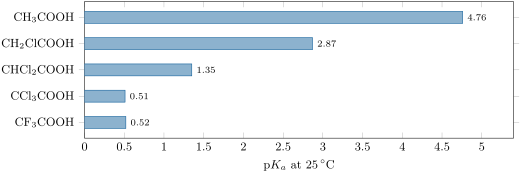
Alkyl groups work the other way, a little: propanoic acid () is slightly weaker than ethanoic acid (4.76), and methanoic acid (3.74), with no alkyl group, is stronger than both.
18.2 Mesomeric effects
When an atom bearing a lone pair, or a charge, is bound to a system, its electrons can be shared with that system; resonance structures (Chapter 3) describe the sharing.
Definition 18.3 (Mesomeric effect, donor and acceptor groups)
The mesomeric effect is the shift of electron density through a conjugated system, shown by resonance structures. A donor group gives a lone pair to the system, a effect (, , , ); an acceptor group draws electrons from it through a bond to an electronegative atom, a effect (, , ).
Proposition 18.4 (Mesomeric effect and acidity)
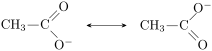
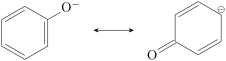
An acid whose conjugate base spreads its charge by resonance is stronger than one whose base cannot: carboxylic acids ( about 4–5) are far stronger than alcohols (about 16), and phenol (10.0) lies between. An acceptor group in the position ortho or para to the OH of a phenol strengthens it more than in the position meta.
Proof. In an alkoxide the charge sits on one oxygen; in a carboxylate it is shared by two oxygens; in a phenoxide it is shared by the oxygen and three ring carbons, less electronegative than oxygen, a smaller gain. A group at the ortho or para carbon can take the charge itself through a resonance structure with ; at meta, no resonance structure brings the charge onto the carbon that carries , and only the inductive effect remains. The measured values: 2-nitrophenol 7.23, 4-nitrophenol 7.16, 3-nitrophenol 8.36, against 9.99 for phenol and 15.9 for ethanol. ∎
The same reasoning applies to bases. Methylamine ( of its ammonium 10.66) is a stronger base than ammonia (9.25, Chapter 10), the methyl group pushing electrons onto nitrogen; in aniline the lone pair is shared with the ring and the ammonium is far more acidic (4.60). Pyridine (5.23) keeps its lone pair, but on a nitrogen held in a planar ring with more s character, less available than in an amine.
18.3 Breaking a bond: reactive intermediates
Definition 18.5 (Homolysis and heterolysis)
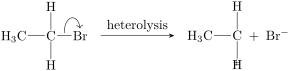
A covalent bond breaks by homolysis when each atom keeps one of the two bonding electrons, giving two radicals, and by heterolysis when one atom keeps both, giving a cation and an anion.
Definition 18.6 (Reactive intermediates)
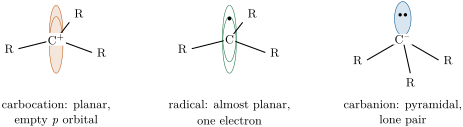
A reactive intermediate is a species formed in one step of a mechanism and consumed in a later one, too reactive to accumulate (Chapter 9). A carbocation has a carbon with three bonds and a positive charge (six valence electrons); a carbanion a carbon with three bonds, a lone pair and a negative charge; a radical an atom with an unpaired electron.
Definition 18.7 (Class of a carbon)
A carbon bound to one other carbon is a primary carbon, to two a secondary carbon, to three a tertiary carbon. A carbocation, a radical or a halogenoalkane takes the class of the carbon concerned.
Proposition 18.8 (Stability of carbocations)
Carbocations are stabilised by groups that give them electrons: tertiary secondary primary methyl; a carbocation next to a double bond (allylic) or a benzene ring (benzylic) is further stabilised by resonance, and one next to an atom with a lone pair () even more.
Proof. Each alkyl group pushes electron density towards the electron-poor carbon ( effect, and a related interaction of its C–H bonds with the empty orbital, described in the Year 2 volume). An allylic cation has two resonance structures putting the charge on either end carbon; a benzylic cation has four, three in the ring; an oxygen lone pair forms a fourth bond to the cationic carbon, , in which every atom has an octet. ∎
Carbanions follow the opposite order (methyl primary secondary tertiary) and are stabilised by acceptor groups; radicals follow the same order as carbocations, less markedly.
18.4 Curly arrows, nucleophiles and electrophiles
Definition 18.9 (Curly arrows)
In a mechanism, a curly arrow shows the movement of an electron pair: it starts on a lone pair or a bond and ends on an atom (where a lone pair or a new bond forms) or between two atoms (a new bond). A half-headed arrow shows the movement of a single electron, in radical reactions.
Method 18.10 (Drawing curly arrows)
- Start from electrons: a lone pair, a bond or a bond, never from a positive charge or an atom without electrons.
- End where the pair goes: a new bond between the two atoms, or a lone pair on the more electronegative atom when a bond breaks.
- Count charges after each step: the atom giving a lone pair to a new bond gains , the atom receiving a pair as a lone pair gains ; the total charge is conserved.
- Never exceed an octet on C, N, O: when a pair arrives, another must leave.

Definition 18.11 (Nucleophile, electrophile, leaving group)
A nucleophile is a species that gives an electron pair to an atom other than hydrogen to form a bond (a Lewis base); an electrophile is a species that accepts such a pair (a Lewis acid, often a carbon bearing a partial positive charge). The nucleophilicity of a species is its reactivity as a nucleophile, measured by rate constants. A leaving group is the group that departs with the bonding pair when a bond to carbon breaks heterolytically.
Proposition 18.12 (Nucleophilicity and basicity)
For nucleophiles that attack through the same atom, nucleophilicity follows basicity: . It fails across a column of the periodic table in protic solvents, where large, polarisable, weakly solvated nucleophiles react faster although they are weaker bases ( ), and for bulky bases, which are poor nucleophiles.
Proof. Basicity measures the equilibrium of the attack on a proton, nucleophilicity the rate of attack on a carbon; both increase with the availability of the electron pair, hence the parallel within one atom. The rate also depends on the energy needed to strip the solvent from the nucleophile and on the distortion of its electron cloud towards a crowded carbon: small anions such as are strongly bound to protic solvent molecules (Chapter 4), and bulky groups hinder the approach to carbon but not to a proton. ∎
A good leaving group is a weak base, stable once it carries the pair: , , , water, sulfonates; and , strong bases, are poor leaving groups — the reason why alcohols must be activated before substitution (Chapter 22).
18.5 Exercises
Exercise 18.1 ★
Classify each carbon of 2-methylbutane and of 2-bromo-2-methylpropane as primary, secondary, tertiary or quaternary (bound to four carbons). Which carbocation forms most easily from each bromide of formula ?
Solution
Solution of Exercise 18.1.
2-Methylbutane, : the three are primary, the secondary, the CH tertiary. 2-Bromo-2-methylpropane: the three are primary, the central carbon tertiary. Of the four bromides (1-bromobutane, 2-bromobutane, 1-bromo-2-methylpropane, 2-bromo-2-methylpropane), the last gives the tertiary carbocation, the most stable.
Exercise 18.2 ★
From the values, compute the ratio of the acidity constants of chloroethanoic and ethanoic acids, and of trifluoroethanoic and ethanoic acids.
Solution
Solution of Exercise 18.2.
; .
Exercise 18.3 ★
Draw the resonance structures of the ethanoate ion, of the 4-nitrophenoxide ion (with the charge on an oxygen of the nitro group) and of the allyl cation .
Solution
Solution of Exercise 18.3.
Ethanoate: the C=O and exchanged between the two oxygens. 4-Nitrophenoxide: the oxygen lone pair forms a C=O, the ring double bonds shift, the carbon bearing forms a C=N bond, and an N=O pair goes to oxygen: a structure with C=O at one end of the ring, C=N at the other and both nitro oxygens negative (a quinoid structure). Allyl cation: .
Exercise 18.4 ★
Complete the curly arrows of the proton transfer of the figure and of . Check the charges.
Solution
Solution of Exercise 18.4.
Second arrow: from the O–H bond of water to its oxygen; products (from , now neutral) and (the oxygen of the former water keeps the pair, charge ). For ammonia: an arrow from the N lone pair to an H of , and one from that O–H bond to the oxygen: N becomes , O becomes 0.
Exercise 18.5 ★★
Rank by increasing acidity: ethanol, phenol, ethanoic acid, 4-nitrophenol, trichloroethanoic acid, water ( of the couple /, 14.0). Justify each step with an inductive or mesomeric argument.
Solution
Solution of Exercise 18.5.
Ethanol (15.9) water (14.0) phenol (9.99, ring delocalisation) 4-nitrophenol (7.16, takes the charge) ethanoic acid (4.76, two equivalent oxygens) trichloroethanoic acid (0.51, three chlorines).
Exercise 18.6 ★★
Rank by increasing basicity: aniline, methylamine, ammonia, pyridine. Explain the position of aniline with a resonance structure.
Solution
Solution of Exercise 18.6.
Aniline (4.60) pyridine (5.23) ammonia (9.25) methylamine (10.66). In aniline the lone pair is shared with the ring (structures with C=N and the negative charge ortho and para); protonating N would cost that delocalisation.
Exercise 18.7 ★★
Why is 3-nitrophenol weaker than 4-nitrophenol but still stronger than phenol? Draw the resonance structures that justify both statements.
Solution
Solution of Exercise 18.7.
In 3-nitrophenoxide, the resonance structures place the charge on the carbons ortho and para to the oxygen, never on the carbon bearing : no mesomeric help, hence weaker than the 4-isomer. The nitro group still pulls electrons through the bonds (), hence stronger than phenol.
Exercise 18.8 ★★
Rank the carbocations , , , , , , and justify.
Solution
Solution of Exercise 18.8.
: alkyl groups give electrons; allyl and benzyl delocalise the charge (two and four structures); the oxygen lone pair gives a structure with a full octet everywhere. The order in the middle of the list depends on the medium.
Exercise 18.9 ★★
Identify the nucleophile and the electrophile in: ; ; ethanal with a cyanide ion; . Draw the curly arrows.
Solution
Solution of Exercise 18.9.
(nucleophile) attacks the carbon of (electrophile), the C–Br pair leaving on Br. gives a pair to (here acid and base are the names used). attacks the carbonyl carbon of ethanal, the C=O pair moving to oxygen. gives its lone pair to the empty orbital of boron in .
Exercise 18.10 ★★★
A solution contains of trichloroethanoic acid. Is the weak-acid formula valid? Compute the pH properly and the degree of dissociation.
Solution
Solution of Exercise 18.10.
No: is much larger than ; the acid is almost totally dissociated. gives , , degree of dissociation .
Exercise 18.11 ★★★
The of alcohols measured in water increase from methanol (15.5) to ethanol (15.9), propan-2-ol (17.1) and 2-methylpropan-2-ol (19.2). Give two explanations, one through the inductive effect of the alkyl groups on the alkoxide, one through the solvation of the alkoxide.
Solution
Solution of Exercise 18.11.
Alkyl groups push electrons () onto the alkoxide oxygen and make its charge less stable, the more so the more groups. Larger alkoxides are also less well solvated by water, which stabilises a small charged oxygen better than one buried among alkyl groups. Both raise the .
Exercise 18.12 ★★★
Explain why amides are neither basic on nitrogen nor nucleophilic, whereas amines are both, using the resonance structure of the amide. Which atom of an amide is protonated in strong acid?
Solution
Solution of Exercise 18.12.
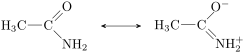
In an amide the nitrogen lone pair is shared with the C=O ( structure); taking it for a proton or an electrophile would destroy that stabilisation. In strong acid the amide is protonated on the oxygen, which carries the partial negative charge.
18.6 Problem: Why Trifluoroethanoic Acid Is So Strong
Problem 18.1
Weekend problem — the inductive series of the halogenated acids, carboxylates against alkoxides, the three nitrophenols, a predominant-reaction calculation, and the ratio of the acidity constants of trifluoroethanoic and ethanoic acids
Data ( at ): ethanoic acid 4.76, chloroethanoic 2.87, dichloroethanoic 1.35, trichloroethanoic 0.51, trifluoroethanoic 0.52, ethanol 15.9, phenol 9.99, 2-nitrophenol 7.23, 3-nitrophenol 8.36, 4-nitrophenol 7.16; .
Part I — The inductive series.
- Compute the ratio of for each step from ethanoic to trichloroethanoic acid.
- Is the effect of each chlorine the same? Comment.
- Explain the trend with the inductive effect.
- Why would a chlorine on the carbon of a longer chain farthest from COOH have almost no effect?
- Fluorine is more electronegative than chlorine. What does the comparison of the trifluoro- and trichloro- acids show, and why is it hard to measure such precisely?
- In which form is each of these acids at pH 3?
Part II — Carboxylates and alkoxides.
- Draw the two resonance structures of the ethanoate ion.
- What do they predict for the two C–O bond lengths of the ion?
- Why has the ethoxide ion no equivalent structures?
- Compute the ratio of the of ethanoic acid and ethanol.
- Place phenol between the two and justify with the phenoxide resonance structures.
- Which of ethanol, phenol and ethanoic acid react almost totally with a hydrogencarbonate solution ( 6.37 for /)?
Part III — The nitrophenols.
- Rank the three nitrophenols and phenol by acidity.
- Draw a resonance structure of 4-nitrophenoxide with the charge on the nitro group.
- Show that no such structure exists for 3-nitrophenoxide.
- Why is 3-nitrophenol still more acidic than phenol?
- 2-Nitrophenol is slightly weaker than 4-nitrophenol although both have the mesomeric effect; propose an explanation involving its OH and the nearby nitro group.
- At pH 7.5, which nitrophenols are mostly in the anion form? Why does that make 4-nitrophenol a colour indicator?
Part IV — Trifluoroethanoic acid in water.
- Compute the pH of trifluoroethanoic acid at (do not assume weak dissociation).
- Compute the pH of ethanoic acid at .
- Write the reaction of trifluoroethanoic acid with sodium ethanoate and compute its constant.
- State the ratio , as a power of ten and as a number.
Solution
Solution of Problem 18.1.
1. ; ; . 2. No: each further chlorine helps less. The charge of the carboxylate is already well spread, and the measurements become less precise as the acid approaches total dissociation. 3. Each Cl attracts electron density through the C–C and C–O bonds and stabilises the carboxylate (). 4. The inductive effect fades within two or three bonds. 5. The two acids appear equally strong (0.52 and 0.51). In water, both are almost totally dissociated at usual concentrations (Chapter 10, levelling): a near 0 is the limit of what water can distinguish, and the two values carry uncertainties of a few tenths. 6. Ethanoic acid: acid form (); chloroethanoic: both, the anion slightly predominant (); the three others: anion. 7. . 8. Two equal C–O bonds, between a double and a single bond. 9. The charge is on the single oxygen, with no bond to share it. 10. , about . 11. The phenoxide charge spreads to three ring carbons, less electronegative than oxygen: a gain, smaller than in a carboxylate: 9.99 between 4.76 and 15.9. 12. : ethanoic acid , favoured (carbon dioxide is released with excess hydrogencarbonate); phenol and ethanol : no reaction. 13. 4-Nitrophenol (7.16) 2-nitrophenol (7.23) 3-nitrophenol (8.36) phenol (9.99). 14. The quinoid structure of Exercise 18.3, with the charge on an oxygen of the nitro group. 15. The charge reaches only the carbons ortho and para to the oxygen; the nitro carbon is meta. 16. The effect of . 17. In 2-nitrophenol the OH forms a hydrogen bond with an oxygen of the neighbouring nitro group, which stabilises the acid form and makes the proton slightly harder to remove. 18. Anion fractions : 4-nitro , 2-nitro , 3-nitro . Acid and anion of 4-nitrophenol absorb differently, the anion in the visible: its colour appears around its . 19. : , : almost a strong acid. 20. . 21. , : quantitative. 22. , about ten thousand.