All books

Professional

Apps About Coach Log in Start reading

Chemistry · Glossary

What is Molecular partition function?

Definition 10.6 University Chemistry — Year 3 · Chapter 10 — Statistical Thermodynamics: Partition Functions

The molecular partition function of a molecule at temperature TT is the sum

q=∑levelsgie−εi/kT=∑statese−εs/kT,q = \sum_{\text{levels}}g_i\eu^{-\varepsilon_i/kT} = \sum_{\text{states}}\eu^{-\varepsilon_s/kT},

with energies measured from the lowest level, so that q≥1q \ge 1.

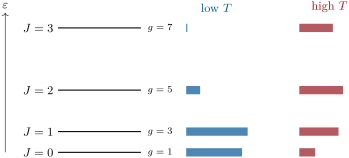
A Boltzmann staircase: rotational levels J = 0 to 3 (energies 0, 2, 6, 12 times hcB, degeneracies 2J + 1) and their populations, as bar lengths, at kT = 2hcB and kT = 10hcB (the four levels alone). Heating empties the lowest level towards the upper ones; at both temperatures the bars add up to the same total, the number of molecules.
A Boltzmann staircase: rotational levels J=0J = 0 to 3 (energies 00, 22, 66, 1212 times hcBhcB, degeneracies 2J+12J + 1) and their populations, as bar lengths, at kT=2hcBkT = 2hcB and kT=10hcBkT = 10hcB (the four levels alone). Heating empties the lowest level towards the upper ones; at both temperatures the bars add up to the same total, the number of molecules.
Read in context →