
全部书籍

专业

应用 关于 Coach 登录 开始阅读

书籍暂未推出简体中文版——当前显示英文版。

Chemistry · 术语表

什么是 Oscillating reaction, limit cycle?

又称: oscillating reaction · limit cycle

Definition 13.19 University Chemistry — Year 3 · 第 13 章 — Complex Kinetics: Chains, Enzymes and Oscillations

An oscillating reaction is one in which the concentrations of intermediates rise and fall periodically while the overall reaction proceeds towards equilibrium. A limit cycle is a closed trajectory in the space of concentrations towards which neighbouring trajectories converge, so that the oscillation has an amplitude independent of the starting point.
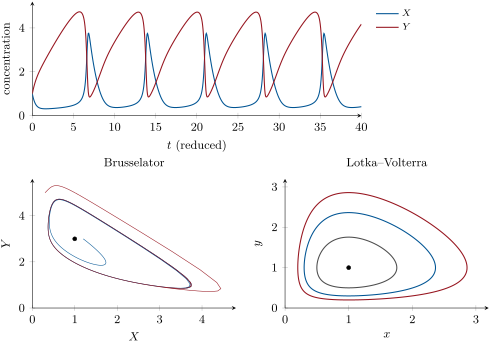

Top: the Brusselator (A = 1, B = 3 > 1 + A2) settles into sustained oscillations of period 7.2 (reduced time). Bottom left: two trajectories, one starting near the unstable steady state (dot) and one far outside, wind onto the same limit cycle. Bottom right: Lotka–Volterra orbits, each fixed by its starting point, around the steady state (dot).
Top: the Brusselator (A=1A = 1, B=3>1+A2B = 3 > 1 + A^2) settles into sustained oscillations of period 7.2 (reduced time). Bottom left: two trajectories, one starting near the unstable steady state (dot) and one far outside, wind onto the same limit cycle. Bottom right: Lotka–Volterra orbits, each fixed by its starting point, around the steady state (dot).
Spiral waves of the Belousov–Zhabotinsky reaction in a thin layer of solution: each blue front is a wave of oxidation of the catalyst, which travels into the reduced (red) medium and cannot re-enter the region it just left.
在原文中阅读 →