
All books

Professional

Apps About Coach Log in Start reading

Chemistry · Glossary

What is Ozone depletion, reservoir species?

Also known as: ozone depletion · reservoir species

Definition 14.15 University Chemistry — Year 3 · Chapter 14 — Photochemistry

Ozone depletion is the decrease of the stratospheric ozone column caused by catalytic cycles of radicals (Cl and ClO, NO and NOX2\ce{NO2}, OH and HOX2\ce{HO2}). A reservoir species is a stable molecule (HCl, ClONOX2\ce{ClONO2}) that holds a catalytic radical in an inactive form, from which it can later be released.
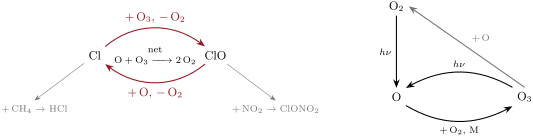
Left: the chlorine catalytic cycle, which destroys one ozone molecule and one oxygen atom per turn and returns the chlorine atom; the grey arrows lead to the reservoirs. Right: the Chapman cycle, in which O and O3 exchange rapidly by recombination and photolysis while the slow steps make and destroy odd oxygen.
Left: the chlorine catalytic cycle, which destroys one ozone molecule and one oxygen atom per turn and returns the chlorine atom; the grey arrows lead to the reservoirs. Right: the Chapman cycle, in which O\ce{O} and OX3\ce{O3} exchange rapidly by recombination and photolysis while the slow steps make and destroy odd oxygen.
Left: ozone at a model altitude of about 30\, km (230\, K, evaluated rate constants, photolysis rates of the weekend problem), building up from zero under the Chapman mechanism, and lower with a chlorine cycle. Right: the Leighton photostationary state of polluted air at 298\, K, [ O3] = j[ NO2]/k[ NO] with j = 8 × 10⁻³\, s-1 (model noon value).
Left: ozone at a model altitude of about 30 km30\,\mathrm{km} (230 K230\,\mathrm{K}, evaluated rate constants, photolysis rates of the weekend problem), building up from zero under the Chapman mechanism, and lower with a chlorine cycle. Right: the Leighton photostationary state of polluted air at 298 K298\,\mathrm{K}, [OX3]=j[NOX2]/k[NO][\ce{O3}] = j[\ce{NO2}]/k[\ce{NO}] with j=8×10⁻³ s−1j = 8 \times 10^{-3}\,\mathrm{s}^{-1} (model noon value).
Read in context →