
All books

Professional

Apps About Coach Log in Start reading

Chemistry · Glossary

What is Photoisomerisation, photostationary state?

Also known as: photoisomerisation · photostationary state

Definition 14.6 University Chemistry — Year 3 · Chapter 14 — Photochemistry

A photoisomerisation is a light-induced conversion of one isomer into another, typically E→ZE \to Z about a double bond. Under continuous irradiation two isomers that both absorb reach a photostationary state, a steady composition set by the light, not by thermodynamics.
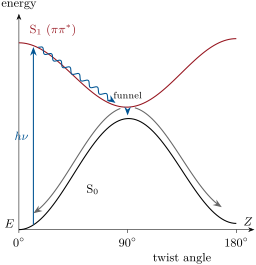
Ground state (S_0) and first excited state (S_1) of an alkene against the twist of its double bond (schematic). Excitation of the E isomer (vertical arrow) is followed by twisting on S_1 to the perpendicular geometry, where the two surfaces nearly touch; the molecule returns to S_0 there and relaxes to E or to Z.
Ground state (S0\mathrm S_0) and first excited state (S1\mathrm S_1) of an alkene against the twist of its double bond (schematic). Excitation of the EE isomer (vertical arrow) is followed by twisting on S1\mathrm S_1 to the perpendicular geometry, where the two surfaces nearly touch; the molecule returns to S0\mathrm S_0 there and relaxes to EE or to ZZ.
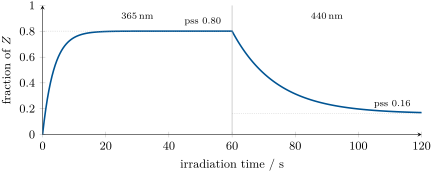
A model photoswitch (an azobenzene-like molecule) irradiated at 365\, nm, where the E isomer absorbs much more strongly, then at 440\, nm, where the Z isomer does: the composition switches between two photostationary states (model absorption coefficients and quantum yields).
A model photoswitch (an azobenzene-like molecule) irradiated at 365 nm365\,\mathrm{nm}, where the EE isomer absorbs much more strongly, then at 440 nm440\,\mathrm{nm}, where the ZZ isomer does: the composition switches between two photostationary states (model absorption coefficients and quantum yields).
Read in context →