University Chemistry — Year 3 · Bachelor Year 3
14Photochemistry
Vision begins when one photon bends one molecule. In the rod cells of the eye, retinal sits in its protein in the 11-cis form; a photon of green light turns it into the all-trans form, and the isomerisation is essentially complete within , faster than almost any other chemical event. The rest of vision, an enormous biochemical amplification, follows from that single bent molecule. The same rules (one photon excites one molecule, which then chooses among several fates) govern sunscreens, the synthesis of strained rings, photodynamic therapy, the smog over cities and the ozone layer that shields the surface of the Earth from ultraviolet light.
You already know
Chapter 7 described the excited states of molecules, the Jablonski diagram, intersystem crossing, fluorescence and phosphorescence, quenching and the quantum yield of a photophysical process. The Year 1 volume defined radicals, homolysis and / isomers; the Year 2 volume concerted reactions, frontier orbitals and catalytic cycles. Chapter 13 treated chain reactions and steady states.
14.1 Light as a reagent
Two old principles start the subject: only light that is absorbed can cause a chemical change (Grotthuss and Draper), and each absorbed photon excites one molecule (Stark and Einstein).
Definition 14.1 (Photon flux, chemical actinometer)
The photon flux of a light source is the number of photons it delivers per unit time, often counted in moles of photons (einstein) per second. A chemical actinometer is a photochemical reaction of accurately known quantum yield used to measure a photon flux.
Proposition 14.2 (Stark–Einstein law)
In ordinary light intensities, each absorbed photon excites exactly one molecule; the primary quantum yields of all the processes that start from the excited state add up to 1.
Partial proof. That one photon is absorbed by one molecule at a time is admitted (two-photon absorption needs the intensities of pulsed lasers). The excited molecule then disappears by competing first-order processes of rate constants (Chapter 7): the fraction that takes path is , and . ∎
The quantum yield of a reaction, the number of molecules converted per photon absorbed, need not obey this limit: a primary photochemical step can start a chain. A mixture of and exposed to light reacts with quantum yields of and more, each photolysed starting a chain like that of the hydrogen–bromine reaction of Chapter 13; a quantum yield larger than 1 is the signature of a chain.
Proposition 14.3 (Rate of a photochemical reaction)
A solution of absorbance at the irradiation wavelength, receiving a photon flux (einstein per second), absorbs ; if the reactant absorbs all of it, the reaction converts moles per second.
Proof. By the Beer–Lambert law the transmitted flux is , so the absorbed one is ; by definition of the quantum yield, molecules react per photon absorbed. ∎
Method 14.4 (The rate of a photoreaction from the lamp)
- Photon energy ; photon flux for a power reaching the sample, or measured with an actinometer; divide by for einstein per second.
- Absorbed fraction , with at the irradiation wavelength (it changes as the reactant is consumed).
- Rate in mol/s, divided by the volume for a concentration rate.
Method 14.5 (Ferrioxalate actinometry)
- Irradiate, in the same cell and geometry as the experiment, an acidified solution of potassium tris(oxalato)ferrate(III), concentrated enough to absorb practically all the light below about .
- Light reduces Fe(III) to Fe(II) with a calibrated quantum yield; after a measured time, add 1,10-phenanthroline and buffer, and measure the absorbance of the red complex.
- Moles of Fe(II) divided by (quantum yield time) give the photon flux.
14.2 Photochemical reactions
Definition 14.6 (Photoisomerisation, photostationary state)
A photoisomerisation is a light-induced conversion of one isomer into another, typically about a double bond. Under continuous irradiation two isomers that both absorb reach a photostationary state, a steady composition set by the light, not by thermodynamics.
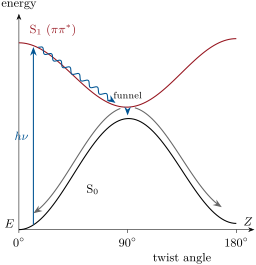
The twisting of a double bond explains why light isomerises alkenes. In the ground state the energy rises as the two ends twist, to a maximum at where the bond is broken. In the excited state the order is reversed: the twisted geometry is the most stable. An excited molecule twists towards , where the two surfaces come together, crosses back to the ground state there, and falls to either side: to the isomer it started from or to the other one.
Proposition 14.7 (Photostationary composition)
Under monochromatic irradiation of an optically thin solution, two isomers and with absorption coefficients , and quantum yields , reach the photostationary ratio
Proof. In an optically thin sample each isomer absorbs a flux proportional to , so with a constant fixed by the light; the steady state sets the bracket to zero. (The result holds also for thick samples, both isomers then sharing the absorbed light in the same proportion.) ∎
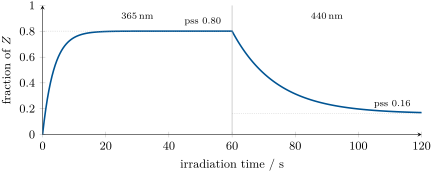
The 11-cis to all-trans isomerisation of retinal in rhodopsin is such a reaction, made exceptionally fast and selective by the protein. Synthetic photoswitches built on azobenzene or stilbene are used to control molecular machines, materials and, attached to drugs or ion channels, biological activity with light.
Definition 14.8 (Photolysis)
Photolysis is the breaking of a bond by light. In the atmosphere, the first-order rate constant of the photolysis of a species, its photolysis rate constant, sums over wavelengths the solar photon flux times the absorption cross-section times the quantum yield.
A photon breaks a bond only if its energy exceeds the dissociation energy: . For , from the thermochemical tables, and only light shorter than can split it.
Excited ketones and alkenes also form bonds. Two alkenes, one of them excited, combine into a cyclobutane: the photocycloaddition, forbidden in the ground state and allowed in the excited state for orbital reasons given in Chapter 26. It makes four-membered rings, strained and otherwise hard to reach, in one step.
Definition 14.9 (Norrish reactions)
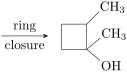
A Norrish type I reaction is the cleavage, by an excited ketone, of the bond between the carbonyl carbon and an carbon, into an acyl and an alkyl radical. A Norrish type II reaction is the abstraction, by the oxygen of an excited ketone, of a hydrogen atom from the carbon, giving a 1,4-biradical that either cleaves into an enol and an alkene or closes into a cyclobutanol.


The photoreduction of benzophenone is the classic bimolecular version: its triplet abstracts a hydrogen atom from an alcohol solvent such as propan-2-ol, and two of the resulting diphenylhydroxymethyl radicals couple into benzopinacol, which crystallises from the solution.
14.3 Photosensitisation
Definition 14.10 (Photosensitisation, singlet oxygen)
A photosensitiser is a molecule that absorbs light and transfers the energy or an electron to another molecule, which does not itself absorb: this is photosensitisation. In triplet energy transfer the triplet state of the sensitiser, formed by intersystem crossing, gives its energy to the acceptor on contact, leaving the acceptor in its triplet state. Singlet oxygen is the lowest excited state of , , formed this way from ground-state oxygen.
Proposition 14.11 (Energy condition for triplet transfer)
Triplet–triplet energy transfer from a donor D to an acceptor A is close to the diffusion limit when exceeds by more than about , and falls steeply as the difference becomes negative.
Partial proof. The transfer conserves spin (two triplets exchanged for a singlet and a triplet) and needs orbital contact (an exchange mechanism, admitted). Its equilibrium constant is , about 60 for a excess at : the forward step then happens at nearly every encounter. When the difference is negative, the forward rate constant is the diffusion limit times the inverse of that factor (the uphill direction pays the Boltzmann factor); the quantitative curve is admitted. ∎
A good sensitiser absorbs where the acceptor does not, crosses to its triplet with a high yield, and has a long triplet lifetime: benzophenone, with a triplet yield close to 1, is the standard. Singlet oxygen is a reactive electrophile: it adds to dienes and to electron-rich alkenes. In photodynamic therapy a sensitiser that accumulates in a tumour, illuminated through an optical fibre, makes singlet oxygen that destroys the cells around it.
Definition 14.12 (Photoredox catalysis)
Photoredox catalysis uses a photosensitiser whose excited state is both a stronger oxidant and a stronger reductant than its ground state to transfer single electrons to or from substrates, generating radicals under visible light; the sensitiser is regenerated in a catalytic cycle.
The ruthenium complex is the prototype: its metal-to-ligand charge transfer excited state, reached with blue light and living about a microsecond, can take an electron from an amine or give one to an organic halide. The radicals formed take part in bond-forming reactions under conditions far milder than those of classical radical chemistry.
14.4 Photochemistry of the atmosphere
Definition 14.13 (Chapman mechanism, ozone layer)
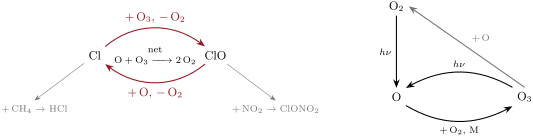
The Chapman mechanism is the set of four steps
The ozone layer is the region of the stratosphere, about 15 to above the ground, where these reactions maintain the largest concentrations of ozone.
Theorem 14.14 (Chapman steady state)
In the Chapman mechanism, O and reach the steady state
Proof. O and interconvert quickly through steps 2 and 3 (seconds), much faster than they are made or destroyed: setting the fast exchange to equilibrium, , gives the ratio. Their sum, the odd oxygen, is made by step 1 (two O per ) and destroyed by step 4 (two odd oxygens per event): . Substituting from the ratio gives . ∎
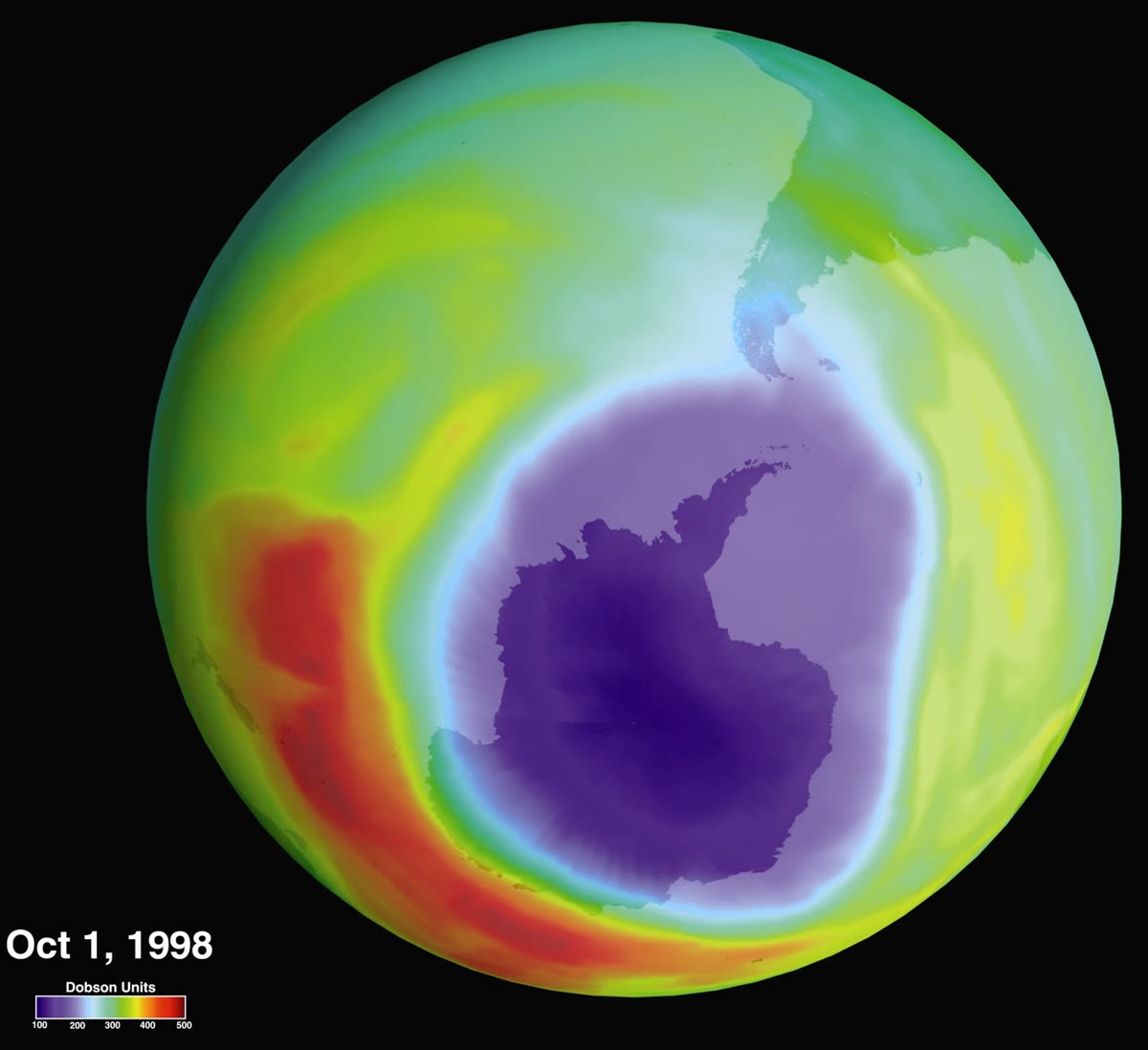
With the rate constants of the evaluated database and photolysis rates typical of (data of the weekend problem), the Chapman model gives about ozone molecules per , some fifteen parts per million. Integrated over altitude, the whole atmosphere holds on average about 300 Dobson units of ozone: compressed to the surface pressure, a layer thick. The Chapman mechanism alone predicts more than is observed: catalytic cycles destroy ozone faster.
Definition 14.15 (Ozone depletion, reservoir species)
Ozone depletion is the decrease of the stratospheric ozone column caused by catalytic cycles of radicals (Cl and ClO, NO and , OH and ). A reservoir species is a stable molecule (HCl, ) that holds a catalytic radical in an inactive form, from which it can later be released.
Proposition 14.16 (Chain length of the chlorine cycle)
If at each turn the Cl atom reacts with with probability and the ClO radical with O with probability , the mean number of turns before the chlorine is captured in a reservoir is with ; each turn destroys one ozone molecule.
Proof. Each turn is completed with probability , independently of the previous ones: the number of completed turns before capture has probability , and . ∎
![Left: ozone at a model altitude of about 30\, km (230\, K, evaluated rate constants, photolysis rates of the weekend problem), building up from zero under the Chapman mechanism, and lower with a chlorine cycle. Right: the Leighton photostationary state of polluted air at 298\, K, [ O3] = j[ NO2]/k[ NO] with j = 8 × 10⁻³\, s-1 (model noon value).](/images/onecourse/chapters/chemistry-4/b3-photochemistry/fig-8d3da4ba0932.svg)
Each chlorine atom, freed in the stratosphere from chlorofluorocarbons by ultraviolet photolysis, destroys ozone in tens of turns before it is stored as HCl or , and is released again many times over the years it spends there. Over Antarctica, in the polar night, clouds of ice and nitric acid hydrate form; on their surfaces the two reservoirs react together, , the nitric acid stays in the particles, and when the Sun returns in spring is photolysed: with removed, the chlorine is not captured again, and a cycle through the ClO dimer destroys ozone without needing O atoms. The ozone column falls to about 100 Dobson units: the ozone hole.
Proposition 14.17 (Leighton relation)
In sunlit air where ozone is made only by the photolysis of and destroyed only by NO, the three species reach the photostationary state
Proof. (), (fast: every O atom makes an ), and (): at steady state the ozone made, , equals the ozone destroyed, . ∎
The cycle by itself makes no net ozone: it only exchanges NO, and . What raises the ratio , and hence the ozone, is the oxidation of NO to without consuming ozone, by peroxy radicals that come from the oxidation of hydrocarbons by OH, the detergent of the troposphere.
Definition 14.18 (Photochemical smog)
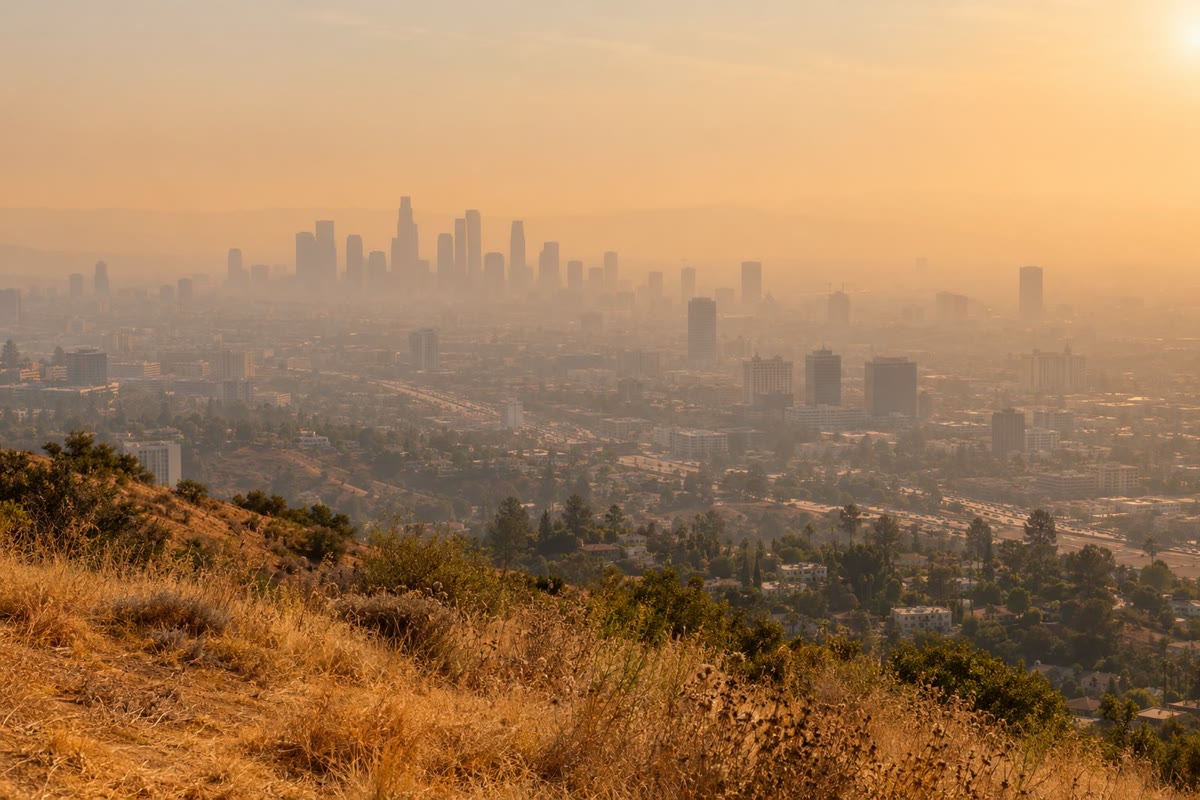
Photochemical smog is the mixture of ozone, nitrogen dioxide, aldehydes, peroxyacyl nitrates and fine particles formed in sunlit air polluted by nitrogen oxides and volatile organic compounds.
In the lab — A photoreactor
A medium-pressure mercury lamp, cooled in a quartz jacket, sits in the centre of the reaction vessel; a glass filter sleeve removes the wavelengths below about , which would destroy the products. The solution is deoxygenated with a stream of nitrogen (oxygen quenches triplets) and stirred. The whole reactor is enclosed: the lamp emits ultraviolet light harmful to eyes and skin, and is never looked at, even briefly.
Safety


Benzophenone, a common sensitiser and the reactant of the photoreduction: suspected of causing cancer, may damage organs after prolonged exposure, toxic to aquatic life. Weighed and handled with gloves; residues go to the organic waste.
History — The photochemistry of the future, and the hole in the sky
In 1912 Giacomo Ciamician, in Bologna, asked whether industry might one day run on sunlight, as plants do, rather than on coal; he had spent years exposing flasks of organic compounds to the sun on the roof of his laboratory. In 1985, three scientists working at an Antarctic research station reported that the springtime ozone column over it had been falling steeply since the late 1970s. The ozone hole, explained within a few years by the chemistry of this chapter, led to the phasing out of chlorofluorocarbons.
14.5 Exercises
Exercise 14.1 ★
A lamp delivers at . How many photons per second, and how many einstein per second?
Solution
Solution of Exercise 14.1.
; photons per second, i.e. .
Exercise 14.2 ★
In , a solution absorbing converts of reactant. Compute the quantum yield.
Solution
Solution of Exercise 14.2.
Absorbed: ; .
Exercise 14.3 ★
The photochemical reaction of with has quantum yields up to and more. What does this show? Write the propagation steps.
Solution
Solution of Exercise 14.3.
Far more molecules react than photons are absorbed: each photolysed starts a chain, and , which runs thousands of turns before termination.
Exercise 14.4 ★
From the enthalpies of formation at 0 K of O () and (), compute the longest wavelengths that can split into two atoms and into and O.
Solution
Solution of Exercise 14.4.
; . : , .
Exercise 14.5 ★★
A photoswitch has, at , and , with and (data of the exercise). Compute the photostationary composition.
Solution
Solution of Exercise 14.5.
: 80 % , 20 % .
Exercise 14.6 ★★
Give the products of the Norrish type II reaction of hexan-2-one, and explain why pentan-2-one gives ethene rather than propene.
Solution
Solution of Exercise 14.6.
Hexan-2-one: the 1,4-biradical cleaves into the enol of acetone (hence acetone) and propene, or closes into 1,2-dimethylcyclobutan-1-ol. In pentan-2-one the carbon is the terminal : cleavage of the – bond leaves .
Exercise 14.7 ★★
An acceptor has a triplet energy of . Among three candidate sensitisers with triplet energies of 289, 253 and (data of the exercise), which transfers efficiently? Estimate the equilibrium constant of transfer for each at .
Solution
Solution of Exercise 14.7.
with : 289 gives ; 253 gives ; 236 gives . Only the first transfers at almost every encounter.
Exercise 14.8 ★★
At , with , and , compute and the steady-state ratio .
Solution
Solution of Exercise 14.8.
; ; .
Exercise 14.9 ★★
At , compute the rate constants of and , and the probability that a Cl atom meets rather than when and .
Solution
Solution of Exercise 14.9.
; . Pseudo-first-order rates 54 and : probability .
Exercise 14.10 ★★★
At noon in a city, and . Compute the photostationary ozone at in molecules per and in ppb (air at ). What happens at night?
Solution
Solution of Exercise 14.10.
; . Air at and holds : . At night is no longer photolysed and NO destroys ozone until one of them is used up.
Exercise 14.11 ★★★
A solution of absorbance 0.50 at receives of light at that wavelength; the reaction has . Compute the initial rate in .
Solution
Solution of Exercise 14.11.
; photons per second . Absorbed: , ; rate , i.e. in .
Exercise 14.12 ★★★
A ferrioxalate actinometer, with a quantum yield of 1.25 at (data of the exercise) and total absorption, forms of Fe(II) in . Compute the photon flux. Why must the conversion stay small?
Solution
Solution of Exercise 14.12.
. At low conversion the actinometer still absorbs all the light, and the coloured products do not filter it.
14.6 Problem: Making and Unmaking the Ozone Layer
Problem 14.1
Weekend problem — making and unmaking the ozone layer: photon thresholds, the Chapman steady state with evaluated rate constants, the chlorine cycle, and the reservoirs that stop it
A model of the stratosphere near (data of the problem): , , , photolysis rate constants () and (), , . Evaluated rate constants (, or for , concentrations being counted per ): ; ; Cl + : ; O + ClO: ; Cl + : ; ClO + + M: at these conditions.
Part I — Photon thresholds.
- Compute from .
- Deduce the longest wavelength that splits .
- Compute the energy of () and its threshold wavelength.
- Visible light could thus split ozone; why is the ultraviolet absorption of ozone the one that matters for life?
- Why is photolysed only high in the atmosphere?
Part II — The Chapman steady state.
- Write the four Chapman steps.
- Compute and at .
- Compute .
- Compute .
- Show that .
- Compute and its mixing ratio.
- Compute .
- Observed ozone is lower than this. Why?
Part III — The chlorine cycle.
- Write the cycle and its net reaction.
- Compute the lifetime of a Cl atom against .
- Compute the lifetime of ClO against O.
- Deduce the steady ratio .
- With , compare the rate of odd-oxygen loss by the cycle with that of the Chapman step .
- Which step limits the cycle?
Part IV — The reservoirs.
- Compute the probability that a Cl atom reacts with rather than with .
- Compute the probability that ClO reacts with O rather than with .
- Deduce the probability that a turn of the cycle is completed.
- Deduce the mean number of turns before the chlorine is captured.
- Explain how polar stratospheric clouds lengthen the chain.
- State the result: the number of ozone molecules one chlorine atom destroys, in this model, before it is captured in a reservoir.
Solution
Solution of Problem 14.1.
1. . 2. . 3. ; . 4. The visible absorption of ozone is weak; its strong ultraviolet absorption (about 200 to ) removes the radiation that damages DNA and skin. 5. Light below is absorbed by itself on the way down: little of it penetrates below the upper stratosphere. 6. ; ; ; . 7. ; . 8. . 9. . 10. Odd-oxygen balance with (see the theorem). 11. , a mixing ratio of (). 12. . 13. Catalytic cycles (nitrogen oxides, hydrogen oxides, chlorine) add loss channels for odd oxygen. 14. , ; net . 15. . 16. . 17. . 18. Practically all the chlorine is ClO: loss , against for the Chapman step: the cycle adds about 7 %. 19. , the slow step (). 20. . 21. . 22. . 23. . 24. On the clouds, frees the chlorine, and the nitric acid stays in the particles: without , approaches 1 and the chain becomes very long; a cycle through the ClO dimer destroys ozone without O atoms. 25. About 40 ozone molecules per chlorine atom before capture (in this model of ); each atom is released from its reservoirs many times.