
সব বই

পেশাদার

1 Markets I: The Ecosystem and Exchange-Traded Marketsবাজার অনলাইন 2 Markets II: Rates, FX and Creditবাজার অনলাইন 3 Markets III: Commodities, Energy and Cryptoবাজার অনলাইন 4 Quantitative Methodsপদ্ধতি অনলাইন 5 Derivatives and Volatilityডেরিভেটিভস অনলাইন 6 Rates, Credit, XVA and Riskসুদহার, ঋণ ও ঝুঁকি অনলাইন 7 Research Craft: Predictors, Backtests, Measurement, Portfoliosগবেষণা অনলাইন 8 Strategies I: Equities and Futuresকৌশল অনলাইন 9 Strategies II: Volatility, Relative Value, Macro and the Bank Desksকৌশল অনলাইন 10 Microstructure and Executionএক্সিকিউশন অনলাইন 11 Market Making and High-Frequency Tradingমার্কেট মেকিং অনলাইন 12 Machine Learning for Marketsমেশিন লার্নিং অনলাইন 13 Low-Latency Softwareপ্রযুক্তি অনলাইন 14 Networks, Hardware and Trading Infrastructureপ্রযুক্তি অনলাইন 15 Research, Data and Risk Platformsপ্রযুক্তি অনলাইন 16 The Desk and the Firmপ্রতিষ্ঠান অনলাইন 17 The Industry: Firms, Roles and Careersক্যারিয়ার অনলাইন 18 Interviews I: Maths, Probability and Speedক্যারিয়ার অনলাইন 19 Interviews II: Markets, Trading Games and the Final Roundক্যারিয়ার অনলাইন 20 Interviews III: Codeক্যারিয়ার অনলাইন
অ্যাপ পরিচিতি Coach সাইন ইন পড়া শুরু করো

বইগুলো এখনো বাংলা ভাষায় পাওয়া যায় না — ইংরেজি সংস্করণ দেখানো হচ্ছে।

Chemistry · পরিভাষা

Photoisomerisation, photostationary state কী?

অন্য নাম: photoisomerisation · photostationary state

Definition 14.6 University Chemistry — Year 3 · অধ্যায় 14 — Photochemistry

A photoisomerisation is a light-induced conversion of one isomer into another, typically E→ZE \to Z about a double bond. Under continuous irradiation two isomers that both absorb reach a photostationary state, a steady composition set by the light, not by thermodynamics.
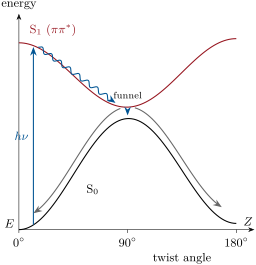
Ground state (S_0) and first excited state (S_1) of an alkene against the twist of its double bond (schematic). Excitation of the E isomer (vertical arrow) is followed by twisting on S_1 to the perpendicular geometry, where the two surfaces nearly touch; the molecule returns to S_0 there and relaxes to E or to Z.
Ground state (S0\mathrm S_0) and first excited state (S1\mathrm S_1) of an alkene against the twist of its double bond (schematic). Excitation of the EE isomer (vertical arrow) is followed by twisting on S1\mathrm S_1 to the perpendicular geometry, where the two surfaces nearly touch; the molecule returns to S0\mathrm S_0 there and relaxes to EE or to ZZ.
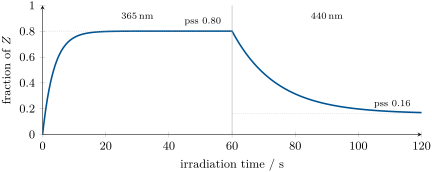
A model photoswitch (an azobenzene-like molecule) irradiated at 365\, nm, where the E isomer absorbs much more strongly, then at 440\, nm, where the Z isomer does: the composition switches between two photostationary states (model absorption coefficients and quantum yields).
A model photoswitch (an azobenzene-like molecule) irradiated at 365 nm365\,\mathrm{nm}, where the EE isomer absorbs much more strongly, then at 440 nm440\,\mathrm{nm}, where the ZZ isomer does: the composition switches between two photostationary states (model absorption coefficients and quantum yields).
প্রসঙ্গসহ পড়ো →