All books

Professional

Apps About Coach Log in Start reading

Chemistry · Glossary

What is Retention factor?

Definition 22.9 School Chemistry — Grades 1 to 12 · Chapter 22 — Chemical Species, Natural and Synthetic

The retention factor of a spot is

Rf=distance from the starting line to the spotdistance from the starting line to the solvent front,R_f = \frac{\text{distance from the starting line to the spot}} {\text{distance from the starting line to the solvent front}},

a number between 0 and 1. For a given plate, eluent and temperature, each species has its own RfR_f.

Read in context →
Definition 29.20 University Chemistry — Year 1 · Chapter 29 — Lab Techniques I: Safety, Measurement and Separation

In thin-layer chromatography (TLC), a spot of the sample is deposited on a baseline near the foot of a plate coated with a stationary phase (silica); the plate stands in a closed tank in a little eluent, which rises through the coating by capillarity and carries the species at different rates. The retention factor of a species is

Rf=distance travelled by the spotdistance travelled by the eluent front,R_f = \frac{\text{distance travelled by the spot}} {\text{distance travelled by the eluent front}},

both measured from the baseline; 0≤Rf≤10 \le R_f \le 1, and for given stationary phase, eluent and temperature it characterises the species.
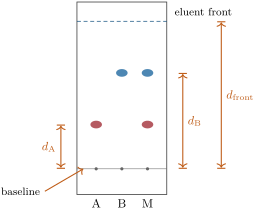
A developed TLC plate: references A and B and a mixture M, deposited on the baseline. R_f( A) = d_ A/d_ front = 0.30, R_f( B) = 0.65; the mixture shows both spots, at the same heights.
A developed TLC plate: references A and B and a mixture M, deposited on the baseline. Rf(A)=dA/dfront=0.30R_f(\mathrm{A}) = d_{\mathrm{A}}/d_{\mathrm{front}} = 0.30, Rf(B)=0.65R_f(\mathrm{B}) = 0.65; the mixture shows both spots, at the same heights.
Read in context →
