University Chemistry — Year 1 · Bachelor Year 1
29Lab Techniques I: Safety, Measurement and Separation
Two students recrystallise the same batch of aspirin and measure its melting point on the same heated bench. One reads , the other . Do they disagree? Is the product pure? Neither question can be answered from the two numbers alone: a measurement is worth something only with its uncertainty, and a comparison only with a rule. This last chapter gathers the practical side of the year: how to read the hazards of what is on the bench, how to state a measured value and its uncertainty and compare it with another, and how the classic operations of the organic laboratory — extraction, filtration, recrystallisation, distillation — separate a product from what surrounds it, then check that it is pure.
You already know
Solubility and miscibility from intermolecular forces, polar and apolar solvents (Chapter 4); burettes, pipettes and the end point of a titration (Chapter 15). The school volume (grade 10) introduced liquid–liquid extraction, recrystallisation, thin-layer chromatography and the yield of a synthesis; here they are given their numbers.
29.1 Hazards and their labels
Definition 29.1 (Hazard and risk)
A hazard is the intrinsic property of a substance (or of a situation) that can cause harm: flammability, corrosiveness, toxicity. The risk is the likelihood that harm actually occurs, and its severity, under the given conditions of use: it depends on the hazard and on the exposure (quantity, concentration, duration, route, protection).
A hazard cannot be changed without changing the substance; a risk is reduced by working on the exposure: a smaller quantity, a more dilute solution, a fume cupboard, gloves and goggles, or a less hazardous reagent for the same job.
Definition 29.2 (GHS labelling)
The labels of chemicals follow the Globally Harmonized System (GHS).
- A hazard pictogram is a black symbol on a white diamond with a red border; there are nine,
GHS01toGHS09. - The signal word is Danger for the more severe hazard categories and Warning for the less severe; a label carries one only, the more severe.
- A hazard statement is a standard phrase, coded H followed by three digits, describing a hazard: H2xx physical hazards, H3xx health hazards, H4xx environmental hazards.
- A precautionary statement, coded P and three digits, gives a measure to take: P1xx general, P2xx prevention, P3xx response, P4xx storage, P5xx disposal.
- The safety data sheet is the document the supplier provides with a product, in standard sections: identification, hazards, composition, first aid, fire fighting, handling and storage, exposure controls and protection, physical and chemical properties, stability, toxicity, disposal and transport.
 GHS01 explosive |  GHS02 flammable |  GHS03 oxidising |  GHS04 gas under pressure |  GHS05 corrosive |
 GHS06 acute toxicity |  GHS07 harmful, irritant |  GHS08 health hazard |  GHS09 environment |
Example 29.3 (Reading the label of ethanol)
A bottle of ethanol carries the pictograms GHS02 and GHS07, the signal word Danger, and the statements H225 (highly flammable liquid and vapour, a physical hazard, whose category calls for Danger) and H319 (causes serious eye irritation, a health hazard, Warning on its own). Its precautionary statements include P210 (keep away from heat, sparks and open flames; no smoking), P233 (keep the container tightly closed), P280 (wear gloves and eye protection), P305+P351+P338 (if in eyes: rinse cautiously with water for several minutes, remove contact lenses, continue rinsing) and P403+P235 (store in a well-ventilated place, keep cool). The practical consequences: no flame on the bench where ethanol is used, goggles, a closed bottle.
Method 29.4 (Preparing a session from the safety data sheets)
For each substance used or formed:
- read its pictograms, signal word and H statements (section 2 of the sheet), and note the physical hazards (fire, pressure, reactivity) apart from the health and environmental ones;
- for each operation (weighing, heating, transferring, filtering), estimate the exposure: quantity, state (a volatile liquid or a fine powder reaches the lungs), duration;
- choose the measures: substitution by a less hazardous reagent, smaller scale, fume cupboard, then personal protection (P2xx statements);
- plan the response to an incident (P3xx: eyes, skin, swallowing, fire) and where each waste goes (P5xx).
In the lab — Waste
Nothing goes down the sink by default. Organic solvents are collected in two containers, halogenated (dichloromethane, chloroform) and non-halogenated (ethanol, propanone, cyclohexane, ethyl ethanoate), since they are treated differently; aqueous acid and base solutions are neutralised before disposal; solutions of heavy-metal ions (chromium, copper, silver) have their own containers; broken glass and contaminated solids are kept apart from ordinary rubbish. The statement P273, “avoid release to the environment”, on a label is a reminder that the waste container, not the drain, is the end of the experiment.
29.2 Measurement and uncertainty
A measured value is never the exact value of the quantity measured: repeat the measurement and the result changes a little; read the scale and the last digit is a guess. The uncertainty says how far from the measured value the true value may reasonably lie.
Definition 29.5 (Measurement uncertainty)
- The measurement uncertainty is a parameter that characterises the dispersion of the values that can reasonably be attributed to the quantity measured.
- The standard uncertainty is that uncertainty expressed as a standard deviation.
- A type A evaluation obtains by the statistical analysis of a series of repeated measurements; a type B evaluation obtains it by any other means: the graduation of an instrument, the tolerance stated by its maker, a calibration certificate, the number of digits of a tabulated value.
- The expanded uncertainty is the standard uncertainty multiplied by a coverage factor , usually ; for a normal distribution the interval contains the true value with a probability of about .
- The relative uncertainty is , often given in per cent.
Proposition 29.6 (Type A evaluation)
If independent measurements of the same quantity are made, the best estimate is their mean ; the experimental standard deviation is
and the standard uncertainty of the mean is .
Proof. Admitted at this level; the statistics of repeated measurements, including the Student coefficient used when is small, are treated in the Year 2 volume. ∎
Example 29.7 (Twenty end points)
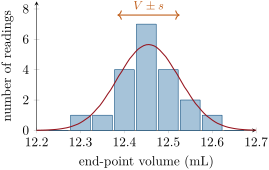
For the twenty readings of the figure, , and . One reading is uncertain by about ; the mean of twenty by about , four and a half times less. The result is with .
Proposition 29.8 (Type B evaluation for a rectangular distribution)
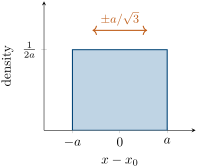
If all that is known of a quantity is that it lies, with equal probability, anywhere between and , its standard uncertainty is
Proof. The probability density is on and zero elsewhere; its mean is by symmetry and its variance is
∎
Example 29.9 (A reading and a tolerance)
A burette graduated every is read to half a division: the reading lies within of the value noted, so . A pipette whose maker states a tolerance of delivers its volume with . A tabulated value given as is known to : .
Proposition 29.10 (Combining uncertainties)
For independent quantities: if or , then ; if or , then
Several sources of uncertainty on the same quantity (a type A part and type B parts) combine in the same way, as a sum of squares.
Proof. Admitted at this level. ∎
The squares, not the uncertainties themselves, add: two independent errors rarely push in the same direction at full size. A titrated volume is a difference of two burette readings, so its reading uncertainty is ; and one large source of uncertainty dominates the others, which is where an improvement should be sought. The general rule, with partial derivatives, belongs to the Year 2 volume.
Method 29.11 (Reporting a result)
- List the sources of uncertainty; evaluate each as a standard uncertainty (type A from a series, type B as from a half-width).
- Combine them as a sum of squares (Proposition 29.10).
- Give the expanded uncertainty with one or two significant figures, and round the value to the same decimal place: unit, .
Definition 29.12 (Normalised deviation)
The normalised deviation (or -score) between two independent values and of the same quantity, of standard uncertainties and , is
The two values are said to be compatible when ; a measured value is compatible with a reference value under the same condition.
Example 29.13 (The two students)
The two melting points of the opening, and , were each obtained with a standard uncertainty of (reading and calibration of the bench). Then : the students agree. Their mean, , is also compatible with the tabulated melting point of aspirin, under rapid heating. A tabulated value given to the unit has , so a single reading with is compatible with it while it lies within of it: a reading below about would have pointed to an impure product.
29.3 Separating
Definition 29.14 (Partition coefficient)
When a solute A is shared, at equilibrium, between two immiscible solvents, an organic phase and an aqueous phase, the ratio of its concentrations
is, for dilute solutions at a given temperature, a constant: the partition coefficient of A between the two solvents.
Proposition 29.15 (Several extractions are better than one)
A volume of aqueous solution is extracted times, each time with a fresh volume of organic solvent. The fraction of A left in the aqueous phase is
For a fixed total volume of solvent, small portions extract more than one large portion.
Proof. Let be the amount of A in the aqueous phase before an extraction, and after. At equilibrium the organic phase holds , and , so and . Each extraction multiplies the amount left by the same factor; after of them, is the -th power. With a total volume split in portions , ; since decreases with , increases with for , and decreases, towards the limit . ∎
Example 29.16 (One portion or three)
A solute with is extracted from of water with of ethyl ethanoate. In one portion, : is extracted. In three portions of , : . Ethyl ethanoate () is the upper layer in the separating funnel; dichloromethane () would be the lower one.
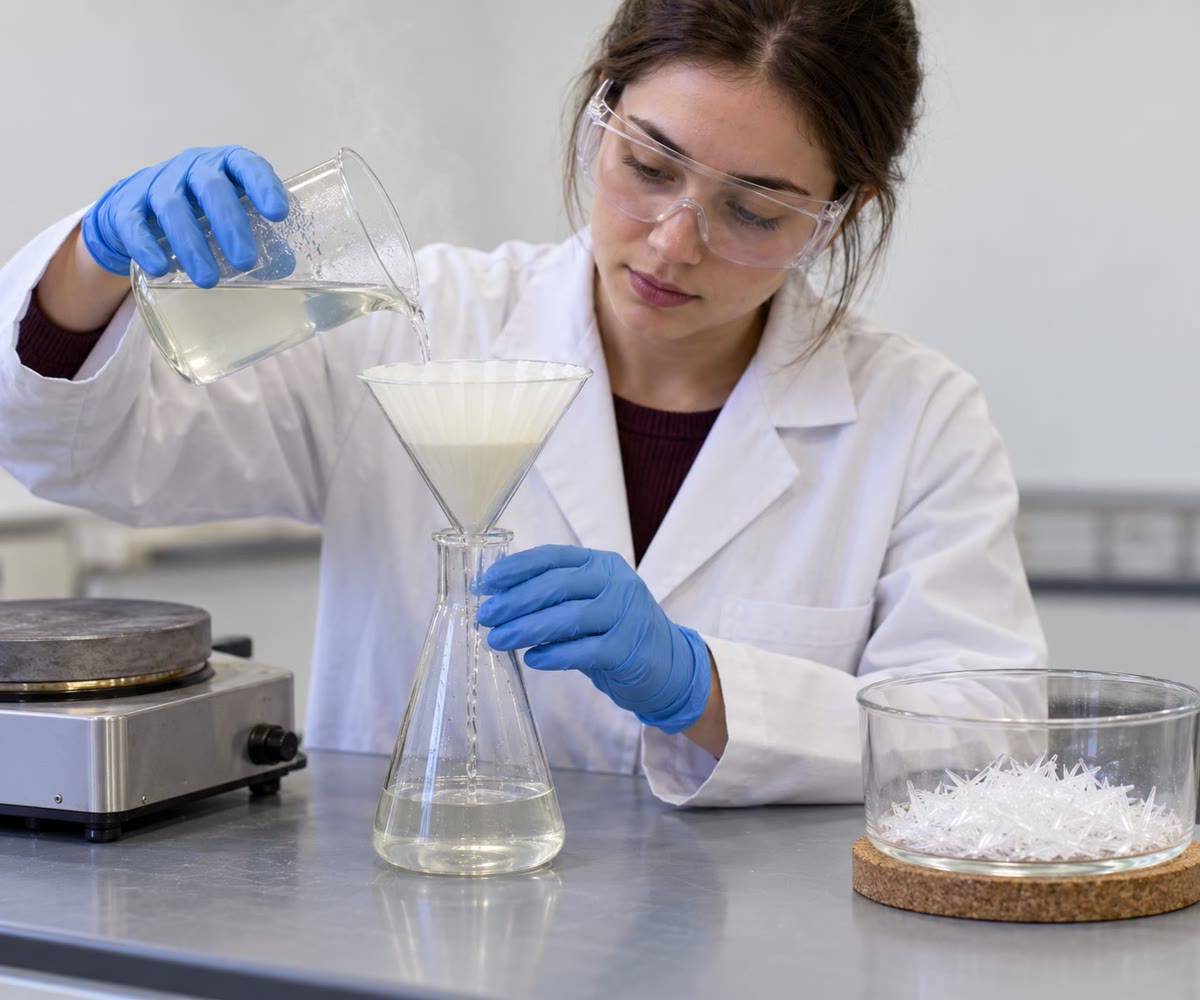
Filtration separates a solid from a liquid. By gravity, through a fluted paper in a funnel, it keeps back an insoluble impurity from a hot solution that must not cool on the way (hot filtration, as in the photograph at the head of the chapter). Under reduced pressure, in a Büchner funnel on a side-arm flask (as drawn in the school volume), it collects a solid quickly and leaves it almost dry; the solid is washed on the filter with a little cold solvent.
Definition 29.17 (Recrystallisation)
Recrystallisation purifies a solid by dissolving it in the minimum of a hot solvent in which it is very soluble hot and little soluble cold, then letting it crystallise on cooling; the impurities either stay dissolved in the cold solvent (the mother liquor) or, being insoluble, are removed beforehand by hot filtration.
Method 29.18 (Recrystallising a solid)
- Choose the solvent: the product very soluble hot and little soluble cold, the soluble impurities soluble even cold, no reaction with the product, a boiling point below the product’s melting point; a mixture of two miscible solvents (ethanol and water) can be tuned to the product.
- Dissolve the crude solid in the minimum of boiling solvent, added in small portions, under reflux if the solvent is volatile or flammable.
- If an insoluble impurity remains, filter hot.
- Let the solution cool slowly, then in ice: slow cooling gives larger, purer crystals, which trap less mother liquor.
- Filter under reduced pressure, wash with a little ice-cold solvent, dry, weigh; check the purity (melting point, TLC).
Example 29.19 (The price of purity)
Aspirin dissolves in water at about at and at , much more near the boiling point. If of mother liquor and of washing water leave the filter at , they carry away about of aspirin, whatever its purity. Every millilitre of solvent beyond the minimum costs yield.
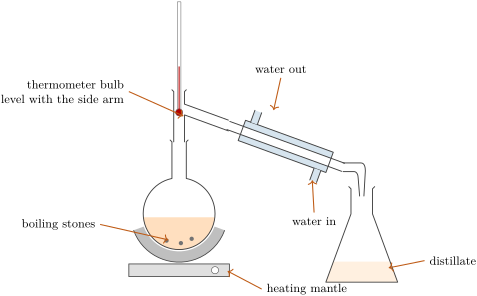
A liquid is purified, or two liquids of well-separated boiling points are separated, by simple distillation: the mixture is boiled, the vapour, richer in the more volatile component, is condensed and collected. The temperature at the side arm is that of the vapour that distils; while it stays constant, a pure substance is passing over. Liquids of close boiling points need fractional distillation, a column between the flask and the head, treated with the liquid–vapour diagrams of the Year 2 volume.
Safety

A distillation apparatus is never closed: heated, a sealed system bursts. Boiling stones are added to the cold liquid, never to a liquid already hot (it may boil over at once). A flammable distillate is collected away from any flame, the receiver if needed in ice.
29.4 Identifying and checking purity
Definition 29.20 (Retention factor)
In thin-layer chromatography (TLC), a spot of the sample is deposited on a baseline near the foot of a plate coated with a stationary phase (silica); the plate stands in a closed tank in a little eluent, which rises through the coating by capillarity and carries the species at different rates. The retention factor of a species is
both measured from the baseline; , and for given stationary phase, eluent and temperature it characterises the species.
On polar silica, a polar species is held back more strongly than a less polar one and has the smaller ; a more polar eluent moves every spot further. Two species with the same on one plate may still differ; two different prove them different. A pure product gives a single spot.
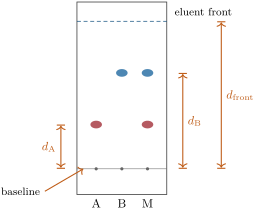
Method 29.21 (Running a TLC)
- Draw the baseline in pencil about from the foot; deposit small spots of dilute solutions of the sample and of the references side by side.
- Put a few millimetres of eluent in the tank (below the baseline), close it, let the atmosphere saturate; stand the plate in it.
- Remove the plate when the front is about from the top; mark the front at once; dry.
- Reveal colourless spots (ultraviolet lamp on a fluorescent plate, iodine vapour, a stain); circle them in pencil.
- Measure the distances from the baseline and compute each ; compare the sample with the references on the same plate.
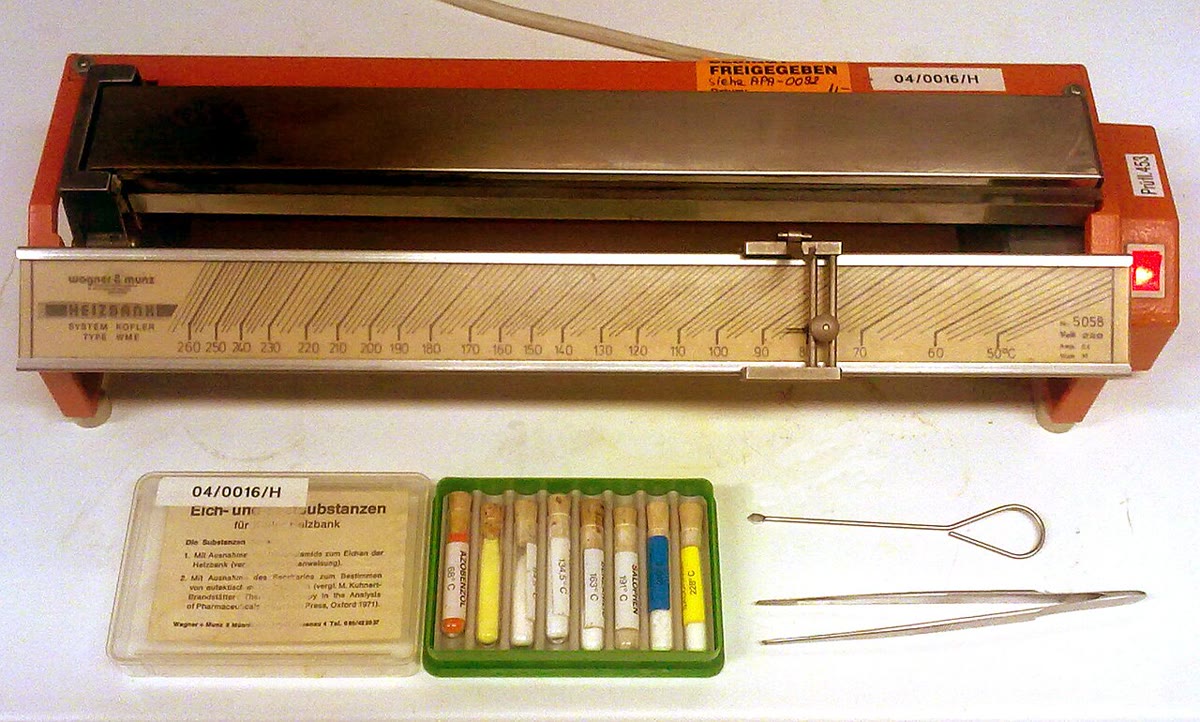
Method 29.22 (Measuring a melting point on a heated bench)
- Switch the bench on well in advance: the gradient takes time to settle.
- Calibrate it with a pure reference substance melting close to the expected value, sprinkled on the strip; set the pointer so that the scale reads its melting point on the line.
- Sprinkle a few crystals of the dry sample from the cold end towards the hot end; push them back and forth with the spatula and set the pointer on the limit beyond which the solid melts at once.
- Read, repeat, clean the strip; take the mean of the readings and state the uncertainty (Method 29.11).
A pure crystalline substance melts sharply at its melting point; an impure one starts to melt lower and melts over a range of temperatures, because the impurity lowers the temperature at which the solid and the liquid coexist (the reason, the chemical potential of a solvent lowered by a solute, is in the Year 2 volume). A melting point well below the tabulated value, or a broad melting range, therefore reveals impurities; a value compatible with the tabulated one, in the sense of the normalised deviation, supports purity without proving it.
In the lab — Calibrating the bench
The references are chosen to bracket the expected value. Acetanilide, which melts at , and benzoic acid, at , are classic standards for products melting between and ; for aspirin, a standard near is better still. Aspirin itself decomposes as it melts, so its observed melting point depends on how fast it is heated: tables give for rapid heating, which is what a bench does.
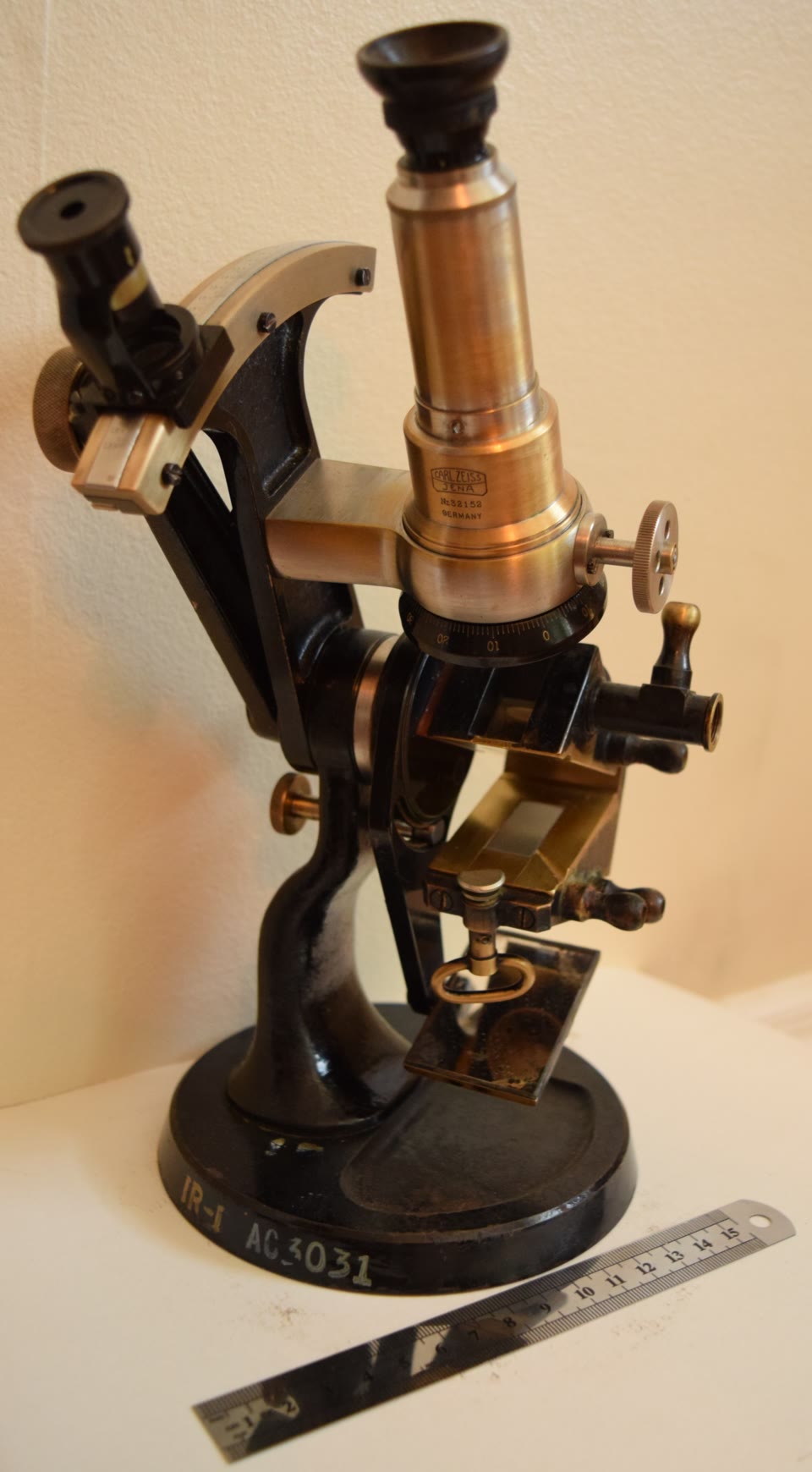
A liquid is identified, and its purity checked, by its refractive index , the ratio of the speed of light in vacuum to its speed in the liquid, measured with the yellow D line of sodium at a stated temperature (usually ), to four decimal places. Water has , ethanol 1.3611 and cyclohexane 1.4266 at . The index falls slightly as the temperature rises, so the instrument is thermostatted.
29.5 Exercises
Exercise 29.1 ★
A bottle of propanone carries the pictograms GHS02 and GHS07 and the statements H225, H319 and H336. Which signal word does it carry? Which statements describe a physical hazard, which a health hazard? Name two precautions they call for.
Solution
Solution of Exercise 29.1.
Danger: H225 (highly flammable liquid, category 2) calls for it, and the label carries the more severe word. H225 is a physical hazard; H319 (serious eye irritation) and H336 (drowsiness or dizziness) are health hazards. Precautions: no flame or spark nearby, a closed bottle; goggles; work in a ventilated place or a fume cupboard.
Exercise 29.2 ★
Hazard or risk? (a) Concentrated sulfuric acid causes severe burns. (b) Weighing of a toxic powder in a fume cupboard with gloves exposes the operator little. (c) Sodium releases hydrogen with water. (d) The same solvent is more dangerous used hot in an open beaker than cold in a closed bottle.
Exercise 29.3 ★
On a TLC plate the eluent front is above the baseline; the sample gives spots at and . Compute their . A reference deposited on the same plate rises to : what can and cannot be concluded?
Solution
Solution of Exercise 29.3.
and . The second spot has the same as the reference: the sample may contain it (it is consistent), but equal on one eluent do not prove identity; a second eluent, or a co-spot of sample and reference that stays a single spot, strengthens the conclusion. The spot at 0.35 is certainly another species.
Exercise 29.4 ★
A burette graduated every is read to half a division. Compute the standard uncertainty of one reading, then of a delivered volume, the difference of two readings.
Solution
Solution of Exercise 29.4.
Half-width , rectangular: . For a difference of two independent readings, .
Exercise 29.5 ★★
Five weighings of the same sample give , , , and . Compute the mean, the experimental standard deviation, the standard uncertainty of the mean, and report the result with .
Solution
Solution of Exercise 29.5.
Mean ; deviations , , , 0, (in ), sum of squares , ; ; : g, .
Exercise 29.6 ★★
A solute with partition coefficient between an organic solvent and water is extracted from of water with of solvent in total. Compute the fraction extracted in one portion, in two portions of , and in three of .
Solution
Solution of Exercise 29.6.
One portion: , extracted. Two of : , . Three of : , .
Exercise 29.7 ★★
A titration gives a concentration of with standard uncertainty ; the solution was prepared at with standard uncertainty . Are the two values compatible? What if the titration uncertainty had been ?
Exercise 29.8 ★★
The solubilities (illustrative values, per ) of a solid in three solvents are: solvent P, 1.5 cold and 2.0 boiling; solvent Q, 0.3 cold and 12 boiling; solvent R, 9 cold and 25 boiling. Which solvent suits a recrystallisation, and why not the other two? With the right solvent, what is the largest fraction of of the solid that can be recovered, if the minimum of boiling solvent is used and the mixture cooled?
Solution
Solution of Exercise 29.8.
Q: little soluble cold, very soluble hot. P dissolves the solid hardly better hot than cold (nothing crystallises on cooling); R keeps too much dissolved cold (large losses). With Q, needs at least of boiling solvent, which keeps dissolved cold: at most , , can be recovered (before any loss on the filter).
Exercise 29.9 ★★
A colourless liquid, thermostatted at , has . Which of water, ethanol and cyclohexane can it be? Why is the temperature stated? What would a value of 1.350 suggest?
Solution
Solution of Exercise 29.9.
Ethanol ( at ); water (1.333) and cyclohexane (1.4266) are excluded. The index varies with temperature, so a value means nothing without it. A value of 1.350, between water and ethanol, suggests a mixture, such as ethanol containing water.
Exercise 29.10 ★★★
With the data of Exercise 29.6, show that however finely the of solvent is divided, at most a fraction of the solute can be extracted, and compute it. How many portions reach of that limit?
Solution
Solution of Exercise 29.10.
With and portions, ; as , (since ), and decreases towards (Proposition 29.15). Here , : at most . Three portions already give , of the limit; reaching of it takes 32 portions of less than : beyond two or three portions, the gain is not worth the work.
Exercise 29.11 ★★★
A quantity is known to lie between and , values near being more likely: its density is triangular, . Check that it is normalised and show that its standard uncertainty is . Compare with the rectangular case.
Solution
Solution of Exercise 29.11.
With : . The mean is by symmetry; the variance is , so , against for the rectangular case: knowing that the middle is more likely reduces the uncertainty.
Exercise 29.12 ★★★
A standard solution is made by dissolving the sample of Exercise 29.5 (molar mass , its uncertainty negligible) in a volumetric flask whose volume has a standard uncertainty of . Compute the concentration and its relative and expanded uncertainties. Which source dominates?
Solution
Solution of Exercise 29.12.
. Relative uncertainties: mass , volume ; combined , that is ; , : mol/L, . The weighing dominates, slightly; the two sources are of the same size.
29.6 Problem: Purifying Aspirin
Problem 29.1
Weekend problem — the hazards of a synthesis, the recrystallisation of crude aspirin and its yield, a melting point with its type A and type B uncertainties, and the normalised deviation from the tabulated value
A student makes aspirin by heating of salicylic acid with an excess of ethanoic anhydride, then recrystallises the crude product. Molar masses (): salicylic acid 138.0, aspirin 180.0, ethanoic anhydride 102.0. Labels: salicylic acid GHS05, GHS07, H302, H318; ethanoic anhydride GHS02, GHS05, GHS06, GHS07, H226, H302, H314, H332; aspirin GHS07, H302. Solubility of aspirin in water: at . Tabulated melting point of aspirin (rapid heating): .
Part I — Hazards.
- What does each pictogram on the label of ethanoic anhydride mean?
- Which signal word does the label of salicylic acid carry? And that of aspirin?
- Ethanoic anhydride has the more severe hazards. Explain how the risk of handling of it can nevertheless be made small.
- Which of the anhydride’s statements call for goggles and gloves, and which for the fume cupboard and the absence of flames?
- What is done at once if a drop of anhydride reaches an eye?
- The filtrate of the recrystallisation contains ethanoic acid and a little ethanol in water. Where does it go?
Part II — Synthesis and recrystallisation.
- Write the equation of the synthesis, with ethanoic acid as by-product, and check that it is balanced.
- Compute the amount of salicylic acid and the maximum mass of aspirin.
- The crude dry product weighs . Why can the recrystallisation not be skipped although this is of the maximum?
- Aspirin is recrystallised from a little ethanol completed with hot water. Why is the solubility in water at , compared with that near the boiling point, the property that matters?
- Why is the crude solid dissolved in the minimum of hot solvent?
- Why is the solution cooled slowly, then in ice?
- of filtrate at leave the funnel, then of washing water. Estimate the mass of aspirin lost with them.
- The pure dry product weighs . Compute the yield.
Part III — Melting point.
- Six readings on the bench, calibrated just before, give 134, 135, 133, 135, 134 and . Compute the mean.
- Compute the experimental standard deviation.
- Deduce the type A standard uncertainty of the mean.
- Each reading is made to the nearest degree. Compute the type B uncertainty of reading.
- The calibration of the bench is guaranteed to within . Compute the corresponding type B uncertainty, then the combined standard uncertainty.
- Report the melting point with its expanded uncertainty ().
- A classmate’s crude product melts between 120 and . What does this indicate?
Part IV — Comparison with the reference.
- The tabulated value is given to the unit. What standard uncertainty does that imply?
- On a TLC plate (front ), the crude product shows spots at and , salicylic acid one spot at , the recrystallised product one spot at . Compute the values and conclude.
- Why does the melting point of aspirin depend on the heating rate?
- Compute the normalised deviation between the measured and the tabulated melting points, and say whether they are compatible.
Solution
Solution of Problem 29.1.
1. GHS02 flammable, GHS05 corrosive, GHS06 acute toxicity, GHS07 harmful or irritant. 2. Salicylic acid: Danger, because of H318 (serious eye damage, category 1). Aspirin: Warning (H302 only). 3. The hazard is fixed, the exposure is not: a small volume, measured and used in a fume cupboard, with gloves, goggles and a lab coat, the bottle closed at once, no flame nearby. 4. H314 (severe skin burns and eye damage): goggles and gloves. H332 (harmful if inhaled) and H226 (flammable liquid and vapour): the fume cupboard and the absence of flames. 5. Rinse cautiously with water for several minutes, removing contact lenses if possible, and keep rinsing (P305+P351+P338); then seek medical advice. 6. Into the aqueous waste, after neutralisation, not down the sink. 7. : C , H , O . 8. ; at most of aspirin. 9. The crude solid contains unreacted salicylic acid, ethanoic acid and water: its mass is not that of aspirin, and its purity is unknown. 10. What stays dissolved after cooling is lost: a solubility small cold and large hot means the product dissolves when hot and comes back almost entirely when cold. 11. Every extra millilitre keeps its share of product dissolved when cold. 12. Slow growth gives larger, more regular crystals that trap less mother liquor and impurities; the ice lowers the solubility, hence the loss. 13. . 14. (). 15. . 16. Deviations , , , , , ; sum of squares 5.5; . 17. . 18. Half-width : . 19. ; . 20. : , . 21. It melts low and over a range of : it is impure (salicylic acid, ethanoic acid, water). 22. Given to the unit, the value lies within : . 23. and . The crude product contained salicylic acid (same as the reference) and aspirin; after recrystallisation only the aspirin spot remains: the salicylic acid has been removed, at least below what the plate detects. 24. Aspirin decomposes as it melts; heated slowly, it has time to decompose, and the mixture formed melts lower. The tabulated value refers to rapid heating, as on the bench. 25. 0.60: well below 2, the measured and tabulated melting points are compatible.