
All books

Professional

Apps About Coach Log in Start reading

Chemistry · Glossary

What is Stopped flow, flash photolysis?

Also known as: stopped-flow method · flash photolysis

Definition 13.25 University Chemistry — Year 3 · Chapter 13 — Complex Kinetics: Chains, Enzymes and Oscillations

The stopped-flow method mixes two reactant solutions in about a millisecond by driving them through a mixer into an observation cell, then stops the flow and records the absorbance or fluorescence. Flash photolysis creates a reactive species by a short intense light pulse and follows its reactions with a second, delayed light beam.
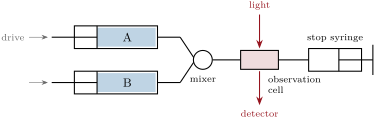
A stopped-flow apparatus. The drive pushes two syringes; the solutions meet in the mixer and fill the observation cell within about a millisecond; the plunger of the stop syringe hits a block, the flow stops, and the detector records the reaction of the freshly mixed solution.
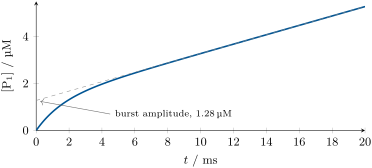
A stopped-flow burst trace (data of the weekend problem): the first product of a two-step enzyme appears in a fast burst followed by a straight line; the dashed line extrapolates the steady state back to t = 0.
A stopped-flow burst trace (data of the weekend problem): the first product of a two-step enzyme appears in a fast burst followed by a straight line; the dashed line extrapolates the steady state back to t=0t = 0.
Read in context →