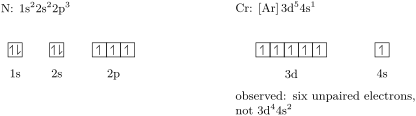
An unpaired electron is an electron alone in its orbital. A species with unpaired electrons is attracted by a magnet (it is paramagnetic, a property studied in physics).
Examples
Example 1.18 (Carbon, nitrogen, oxygen, iron)
The method gives, for four atoms:
| atom | configuration | last subshell | unpaired |
|---|
| C (Z=6) | [He]2s22p2 | 2p:  | 2 |
| N (Z=7) | [He]2s22p3 | 2p:  | 3 |
| O (Z=8) | [He]2s22p4 | 2p:  | 2 |
| Fe (Z=26) | [Ar]3d64s2 | 3d:  | 4 |
For iron the Klechkowski order fills 4s (Z=19,20) before 3d (Z=21 to 30); the configuration is written with 3d first.
Example 1.22 (Copper and its ions)
Cu is [Ar]3d104s1; CuX+ is [Ar]3d10, with no unpaired electron; CuX2+ is [Ar]3d9, with one. ZnX2+, [Ar]3d10, has none.
 Coach
Coach