University Chemistry — Year 1 · Bachelor Year 1
1Quantum Numbers and Electron Configurations
Fill a glass tube with hydrogen at low pressure, pass an electric discharge through it, and look at the pink glow through a prism. The light is not spread into a rainbow. It is split into four sharp lines — one red, one blue-green, two violet — and nothing in between. A hot solid shines at every wavelength; a hydrogen atom emits only a handful. The explanation, found between 1913 and 1926, is that the energy of an electron in an atom cannot take any value: it is quantised. This chapter states the rules of that quantisation as a chemist uses them — four quantum numbers, three filling rules — and turns them into the electron configuration of every atom and ion, the key to the periodic table of the next chapter.
You already know
Book 1 (grade 10) placed the electrons of the first twenty elements in shells and subshells, 1s, 2s, 2p, 3s, 3p, and called the electrons of the outermost shell its valence electrons. From physics we use, as known, that light of wavelength is made of photons of energy , where is the Planck constant and the speed of light.

1.1 Quantised energies: the hydrogen spectrum
Definition 1.1 (Energy level, ground state, excited state)
The energy of an electron bound in an atom can take only certain values, the energy levels of the atom. The zero of energy is taken when the electron is at rest infinitely far from the nucleus (the atom is ionised), so every level of a bound electron is negative. The lowest level is the ground state; every other level is an excited state.
An atom passes from a level of energy to a lower level by emitting one photon, and from the lower to the higher level by absorbing one, of energy
A spectrum of lines is therefore a picture of the differences between the levels.
Theorem 1.2 (Energy levels of the hydrogen atom)
The energy levels of the hydrogen atom are
where is the Rydberg energy (corrected for the motion of the nucleus). The ground state is and the ionisation energy of the atom is .
Proof. Admitted at this level. ∎
Remark 1.3 (Where the formula comes from)
The formula follows from solving the Schrödinger equation of the electron in the field of the proton; the solution, and the shapes of the wavefunctions it gives, are derived in the Year 2 volume. Niels Bohr had obtained the same levels in 1913 from a simpler model of circular orbits, which is now abandoned.
Proposition 1.4 (The Rydberg formula)
The lines emitted by hydrogen have wavelengths given by
for the transition from level down to level . The lines that end on the same level form a series: Lyman for (ultraviolet), Balmer for (visible), Paschen for (infrared).
Proof. The photon carries the energy lost by the atom: . Dividing by gives the formula. ∎
Example 1.5 (The red line of hydrogen)
For the transition : . With (from the values of , and ), : the red line. The other Balmer lines, , , , fall at 486, 434 and ; the next one, at , is already in the ultraviolet. The measured wavelengths, 656.3, 486.1, 434.0 and , agree to better than one part in two thousand; the small remaining gap comes from measuring in air rather than in vacuum.
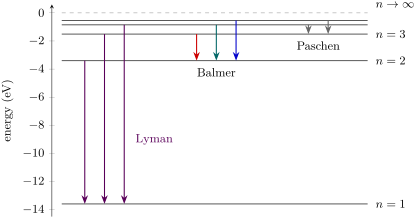
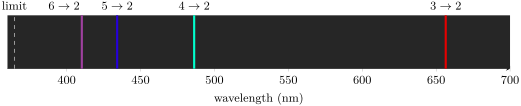
History — Bohr’s atom, 1913
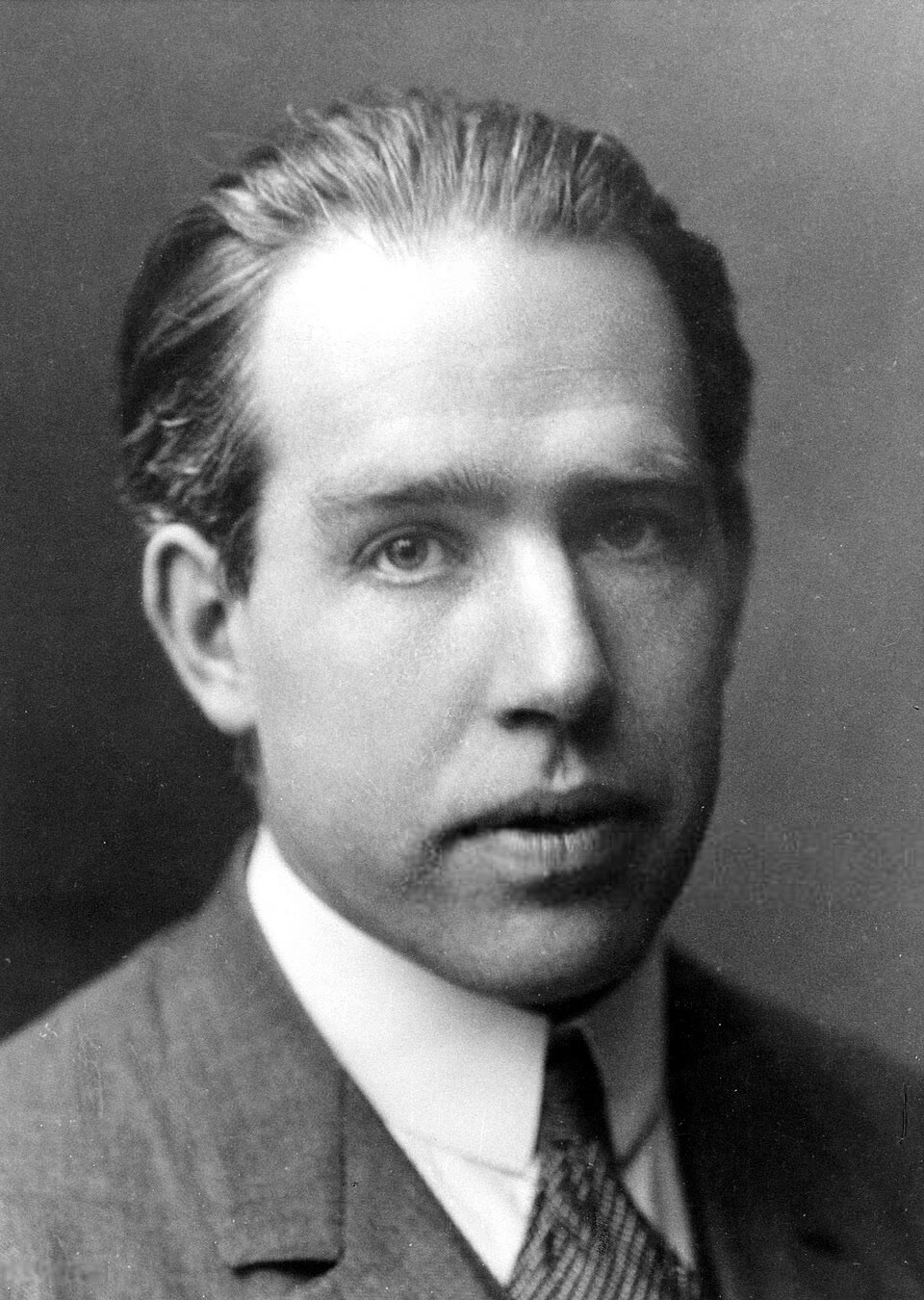
In 1913 Niels Bohr, a 28-year-old Danish physicist working in Manchester, proposed that the electron of hydrogen could circle the nucleus only on certain orbits, and that light was emitted when it jumped from one orbit to a lower one. His model gave the Balmer lines exactly, and the value of the Rydberg constant from , and the mass of the electron. The orbits did not survive the quantum mechanics of 1925–1926, but the quantised levels did. Bohr received the Nobel Prize in Physics in 1922.
1.2 Four quantum numbers
In an atom with many electrons the energies are no longer given by a single formula, but each electron is still described by a small set of integers, its quantum numbers.
Definition 1.6 (Quantum numbers)
The state of an electron in an atom is labelled by four numbers:
- the principal quantum number , which mainly fixes the energy and the size;
- the azimuthal quantum number (or secondary quantum number) , which fixes the shape; are written s, p, d, f;
- the magnetic quantum number , which fixes the orientation ( values);
- the spin quantum number or , an intrinsic property of the electron, drawn as an arrow up or down.
Definition 1.7 (Atomic orbital, shell, subshell)
An atomic orbital is the one-electron state labelled by the three numbers ; it is drawn as one box,  . The orbitals with the same form an electron shell; those with the same and form a subshell, named by and the letter of : 2p is the subshell , , made of three orbitals ().
Remark 1.8 (Shapes)
An s orbital is spherical; a p orbital has two lobes along an axis, and the three 2p orbitals point along , and . The mathematical description of these shapes — wavefunctions, their radial and angular parts, their nodes — belongs to the Year 2 volume. In this book an orbital is a box that holds at most two electrons.
Proposition 1.9 (Capacity of a subshell and of a shell)
A subshell of azimuthal number contains orbitals and can hold electrons: 2 in s, 6 in p, 10 in d, 14 in f. The shell contains orbitals and can hold electrons.
Proof. For a given , takes the values from to , and each orbital holds two electrons of opposite spins (Proposition 1.12 below). For a given , runs from to , so the number of orbitals is
and the number of electrons is : 2, 8, 18, 32 for to 4. ∎
Example 1.10 (The third shell)
For : (3s, one orbital), (3p, three orbitals), (3d, five orbitals, ): nine orbitals and up to 18 electrons. An electron in 3d has, for instance, the quantum numbers .
1.3 Building configurations
Definition 1.11 (Electron configuration)
The electron configuration of an atom or ion is the list of its occupied subshells with the number of electrons in each, written as an exponent: for oxygen. The electrons of the highest , together with those of an incompletely filled d or f subshell, are the valence electrons; the others are the core electrons. A configuration is abbreviated by writing the configuration of the preceding noble gas in brackets: oxygen is .
Three rules give the ground-state configuration.
Proposition 1.12 (Pauli exclusion principle)
Two electrons of the same atom never have the same four quantum numbers. Hence one orbital holds at most two electrons, and then with opposite spins:  .
.
Proof. Admitted at this level. ∎
Proposition 1.13 (Klechkowski rule)
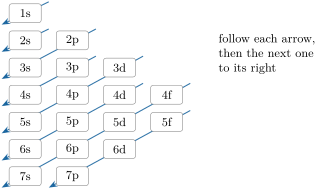
In the ground state of a neutral atom, subshells are filled in the order of increasing , and for equal in the order of increasing :
Proof. Admitted at this level. ∎
Remark 1.14 (An empirical rule)
The Klechkowski rule (also called the Madelung rule) is a summary of observed configurations, not a law: it describes the order in which the subshells fill as the nuclear charge increases. In an atom with many electrons, the electrons repel one another, so the energy of a subshell depends on as well as : a 4s electron, which spends part of its time close to the nucleus, ends up below 3d in potassium and calcium.
Proposition 1.15 (Hund’s rule)
When the electrons of a subshell can be placed in several orbitals of the same energy, the ground state has the largest number of parallel spins: the electrons occupy separate orbitals, spins up, before any orbital is doubly filled.
Proof. Admitted at this level. ∎
Definition 1.16 (Unpaired electron)
An unpaired electron is an electron alone in its orbital. A species with unpaired electrons is attracted by a magnet (it is paramagnetic, a property studied in physics).
Method 1.17 (Writing a ground-state configuration)
To write the configuration of an atom of atomic number :
- place electrons in the subshells in the Klechkowski order, filling each subshell (2, 6, 10, 14) before the next;
- write the result in the order of increasing (grouping 3d with ), and abbreviate with the core of the preceding noble gas;
- for the last, incompletely filled subshell, draw the boxes and apply Hund’s rule to count the unpaired electrons.
Example 1.18 (Carbon, nitrogen, oxygen, iron)
The method gives, for four atoms:
| atom | configuration | last subshell | unpaired |
|---|---|---|---|
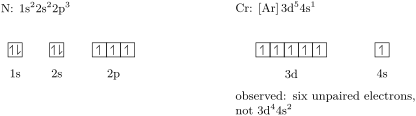
| () | 2p:  | 2 | |
| () | 2p:  | 3 | |
| () | 2p:  | 2 | |
| () | 3d:  | 4 |
For iron the Klechkowski order fills 4s () before 3d ( to 30); the configuration is written with 3d first.
1.4 Ions, exceptions and the shape of the table
Proposition 1.19 (Configurations of ions)
A monatomic anion has the configuration of the atom with the extra electrons added in the next places of the Klechkowski order; a cation of a main-group element loses the electrons of highest . A cation of a transition metal loses its s electrons before its d electrons: is and is , not .
Proof. Admitted at this level. ∎
Remark 1.20 (Filling order is not removal order)
4s fills before 3d in potassium and calcium, yet it is emptied first in the transition-metal ions. There is no contradiction: the order of the subshell energies changes with the nuclear charge and the number of electrons, and in a transition-metal atom or ion the 3d subshell lies below 4s. The Klechkowski rule describes neutral atoms only.
Proposition 1.21 (Two exceptions in the first transition series)
The observed ground-state configurations of chromium and copper are
instead of and predicted by the Klechkowski rule: a half-filled or filled d subshell is especially stable, and the 4s and 3d levels are close.
Example 1.22 (Copper and its ions)
is ; is , with no unpaired electron; is , with one. , , has none.
Proposition 1.23 (Configurations and the periodic table)
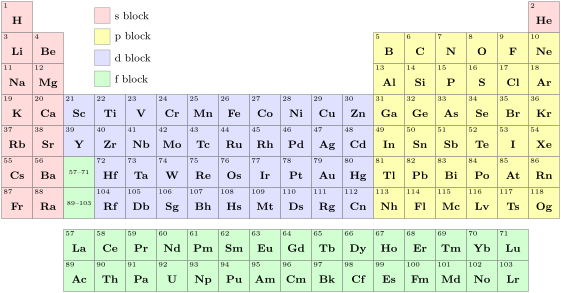
Period of the periodic table begins with the filling of s and ends with the filling of p. The subshells filled in between are, by the Klechkowski rule, f and d. Hence the periods hold elements, and the noble gases have .
Proof. Periods 1 to 3 contain only s (and p for ): , then twice. In periods 4 and 5, d is added: . In periods 6 and 7, f as well: . The noble gases close each period: , , , , , , . ∎
1.5 Exercises
Exercise 1.1 ★
Which of these sets can describe an electron in an atom? Explain each refusal. (a) ; (b) ; (c) ; (d) ; (e) .
Solution
Solution of Exercise 1.1.
(a) Impossible: . (b) Possible (a 3p electron). (c) Impossible: . (d) Possible (a 4f electron). (e) Impossible: for , can only be 0.
Exercise 1.2 ★
How many orbitals, and at most how many electrons, are there in the subshells 3d, 4f and 5p, and in the shell ?
Solution
Solution of Exercise 1.2.
3d: 5 orbitals, 10 electrons; 4f: 7 orbitals, 14 electrons; 5p: 3 orbitals, 6 electrons; shell : orbitals, electrons.
Exercise 1.3 ★
Write the ground-state configurations of , , , and (), in full and abbreviated, and give the number of valence electrons of each.
Solution
Solution of Exercise 1.3.
: , 6 valence electrons. : , 5. : , 1. : , 2. : , 7 (the filled 3d belongs to the core).
Exercise 1.4 ★
Draw the quantum boxes of the valence subshells of nitrogen, sulfur and chlorine, and count their unpaired electrons.
Solution
Solution of Exercise 1.4.
, 2p: , 3 unpaired. , 3p: , 2 unpaired. , 3p:  , 1 unpaired. In each case 2s or 3s is full, .
Exercise 1.5 ★★
Give the configurations of , , , , , , and . Which noble gas is each isoelectronic with?
Solution
Solution of Exercise 1.5.
, , , , : , isoelectronic with neon. , , : , isoelectronic with argon.
Exercise 1.6 ★★
Write the configurations of , , , and () and give the number of unpaired electrons of each.
Solution
Solution of Exercise 1.6.
The 4s electrons leave first (Proposition 1.19). : , 2 unpaired; : , 5; : , 3 ( ); : , 2; : , 0.
Exercise 1.7 ★★
Compute the energy and the wavelength of the photon emitted in the transition of hydrogen. In which part of the spectrum is it? Take and .
Solution
Solution of Exercise 1.7.
; : infrared (first line of the Paschen series).
Exercise 1.8 ★★
Identify the elements whose ground-state configurations end in (a) ; (b) ; (c) ; (d) . Give the four quantum numbers of one electron of the last subshell of (a).
Solution
Solution of Exercise 1.8.
(a) : sulfur, . (b) : bromine, . (c) : rubidium, . (d) : vanadium, . A 3p electron of sulfur: , for instance.
Exercise 1.9 ★★
Using the Klechkowski rule, explain why the nineteenth electron of potassium goes into 4s and not into 3d, and why period 3 holds 8 elements and not 18.
Solution
Solution of Exercise 1.9.
For 4s, ; for 3d, : 4s comes first. After 3p () the next subshell is 4s (, larger ), which opens period 4; 3d () comes only after 4s. Period 3 therefore contains 3s and 3p only: elements.
Exercise 1.10 ★★★
An ion with a single electron and a nucleus of charge has levels (admitted). For (), compute the ionisation energy and the wavelength of the transition . Compare with hydrogen.
Solution
Solution of Exercise 1.10.
Ionisation energy , four times that of hydrogen. : , , four times shorter than the hydrogen line at : every energy is multiplied by .
Exercise 1.11 ★★★
Say whether each configuration is a ground state, an excited state or impossible, and why: (a) ; (b) ; (c) ; (d) ; (e) .
Solution
Solution of Exercise 1.11.
(a) Excited state of beryllium (ground state ). (b) Impossible: 2p holds at most 6 electrons. (c) Excited state of beryllium. (d) Ground state of phosphorus. (e) Impossible: an s subshell holds two electrons (Pauli).
Exercise 1.12 ★★★
Iron(III) salts are attracted by a magnet more strongly than iron(II) salts, and zinc salts not at all. Rank , , , and by number of unpaired electrons, and explain the observation, assuming the attraction grows with that number.
Solution
Solution of Exercise 1.12.
: 5; : 5; : 4; : 1; : 0. Ranking: . Iron(III) has one more unpaired electron than iron(II), so it is attracted more; zinc(II) has none, so it is not attracted.
1.6 Problem: Lines of a Lamp, and a World with Three Spins
Problem 1.1
Weekend problem — from the four lines of a hydrogen lamp to the length of the periods, and what the table would look like if an electron had three spin states
Take and throughout. The visible band runs from about 400 to .
Part I — The hydrogen lamp.
- Compute the energies to of the hydrogen atom.
- Compute the energy and the wavelength of the photon emitted in the transition . What is its colour?
- Compute the wavelengths of the transitions , and .
- Why does a hydrogen lamp show exactly four visible lines? Compute the wavelength of to support the answer.
- Compute the series limit of the Balmer series.
- Compute the wavelength of the first Lyman line, . Why can it not be seen?
- What is the longest wavelength of a photon able to ionise a hydrogen atom in its ground state?
Part II — Counting states.
- List the values of and for ; how many orbitals does the shell hold?
- Show that the shell holds electrons; apply to .
- Write the Klechkowski order up to 7p.
- Deduce the lengths of the seven periods.
- Explain why the 3d subshell does not appear in period 3.
- Deduce the atomic numbers of the noble gases.
Part III — The transition metals.
- Write the configuration of iron () and draw its 3d boxes. How many unpaired electrons?
- Same questions for and . Which of the two has a half-filled subshell?
- The observed configuration of chromium is . Compare with the prediction, and count the unpaired electrons in each.
- Give the configurations of , and .
- Which of and has unpaired electrons?
- Among , , (), which has the most unpaired electrons?
Part IV — A world with three spins. Imagine a universe where , and obey the same rules as in ours, the Klechkowski order is unchanged, the exclusion principle holds, but the spin number can take three values.
- How many electrons can one orbital hold? A subshell of number ? A shell ?
- Give the capacities of 1s, 2s, 2p, 3s and 3p.
- A noble gas closes a period with a filled p subshell (or 1s for the first). What is the atomic number of the first noble gas?
- Which atomic number would behave like an alkali metal, with a single electron beyond the first noble gas?
- How many elements would the second period hold?
- Compute the atomic number of the second noble gas of this world.
Solution
Solution of Problem 1.1.
1. , , , . 2. , : red. 3. : , (blue-green); : , (violet); : , (violet). 4. : , , already ultraviolet; the higher transitions are shorter still, and is the longest Balmer wavelength. The Lyman lines are all ultraviolet and the Paschen lines all infrared, so only four lines are visible. 5. : , . 6. , : far ultraviolet, invisible to the eye and absorbed by glass and air. 7. The photon must bring at least : . 8. (), (), (): orbitals. 9. orbitals of two electrons: ; for , 32. 10. 1s, 2s, 2p, 3s, 3p, 4s, 3d, 4p, 5s, 4d, 5p, 6s, 4f, 5d, 6p, 7s, 5f, 6d, 7p. 11. Each period runs from s to p: 2, 8, 8, 18, 18, 32, 32. 12. 3d () comes after 4s (), which opens period 4. 13. . 14. ; 3d: , 4 unpaired electrons. 15. : 4 unpaired; : 5 unpaired, a half-filled subshell. 16. Predicted : 4 unpaired; observed : 6 unpaired (5 in 3d, 1 in 4s). 17. , , .
18. , with one unpaired electron; has none. 19. : 0; : 1; : 5. has the most. 20. Three electrons per orbital; per subshell; per shell. 21. 1s: 3; 2s: 3; 2p: 9; 3s: 3; 3p: 9. 22. The first period closes when 1s is full: . 23. , one electron in 2s beyond the noble core. 24. 2s and 2p: elements. 25. : the second noble gas of the three-spin world has .