
All books

Professional

Apps About Coach Log in Start reading

Earth and Space Sciences · Glossary

What is Cross-bedding, palaeocurrent?

Also known as: cross-bedding · palaeocurrent

Definition 21.8 University Earth and Space Sciences — Year 1 · Chapter 21 — Clastic Sediments and Their Environments

Cross-bedding is a layering inclined to the main bedding, made of the successive lee faces (foresets) of migrating ripples or dunes, in units, the sets, bounded by erosion surfaces; cross-bedding made by ripples, in sets a few centimetres thick, is called cross-lamination. A palaeocurrent is the direction of an ancient current, inferred from the structures it left: the foresets dip downstream, so the direction of dip of the cross-beds, once the bedding is restored to the horizontal, is the direction toward which the current flowed.
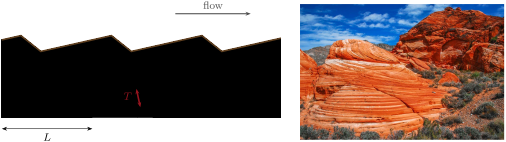
Left: the geometry of climbing bedforms (schematic, angles exaggerated). The troughs travel along straight paths inclined at the angle of climb  (thick lines); between two of them the lower parts of the foresets are preserved, in sets of thickness T = L. Right: cross-bedding in the Aztec Sandstone, Muddy Mountains, Nevada: inclined sets of laminae, each cut off at the top by the erosion surface at the base of the next. Photograph Chip Carroon, Bureau of Land Management, CC BY-SA 2.0, via Wikimedia Commons.
Left: the geometry of climbing bedforms (schematic, angles exaggerated). The troughs travel along straight paths inclined at the angle of climb θ\theta (thick lines); between two of them the lower parts of the foresets are preserved, in sets of thickness T=Lsin⁡θT = L\sin\theta. Right: cross-bedding in the Aztec Sandstone, Muddy Mountains, Nevada: inclined sets of laminae, each cut off at the top by the erosion surface at the base of the next. Photograph Chip Carroon, Bureau of Land Management, CC BY-SA 2.0, via Wikimedia Commons.
Read in context →