
সব বই

পেশাদার

1 Markets I: The Ecosystem and Exchange-Traded Marketsবাজার অনলাইন 2 Markets II: Rates, FX and Creditবাজার অনলাইন 3 Markets III: Commodities, Energy and Cryptoবাজার অনলাইন 4 Quantitative Methodsপদ্ধতি অনলাইন 5 Derivatives and Volatilityডেরিভেটিভস অনলাইন 6 Rates, Credit, XVA and Riskসুদহার, ঋণ ও ঝুঁকি অনলাইন 7 Research Craft: Predictors, Backtests, Measurement, Portfoliosগবেষণা অনলাইন 8 Strategies I: Equities and Futuresকৌশল অনলাইন 9 Strategies II: Volatility, Relative Value, Macro and the Bank Desksকৌশল অনলাইন 10 Microstructure and Executionএক্সিকিউশন অনলাইন 11 Market Making and High-Frequency Tradingমার্কেট মেকিং অনলাইন 12 Machine Learning for Marketsমেশিন লার্নিং অনলাইন 13 Low-Latency Softwareপ্রযুক্তি অনলাইন 14 Networks, Hardware and Trading Infrastructureপ্রযুক্তি অনলাইন 15 Research, Data and Risk Platformsপ্রযুক্তি অনলাইন 16 The Desk and the Firmপ্রতিষ্ঠান অনলাইন 17 The Industry: Firms, Roles and Careersক্যারিয়ার অনলাইন 18 Interviews I: Maths, Probability and Speedক্যারিয়ার অনলাইন 19 Interviews II: Markets, Trading Games and the Final Roundক্যারিয়ার অনলাইন 20 Interviews III: Codeক্যারিয়ার অনলাইন
অ্যাপ পরিচিতি Coach সাইন ইন পড়া শুরু করো

বইগুলো এখনো বাংলা ভাষায় পাওয়া যায় না — ইংরেজি সংস্করণ দেখানো হচ্ছে।

Earth and Space Sciences · পরিভাষা

Cross-bedding, palaeocurrent কী?

অন্য নাম: cross-bedding · palaeocurrent

Definition 21.8 University Earth and Space Sciences — Year 1 · অধ্যায় 21 — Clastic Sediments and Their Environments

Cross-bedding is a layering inclined to the main bedding, made of the successive lee faces (foresets) of migrating ripples or dunes, in units, the sets, bounded by erosion surfaces; cross-bedding made by ripples, in sets a few centimetres thick, is called cross-lamination. A palaeocurrent is the direction of an ancient current, inferred from the structures it left: the foresets dip downstream, so the direction of dip of the cross-beds, once the bedding is restored to the horizontal, is the direction toward which the current flowed.
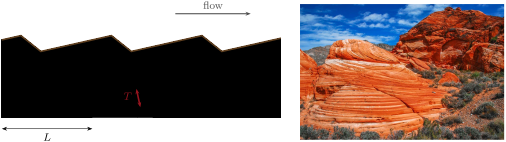
Left: the geometry of climbing bedforms (schematic, angles exaggerated). The troughs travel along straight paths inclined at the angle of climb  (thick lines); between two of them the lower parts of the foresets are preserved, in sets of thickness T = L. Right: cross-bedding in the Aztec Sandstone, Muddy Mountains, Nevada: inclined sets of laminae, each cut off at the top by the erosion surface at the base of the next. Photograph Chip Carroon, Bureau of Land Management, CC BY-SA 2.0, via Wikimedia Commons.
Left: the geometry of climbing bedforms (schematic, angles exaggerated). The troughs travel along straight paths inclined at the angle of climb θ\theta (thick lines); between two of them the lower parts of the foresets are preserved, in sets of thickness T=Lsin⁡θT = L\sin\theta. Right: cross-bedding in the Aztec Sandstone, Muddy Mountains, Nevada: inclined sets of laminae, each cut off at the top by the erosion surface at the base of the next. Photograph Chip Carroon, Bureau of Land Management, CC BY-SA 2.0, via Wikimedia Commons.
প্রসঙ্গসহ পড়ো →