বইগুলো এখনো বাংলা ভাষায় পাওয়া যায় না — ইংরেজি সংস্করণ দেখানো হচ্ছে।
Earth and Space Sciences · পরিভাষা
Ekman layer, Ekman transport, Ekman spiral কী?
অন্য নাম: Ekman layer · Ekman transport · Ekman spiral · sverdrup (unit)
Definition 29.3University Earth and Space Sciences — Year 1 · অধ্যায় 29 — The Circulation of the Ocean
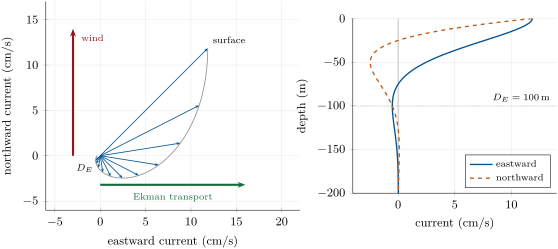
The Ekman layer is the thin surface layer of the ocean, at most a few hundred metres thick, in which the stress of the wind is carried down by turbulent friction and balanced by the Coriolis force. The Ekman transport is the mass of water that the layer carries per second across a vertical strip 1m wide, from the surface down to below the layer:
M=∫−d0ρvdz(kgm−1s−1);
divided by the density, it is a volume transport per metre, in m2s−1. The Ekman spiral is the turning and weakening of the current with depth in the layer. Ocean transports are counted in sverdrups: 1Sv=106m3s−1.
Ekman’s spiral under a wind of 10m/s blowing towards the north at 35∘ N, with Ekman’s constants. Left: the current seen from above at the surface and every tenth of the Ekman depth DE down to DE (blue arrows), the grey curve joining their tips; the surface current is 45∘ to the right of the wind, the deeper ones are weaker and turned further right. The transport of the whole layer (green; direction only) is at 90∘ to the right of the wind. Right: the two components against depth.
উদাহরণ
Example 29.5(The transport under a fresh breeze)
A wind of 10m/s blowing towards the north at 35∘ N exerts T=0.170Pa. With f=2Ωsin35∘=8.365×10⁻⁵s−1, the Ekman transport is 0.170/(8.365×10−5)=2036kgm−1s−1, towards the east. With ρ=1027kgm−3, this is 1.98m3s−1 for each metre measured across the transport: across a line 1000km long, about 2Sv.
 Coach