সব বই

পেশাদার

1 Markets I: The Ecosystem and Exchange-Traded Marketsবাজার অনলাইন 2 Markets II: Rates, FX and Creditবাজার অনলাইন 3 Markets III: Commodities, Energy and Cryptoবাজার অনলাইন 4 Quantitative Methodsপদ্ধতি অনলাইন 5 Derivatives and Volatilityডেরিভেটিভস অনলাইন 6 Rates, Credit, XVA and Riskসুদহার, ঋণ ও ঝুঁকি অনলাইন 7 Research Craft: Predictors, Backtests, Measurement, Portfoliosগবেষণা অনলাইন 8 Strategies I: Equities and Futuresকৌশল অনলাইন 9 Strategies II: Volatility, Relative Value, Macro and the Bank Desksকৌশল অনলাইন 10 Microstructure and Executionএক্সিকিউশন অনলাইন 11 Market Making and High-Frequency Tradingমার্কেট মেকিং অনলাইন 12 Machine Learning for Marketsমেশিন লার্নিং অনলাইন 13 Low-Latency Softwareপ্রযুক্তি অনলাইন 14 Networks, Hardware and Trading Infrastructureপ্রযুক্তি অনলাইন 15 Research, Data and Risk Platformsপ্রযুক্তি অনলাইন 16 The Desk and the Firmপ্রতিষ্ঠান অনলাইন 17 The Industry: Firms, Roles and Careersক্যারিয়ার অনলাইন 18 Interviews I: Maths, Probability and Speedক্যারিয়ার অনলাইন 19 Interviews II: Markets, Trading Games and the Final Roundক্যারিয়ার অনলাইন 20 Interviews III: Codeক্যারিয়ার অনলাইন
অ্যাপ পরিচিতি Coach সাইন ইন পড়া শুরু করো

বইগুলো এখনো বাংলা ভাষায় পাওয়া যায় না — ইংরেজি সংস্করণ দেখানো হচ্ছে।

Earth and Space Sciences · পরিভাষা

Equilibrium temperature কী?

Definition 2.2 High School Earth and Space Sciences · অধ্যায় 2 — A Habitable Planet

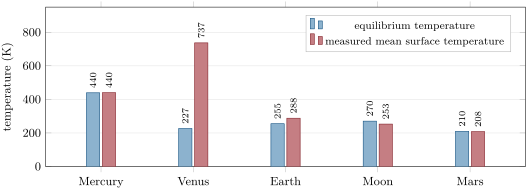
The equilibrium temperature of a planet is the temperature at which a body radiating like a perfect emitter would send to space exactly the power the planet absorbs from its star. The fraction of the incoming light that the planet reflects as a whole is its Bond albedo AA.

Equilibrium temperatures computed from each body’s distance and Bond albedo, beside the measured mean temperatures of their surfaces. Data: NASA planetary fact sheets.

উদাহরণ

Example 2.4 (The Earth)

With S0=1361 W/m2S_0 = 1361\,\mathrm{W}/\mathrm{m}^{2} and A=0.294A = 0.294, Teq=278.3×0.7061/4≈255 KT_{\mathrm{eq}} = 278.3 \times 0.706^{1/4} \approx 255\,\mathrm{K}, that is −18∘C-18{}^{\circ}\mathrm{C}. (NASA’s fact sheet lists 254 K254\,\mathrm{K}.) The average temperature of the Earth’s surface is 288 K288\,\mathrm{K}, 15∘C15{}^{\circ}\mathrm{C}: the greenhouse effect of the atmosphere warms it by about 33 K33\,\mathrm{K}. Without it the oceans would freeze.

প্রসঙ্গসহ পড়ো →
Definition 3.7 University Earth and Space Sciences — Year 1 · অধ্যায় 3 — Comparative Planetology

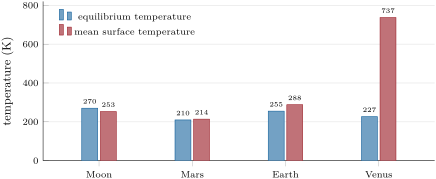
The equilibrium temperature TeqT_\mathrm{eq} of a planet is the uniform temperature at which a black body of the planet’s size would radiate to space exactly the power the planet absorbs from the Sun.

Equilibrium temperature (computed from the irradiance and the Bond albedo) and measured mean surface temperature of four bodies. The atmosphere warms the Earth and above all Venus; Mars’s thin atmosphere does little; the airless Moon is colder, on average, than its equilibrium temperature.
প্রসঙ্গসহ পড়ো →