
সব বই

পেশাদার

1 Markets I: The Ecosystem and Exchange-Traded Marketsবাজার অনলাইন 2 Markets II: Rates, FX and Creditবাজার অনলাইন 3 Markets III: Commodities, Energy and Cryptoবাজার অনলাইন 4 Quantitative Methodsপদ্ধতি অনলাইন 5 Derivatives and Volatilityডেরিভেটিভস অনলাইন 6 Rates, Credit, XVA and Riskসুদহার, ঋণ ও ঝুঁকি অনলাইন 7 Research Craft: Predictors, Backtests, Measurement, Portfoliosগবেষণা অনলাইন 8 Strategies I: Equities and Futuresকৌশল অনলাইন 9 Strategies II: Volatility, Relative Value, Macro and the Bank Desksকৌশল অনলাইন 10 Microstructure and Executionএক্সিকিউশন অনলাইন 11 Market Making and High-Frequency Tradingমার্কেট মেকিং অনলাইন 12 Machine Learning for Marketsমেশিন লার্নিং অনলাইন 13 Low-Latency Softwareপ্রযুক্তি অনলাইন 14 Networks, Hardware and Trading Infrastructureপ্রযুক্তি অনলাইন 15 Research, Data and Risk Platformsপ্রযুক্তি অনলাইন 16 The Desk and the Firmপ্রতিষ্ঠান অনলাইন 17 The Industry: Firms, Roles and Careersক্যারিয়ার অনলাইন 18 Interviews I: Maths, Probability and Speedক্যারিয়ার অনলাইন 19 Interviews II: Markets, Trading Games and the Final Roundক্যারিয়ার অনলাইন 20 Interviews III: Codeক্যারিয়ার অনলাইন
অ্যাপ পরিচিতি Coach সাইন ইন পড়া শুরু করো

বইগুলো এখনো বাংলা ভাষায় পাওয়া যায় না — ইংরেজি সংস্করণ দেখানো হচ্ছে।

Earth and Space Sciences · পরিভাষা

Evaporite, evaporation sequence, sabkha কী?

অন্য নাম: evaporite · evaporation sequence · sabkha

Definition 22.10 University Earth and Space Sciences — Year 1 · অধ্যায় 22 — Carbonate, Siliceous and Evaporite Sediments

An evaporite is a sediment or sedimentary rock of salts precipitated from a natural brine concentrated by evaporation: chiefly gypsum CaSOX4 ⋅ 2 HX2O\ce{CaSO4.2H2O} and anhydrite CaSOX4\ce{CaSO4}, halite NaCl\ce{NaCl}, and the potassium and magnesium salts. The evaporation sequence is the order in which the minerals precipitate from evaporating seawater, the least soluble first: calcium carbonate, then gypsum, then halite, then the potassium and magnesium salts. A sabkha is a coastal salt flat, at or just above the level of the highest tides, where gypsum, anhydrite and halite grow within the sediment from the evaporating brine that soaks it.
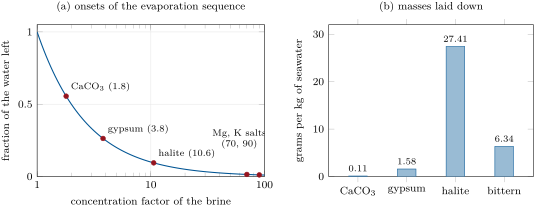
The evaporation of seawater. (a) The fraction of the water left when the brine is concentrated by a given factor, with the onset of each mineral measured at the salt works of Great Inagua and in the laboratory (McCaffrey, Lazar and Holland, 1987). (b) The masses laid down per kilogram of seawater evaporated to dryness, each mineral taking all of the ion that limits it (gypsum counted with its water; the bittern salts counted without theirs), computed from the reference composition of seawater.
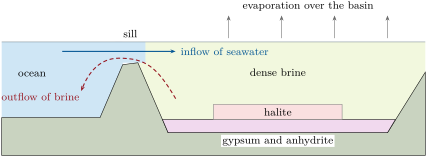
A barred evaporite basin (schematic): seawater flows in over a sill to replace the water evaporated from the basin; the dense brine sinks and part of it flows back to the ocean at depth. The smaller the outflow, the more concentrated the brine; here it has passed halite saturation and halite lies over the earlier gypsum.
প্রসঙ্গসহ পড়ো →