
সব বই

পেশাদার

1 Markets I: The Ecosystem and Exchange-Traded Marketsবাজার অনলাইন 2 Markets II: Rates, FX and Creditবাজার অনলাইন 3 Markets III: Commodities, Energy and Cryptoবাজার অনলাইন 4 Quantitative Methodsপদ্ধতি অনলাইন 5 Derivatives and Volatilityডেরিভেটিভস অনলাইন 6 Rates, Credit, XVA and Riskসুদহার, ঋণ ও ঝুঁকি অনলাইন 7 Research Craft: Predictors, Backtests, Measurement, Portfoliosগবেষণা অনলাইন 8 Strategies I: Equities and Futuresকৌশল অনলাইন 9 Strategies II: Volatility, Relative Value, Macro and the Bank Desksকৌশল অনলাইন 10 Microstructure and Executionএক্সিকিউশন অনলাইন 11 Market Making and High-Frequency Tradingমার্কেট মেকিং অনলাইন 12 Machine Learning for Marketsমেশিন লার্নিং অনলাইন 13 Low-Latency Softwareপ্রযুক্তি অনলাইন 14 Networks, Hardware and Trading Infrastructureপ্রযুক্তি অনলাইন 15 Research, Data and Risk Platformsপ্রযুক্তি অনলাইন 16 The Desk and the Firmপ্রতিষ্ঠান অনলাইন 17 The Industry: Firms, Roles and Careersক্যারিয়ার অনলাইন 18 Interviews I: Maths, Probability and Speedক্যারিয়ার অনলাইন 19 Interviews II: Markets, Trading Games and the Final Roundক্যারিয়ার অনলাইন 20 Interviews III: Codeক্যারিয়ার অনলাইন
অ্যাপ পরিচিতি Coach সাইন ইন পড়া শুরু করো

বইগুলো এখনো বাংলা ভাষায় পাওয়া যায় না — ইংরেজি সংস্করণ দেখানো হচ্ছে।

Earth and Space Sciences · পরিভাষা

Flow law, stress exponent, homologous temperature কী?

অন্য নাম: flow law · stress exponent · homologous temperature

Definition 7.6 University Earth and Space Sciences — Year 3 · অধ্যায় 7 — Deformation Mechanisms and Shear Zones

A flow law gives the strain rate of a rock deforming by one mechanism as a function of the differential stress σ\sigma, the grain size dd, the temperature TT and the pressure PP:

ε˙=A σnd−mexp⁡(−E+PVRT),\dot\varepsilon = A\,\sigma^nd^{-m}\exp\Bigl(-\frac{E + PV}{RT}\Bigr),

with AA, nn, mm, the activation energy EE and the activation volume VV measured in the laboratory. The stress exponent is nn, the grain-size exponent mm. The homologous temperature of a mineral is T/TmT/T_m, its absolute temperature over its absolute melting temperature.
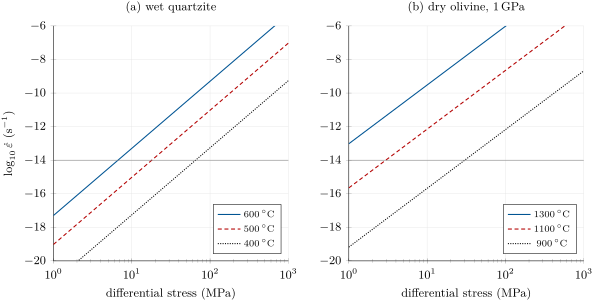
Dislocation-creep flow laws: strain rate against stress at three temperatures. The slope on these axes is the stress exponent, 4 for quartzite and 3.5 for olivine; the grey line marks a geological strain rate, 10-14\, s-1. Olivine needs temperatures some 600\, C higher than quartz to flow as easily.
Dislocation-creep flow laws: strain rate against stress at three temperatures. The slope on these axes is the stress exponent, 4 for quartzite and 3.5 for olivine; the grey line marks a geological strain rate, 10−14 s−110^{-14}\,\mathrm{s}^{-1}. Olivine needs temperatures some 600 ∘C600\,{}^{\circ}\mathrm{C} higher than quartz to flow as easily.
প্রসঙ্গসহ পড়ো →