
全部书籍

专业

应用 关于 Coach 登录 开始阅读

书籍暂未推出简体中文版——当前显示英文版。

Earth and Space Sciences · 术语表

什么是 Flow law, stress exponent, homologous temperature?

又称: flow law · stress exponent · homologous temperature

Definition 7.6 University Earth and Space Sciences — Year 3 · 第 7 章 — Deformation Mechanisms and Shear Zones

A flow law gives the strain rate of a rock deforming by one mechanism as a function of the differential stress σ\sigma, the grain size dd, the temperature TT and the pressure PP:

ε˙=A σnd−mexp⁡(−E+PVRT),\dot\varepsilon = A\,\sigma^nd^{-m}\exp\Bigl(-\frac{E + PV}{RT}\Bigr),

with AA, nn, mm, the activation energy EE and the activation volume VV measured in the laboratory. The stress exponent is nn, the grain-size exponent mm. The homologous temperature of a mineral is T/TmT/T_m, its absolute temperature over its absolute melting temperature.
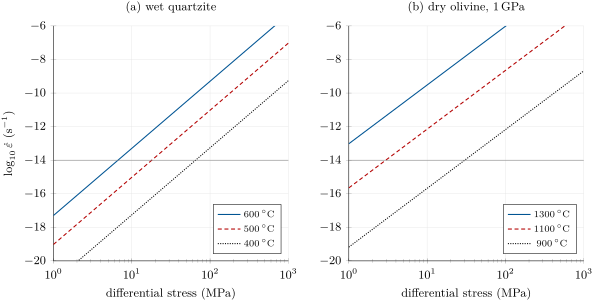
Dislocation-creep flow laws: strain rate against stress at three temperatures. The slope on these axes is the stress exponent, 4 for quartzite and 3.5 for olivine; the grey line marks a geological strain rate, 10-14\, s-1. Olivine needs temperatures some 600\, C higher than quartz to flow as easily.
Dislocation-creep flow laws: strain rate against stress at three temperatures. The slope on these axes is the stress exponent, 4 for quartzite and 3.5 for olivine; the grey line marks a geological strain rate, 10−14 s−110^{-14}\,\mathrm{s}^{-1}. Olivine needs temperatures some 600 ∘C600\,{}^{\circ}\mathrm{C} higher than quartz to flow as easily.
在原文中阅读 →