
全部书籍

专业

应用 关于 Coach 登录 开始阅读

书籍暂未推出简体中文版——当前显示英文版。

Earth and Space Sciences · 术语表

什么是 Focal mechanism, nodal plane, auxiliary plane, P axis, T axis?

又称: first motion · focal mechanism · nodal plane · auxiliary plane · P axis · T axis

Definition 18.7 University Earth and Space Sciences — Year 1 · 第 18 章 — The Earthquake Source

The first motion of a P wave at a seismometer is the direction, up or down, of the first movement of the ground on the vertical record. The focal mechanism of an earthquake is the orientation of the fault plane and the direction of slip on it, as found from its seismic waves. The two perpendicular planes through the focus that separate the pushes from the pulls are its nodal planes; one is the fault plane, and the other, perpendicular to the slip, is the auxiliary plane. The P axis and the T axis are the directions at 45∘45{}^{\circ} from both nodal planes in the middle of the pull quadrants and of the push quadrants:
P=n−d2,T=n+d2.\mathbf P = \frac{\mathbf n - \mathbf d}{\sqrt2}, \qquad \mathbf T = \frac{\mathbf n + \mathbf d}{\sqrt2} .
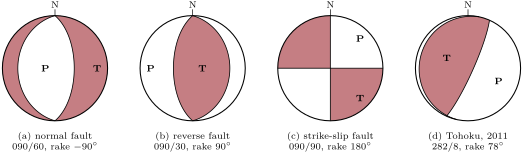
Beach balls: the lower hemisphere around the focus in equal-area projection, north up, the push quadrants shaded, P and T marking the axes (a letter is moved inward when its axis lies near the rim). Each mechanism is given by the attitude of one nodal plane, dip direction and dip, and the rake of the slip on it. (a) A normal fault dipping 60 east: the pull quadrant fills the centre. (b) A reverse fault dipping 30 east: the push quadrant fills the centre. (c) A vertical strike-slip fault: four quadrants meeting at the centre. (d) The Tohoku earthquake of 2011 (U.S. Geological Survey moment tensor): a thrust on a plane dipping 8 toward 282, under Japan, with the steep auxiliary plane on the east.
Beach balls: the lower hemisphere around the focus in equal-area projection, north up, the push quadrants shaded, P and T marking the axes (a letter is moved inward when its axis lies near the rim). Each mechanism is given by the attitude of one nodal plane, dip direction and dip, and the rake of the slip on it. (a) A normal fault dipping 60∘60{}^{\circ} east: the pull quadrant fills the centre. (b) A reverse fault dipping 30∘30{}^{\circ} east: the push quadrant fills the centre. (c) A vertical strike-slip fault: four quadrants meeting at the centre. (d) The Tohoku earthquake of 2011 (U.S. Geological Survey moment tensor): a thrust on a plane dipping 8∘8{}^{\circ} toward 282282, under Japan, with the steep auxiliary plane on the east.
在原文中阅读 →