Coach
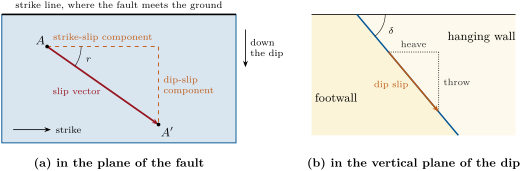
Let a fault be locally a plane that is not vertical. The hanging wall is the block above it, the footwall the block below it. Let be a point of the footwall and the point of the hanging wall that was in contact with it before the movement. The slip vector is the displacement of the hanging wall relative to the footwall; its length is the net slip. The rake (also called the pitch) of the slip vector is the angle, measured in the plane of the fault, from the strike direction given by the right-hand rule to the slip vector, positive when the slip vector points up the plane and negative when it points down it: . This is the seismologists’ convention, used again for earthquakes in Chapter 18; many field geologists record instead an angle between 0 and , measured clockwise from the strike seen from above, and add the sense of movement in words.