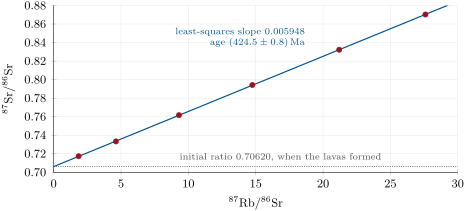
Let S be a stable isotope of the daughter element that no decay produces (86Sr for strontium, 144Nd for neodymium). An isochron is the straight line on which plot, in a graph of y=D/S against x=P/S, samples that formed at the same time with the same value of D/S and have been closed systems since. That shared starting value y0=(D/S)0 is the initial ratio.
উদাহরণ
Example 25.8 (An invented rhyolite)
Six whole-rock samples of a series of rhyolite lavas (exercise data) give:
| x=87Rb/86Sr | 1.85 | 4.62 | 9.30 | 14.75 | 21.20 | 27.60 |
| y=87Sr/86Sr | 0.71732 | 0.73332 | 0.76164 | 0.79420 | 0.83226 | 0.87028 |
Here xˉ=13.22, yˉ=0.784837, Sxx=491.41 and Sxy=2.92308, so m=0.0059484 and b=0.70620. The residuals give s=0.00024, σm=1.10×10⁻⁵ and σb=0.00018. The age is t=ln(1.0059484)/1.3972×10−11=424.5Ma, with σt=1.10×10⁻⁵/(1.3972×10−11×1.0059)=0.8Myr: (424.5±0.8)Ma, initial ratio 0.70620±0.00018 (figure below).
 Coach