
সব বই

পেশাদার

1 Markets I: The Ecosystem and Exchange-Traded Marketsবাজার অনলাইন 2 Markets II: Rates, FX and Creditবাজার অনলাইন 3 Markets III: Commodities, Energy and Cryptoবাজার অনলাইন 4 Quantitative Methodsপদ্ধতি অনলাইন 5 Derivatives and Volatilityডেরিভেটিভস অনলাইন 6 Rates, Credit, XVA and Riskসুদহার, ঋণ ও ঝুঁকি অনলাইন 7 Research Craft: Predictors, Backtests, Measurement, Portfoliosগবেষণা অনলাইন 8 Strategies I: Equities and Futuresকৌশল অনলাইন 9 Strategies II: Volatility, Relative Value, Macro and the Bank Desksকৌশল অনলাইন 10 Microstructure and Executionএক্সিকিউশন অনলাইন 11 Market Making and High-Frequency Tradingমার্কেট মেকিং অনলাইন 12 Machine Learning for Marketsমেশিন লার্নিং অনলাইন 13 Low-Latency Softwareপ্রযুক্তি অনলাইন 14 Networks, Hardware and Trading Infrastructureপ্রযুক্তি অনলাইন 15 Research, Data and Risk Platformsপ্রযুক্তি অনলাইন 16 The Desk and the Firmপ্রতিষ্ঠান অনলাইন 17 The Industry: Firms, Roles and Careersক্যারিয়ার অনলাইন 18 Interviews I: Maths, Probability and Speedক্যারিয়ার অনলাইন 19 Interviews II: Markets, Trading Games and the Final Roundক্যারিয়ার অনলাইন 20 Interviews III: Codeক্যারিয়ার অনলাইন
অ্যাপ পরিচিতি Coach সাইন ইন পড়া শুরু করো

বইগুলো এখনো বাংলা ভাষায় পাওয়া যায় না — ইংরেজি সংস্করণ দেখানো হচ্ছে।

Earth and Space Sciences · পরিভাষা

Long-term carbon cycle; carbonate–silicate cycle কী?

অন্য নাম: long-term carbon cycle · carbonate--silicate cycle

Definition 26.1 University Earth and Space Sciences — Year 2 · অধ্যায় 26 — Climate over Geological Time

The long-term carbon cycle is the exchange of carbon between the surface reservoirs (atmosphere, ocean, biosphere and soils) and the solid Earth: volcanic and metamorphic degassing, the weathering of rocks, and the burial of carbonate and organic carbon in sediments that later become rock or are subducted. Its fluxes are small against the surface reservoirs and act over 10510^5 to 10810^8 years. The carbonate–silicate cycle is its inorganic part: carbon dioxide leaves the mantle and the crust at volcanoes, is consumed by the weathering of silicate rocks, is deposited on the sea floor as carbonate, and returns to the surface when that carbonate is metamorphosed or subducted and degassed.
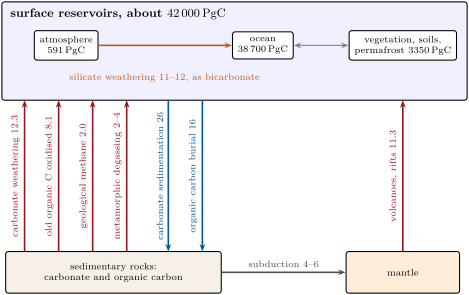
The long-term carbon cycle, with pre-industrial reservoirs from the IPCC’s global carbon budget and present fluxes from a 2024 synthesis, in teramoles of carbon a year (1\, Tmol\, yr-1 = 0.012\, PgC\, yr-1). Red: inputs to the surface reservoirs; blue: outputs. Silicate weathering does not leave the surface: it moves carbon from the air into the ocean as bicarbonate, which then leaves as carbonate sediment.
The long-term carbon cycle, with pre-industrial reservoirs from the IPCC’s global carbon budget and present fluxes from a 2024 synthesis, in teramoles of carbon a year (1 Tmol yr−11\,\mathrm{Tmol}\,\mathrm{yr}^{-1} = 0.012 PgC yr−10.012\,\mathrm{PgC}\,\mathrm{yr}^{-1}). Red: inputs to the surface reservoirs; blue: outputs. Silicate weathering does not leave the surface: it moves carbon from the air into the ocean as bicarbonate, which then leaves as carbonate sediment.
প্রসঙ্গসহ পড়ো →