
全部书籍

专业

应用 关于 Coach 登录 开始阅读

书籍暂未推出简体中文版——当前显示英文版。

Earth and Space Sciences · 术语表

什么是 Long-term carbon cycle; carbonate–silicate cycle?

又称: long-term carbon cycle · carbonate--silicate cycle

Definition 26.1 University Earth and Space Sciences — Year 2 · 第 26 章 — Climate over Geological Time

The long-term carbon cycle is the exchange of carbon between the surface reservoirs (atmosphere, ocean, biosphere and soils) and the solid Earth: volcanic and metamorphic degassing, the weathering of rocks, and the burial of carbonate and organic carbon in sediments that later become rock or are subducted. Its fluxes are small against the surface reservoirs and act over 10510^5 to 10810^8 years. The carbonate–silicate cycle is its inorganic part: carbon dioxide leaves the mantle and the crust at volcanoes, is consumed by the weathering of silicate rocks, is deposited on the sea floor as carbonate, and returns to the surface when that carbonate is metamorphosed or subducted and degassed.
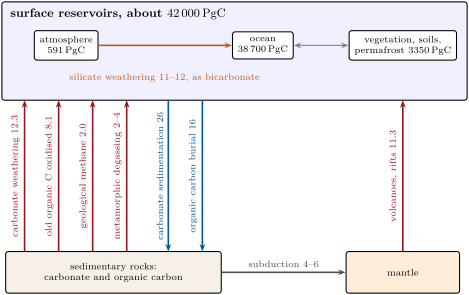
The long-term carbon cycle, with pre-industrial reservoirs from the IPCC’s global carbon budget and present fluxes from a 2024 synthesis, in teramoles of carbon a year (1\, Tmol\, yr-1 = 0.012\, PgC\, yr-1). Red: inputs to the surface reservoirs; blue: outputs. Silicate weathering does not leave the surface: it moves carbon from the air into the ocean as bicarbonate, which then leaves as carbonate sediment.
The long-term carbon cycle, with pre-industrial reservoirs from the IPCC’s global carbon budget and present fluxes from a 2024 synthesis, in teramoles of carbon a year (1 Tmol yr−11\,\mathrm{Tmol}\,\mathrm{yr}^{-1} = 0.012 PgC yr−10.012\,\mathrm{PgC}\,\mathrm{yr}^{-1}). Red: inputs to the surface reservoirs; blue: outputs. Silicate weathering does not leave the surface: it moves carbon from the air into the ocean as bicarbonate, which then leaves as carbonate sediment.
在原文中阅读 →