全部书籍

专业

应用 关于 Coach 登录 开始阅读

书籍暂未推出简体中文版——当前显示英文版。

Earth and Space Sciences · 术语表

什么是 Lysocline, carbonate compensation depth?

又称: lysocline · carbonate compensation depth

Definition 22.6 University Earth and Space Sciences — Year 1 · 第 22 章 — Carbonate, Siliceous and Evaporite Sediments

The lysocline is the depth in the ocean below which the dissolution of calcite on the sea floor first becomes apparent in the sediment and its rate increases sharply. The carbonate compensation depth (CCD) is the depth at which the rate of dissolution of calcite equals the rate at which calcite rains on the sea floor; below it no calcium carbonate accumulates. In practice it is placed where the calcium carbonate content of the surface sediment falls below 10 %10\,\% by weight.

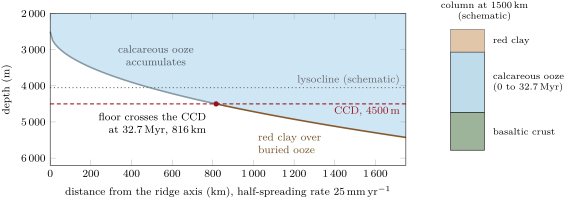
Pelagic sediments on a ridge flank. The floor deepens with age by the depth–age law d = 2500 + 350√ t and moves away from the axis at 25\, mm a year; above the carbonate compensation depth, taken here at 4500\, m, it collects calcareous ooze, below it only red clay. A site far from the axis carries basalt, ooze and red clay, from the bottom up (column on the right, thicknesses schematic). The lysocline, drawn a few hundred metres above the CCD, marks where dissolution begins to show.
Pelagic sediments on a ridge flank. The floor deepens with age by the depth–age law d=2500+350td = 2500 + 350\sqrt t and moves away from the axis at 25 mm25\,\mathrm{mm} a year; above the carbonate compensation depth, taken here at 4500 m4500\,\mathrm{m}, it collects calcareous ooze, below it only red clay. A site far from the axis carries basalt, ooze and red clay, from the bottom up (column on the right, thicknesses schematic). The lysocline, drawn a few hundred metres above the CCD, marks where dissolution begins to show.
在原文中阅读 →