সব বই

পেশাদার

1 Markets I: The Ecosystem and Exchange-Traded Marketsবাজার অনলাইন 2 Markets II: Rates, FX and Creditবাজার অনলাইন 3 Markets III: Commodities, Energy and Cryptoবাজার অনলাইন 4 Quantitative Methodsপদ্ধতি অনলাইন 5 Derivatives and Volatilityডেরিভেটিভস অনলাইন 6 Rates, Credit, XVA and Riskসুদহার, ঋণ ও ঝুঁকি অনলাইন 7 Research Craft: Predictors, Backtests, Measurement, Portfoliosগবেষণা অনলাইন 8 Strategies I: Equities and Futuresকৌশল অনলাইন 9 Strategies II: Volatility, Relative Value, Macro and the Bank Desksকৌশল অনলাইন 10 Microstructure and Executionএক্সিকিউশন অনলাইন 11 Market Making and High-Frequency Tradingমার্কেট মেকিং অনলাইন 12 Machine Learning for Marketsমেশিন লার্নিং অনলাইন 13 Low-Latency Softwareপ্রযুক্তি অনলাইন 14 Networks, Hardware and Trading Infrastructureপ্রযুক্তি অনলাইন 15 Research, Data and Risk Platformsপ্রযুক্তি অনলাইন 16 The Desk and the Firmপ্রতিষ্ঠান অনলাইন 17 The Industry: Firms, Roles and Careersক্যারিয়ার অনলাইন 18 Interviews I: Maths, Probability and Speedক্যারিয়ার অনলাইন 19 Interviews II: Markets, Trading Games and the Final Roundক্যারিয়ার অনলাইন 20 Interviews III: Codeক্যারিয়ার অনলাইন
অ্যাপ পরিচিতি Coach সাইন ইন পড়া শুরু করো

বইগুলো এখনো বাংলা ভাষায় পাওয়া যায় না — ইংরেজি সংস্করণ দেখানো হচ্ছে।

Earth and Space Sciences · পরিভাষা

Molecular cloud, dense core কী?

অন্য নাম: molecular cloud · dense core

Definition 1.2 University Earth and Space Sciences — Year 2 · অধ্যায় 1 — The Interstellar Medium and Star Formation

A molecular cloud is a region of the interstellar medium dense and opaque enough for its hydrogen to be mostly in molecules, HX2\ce{H2}, shielded by dust from the ultraviolet light of the stars that would break them; its temperature is about 10 K10\,\mathrm{K} to 20 K20\,\mathrm{K}. A dense core is a compact condensation inside a molecular cloud, a few tenths of a parsec across or less, with densities of 10410^4 to 10510^5 particles per cubic centimetre, from which a single star or a small group of stars forms.

dark cloudsclumpsdense cores
mass (solar masses)10310^3–10410^450–5000.5–5
size (pc)2–150.3–30.03–0.2
mean density (cm−3\mathrm{cm}^{-3})50–50010310^3–10410^410410^4–10510^5
gas temperature (K)about 1010–208–12
examplesTaurus, Musca—L1544, B68
Table 1.2. The hierarchy of a dark molecular cloud. Densities count all particles. Data: Bergin and Tafalla (2007).
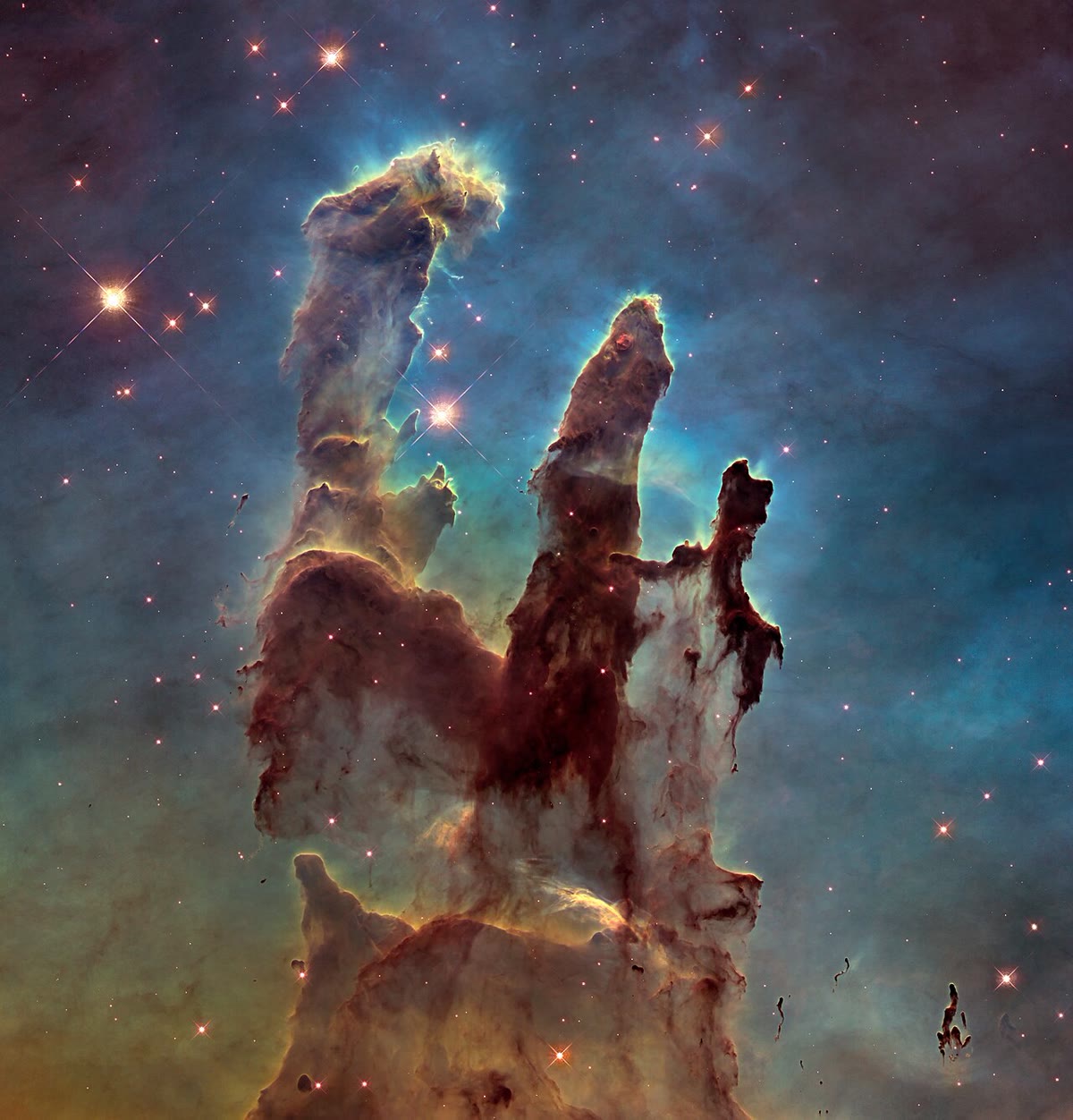
The “Pillars of Creation” in the Eagle Nebula, imaged by the Hubble Space Telescope in visible light. The columns are cold, dense molecular gas and dust, light-years long, eroded and lit from above by the ultraviolet light of massive young stars outside the picture; the dust makes them opaque. Small condensations at their tips are forming stars. NASA, ESA and the Hubble Heritage Team (STScI/AURA), public domain.
প্রসঙ্গসহ পড়ো →