
All books

Professional

Apps About Coach Log in Start reading

Earth and Space Sciences · Glossary

What is p nuclei?

Definition 30.6 University Earth and Space Sciences — Year 3 · Chapter 30 — Where the Elements Come From

The p nuclei are the stable isotopes on the proton-rich side of the valley of stability, beyond the iron peak, that neither the s nor the r process can make: they are shielded from the r process by a stable isobar of lower ZZ and lie off the s path. They are ascribed to a separate p process, probably in supernova explosions, and with few exceptions their abundances are much smaller than those of the neighbouring s and r isotopes.
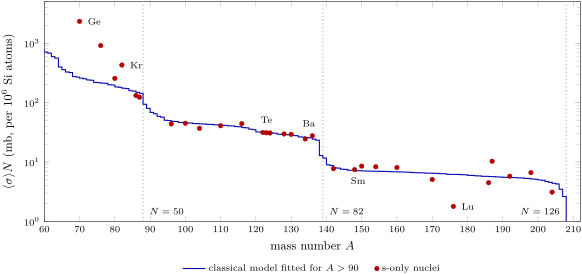
The product of the neutron-capture cross-section at 30\, keV (KADoNiS) and the proto-solar abundance (Asplund, Amarsi and Grevesse, 2021) for the 30 s-only nuclei. Between the magic neutron numbers (dotted lines) it is nearly constant; at each the flow is throttled and the product drops. The line is the classical model of the s process fitted here to the nuclei heavier than A = 90. The lighter ones need a second, weaker component, made in massive stars.
The product of the neutron-capture cross-section at 30 keV30\,\mathrm{keV} (KADoNiS) and the proto-solar abundance (Asplund, Amarsi and Grevesse, 2021) for the 30 s-only nuclei. Between the magic neutron numbers (dotted lines) it is nearly constant; at each the flow is throttled and the product drops. The line is the classical model of the s process fitted here to the nuclei heavier than A=90A = 90. The lighter ones need a second, weaker component, made in massive stars.
Read in context →